

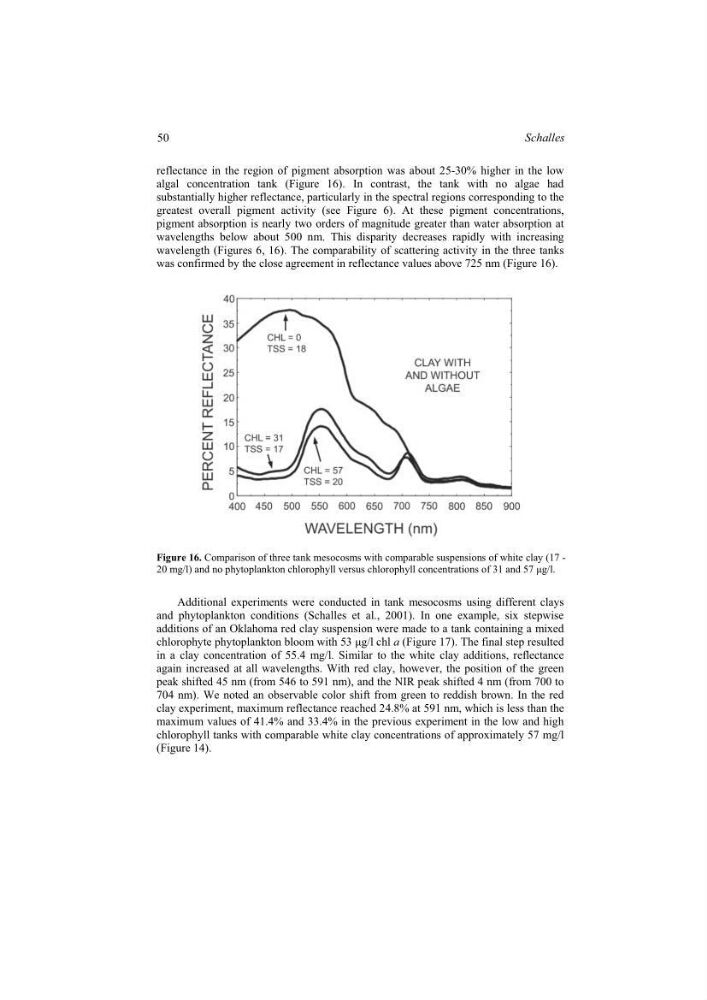
reflectance in the region of pigment absorption was about 25-30% higher in the low
algal concentration tank (Figure 16). In contrast, the tank with no algae had
substantially higher reflectance, particularly in the spectral regions corresponding to the
greatest overall pigment activity (see Figure 6). At these pigment concentrations,
pigment absorption is nearly two orders of magnitude greater than water absorption at
wavelengths below about 500 nm. This disparity decreases rapidly with increasing
wavelength (Figures 6, 16). The comparability of scattering activity in the three tanks
was confirmed by the close agreement in reflectance values above 725 nm (Figure 16).
Figure 16. Comparison of three tank mesocosms with comparable suspensions of white clay (17 -
20 mg/l) and no phytoplankton chlorophyll versus chlorophyll concentrations of 31 and 57 µg/l.
Additional experiments were conducted in tank mesocosms using different clays
and phytoplankton conditions (Schalles et al., 2001). In one example, six stepwise
additions of an Oklahoma red clay suspension were made to a tank containing a mixed
chlorophyte phytoplankton bloom with 53 µg/l chl a (Figure 17). The final step resulted
in a clay concentration of 55.4 mg/l. Similar to the white clay additions, reflectance
again increased at all wavelengths. With red clay, however, the position of the green
peak shifted 45 nm (from 546 to 591 nm), and the NIR peak shifted 4 nm (from 700 to
704 nm). We noted an observable color shift from green to reddish brown. In the red
clay experiment, maximum reflectance reached 24.8% at 591 nm, which is less than the
maximum values of 41.4% and 33.4% in the previous experiment in the low and high
chlorophyll tanks with comparable white clay concentrations of approximately 57 mg/l
(Figure 14).
50
Schalles
algal concentration tank (Figure 16). In contrast, the tank with no algae had
substantially higher reflectance, particularly in the spectral regions corresponding to the
greatest overall pigment activity (see Figure 6). At these pigment concentrations,
pigment absorption is nearly two orders of magnitude greater than water absorption at
wavelengths below about 500 nm. This disparity decreases rapidly with increasing
wavelength (Figures 6, 16). The comparability of scattering activity in the three tanks
was confirmed by the close agreement in reflectance values above 725 nm (Figure 16).
Figure 16. Comparison of three tank mesocosms with comparable suspensions of white clay (17 -
20 mg/l) and no phytoplankton chlorophyll versus chlorophyll concentrations of 31 and 57 µg/l.
Additional experiments were conducted in tank mesocosms using different clays
and phytoplankton conditions (Schalles et al., 2001). In one example, six stepwise
additions of an Oklahoma red clay suspension were made to a tank containing a mixed
chlorophyte phytoplankton bloom with 53 µg/l chl a (Figure 17). The final step resulted
in a clay concentration of 55.4 mg/l. Similar to the white clay additions, reflectance
again increased at all wavelengths. With red clay, however, the position of the green
peak shifted 45 nm (from 546 to 591 nm), and the NIR peak shifted 4 nm (from 700 to
704 nm). We noted an observable color shift from green to reddish brown. In the red
clay experiment, maximum reflectance reached 24.8% at 591 nm, which is less than the
maximum values of 41.4% and 33.4% in the previous experiment in the low and high
chlorophyll tanks with comparable white clay concentrations of approximately 57 mg/l
(Figure 14).
50
Schalles