

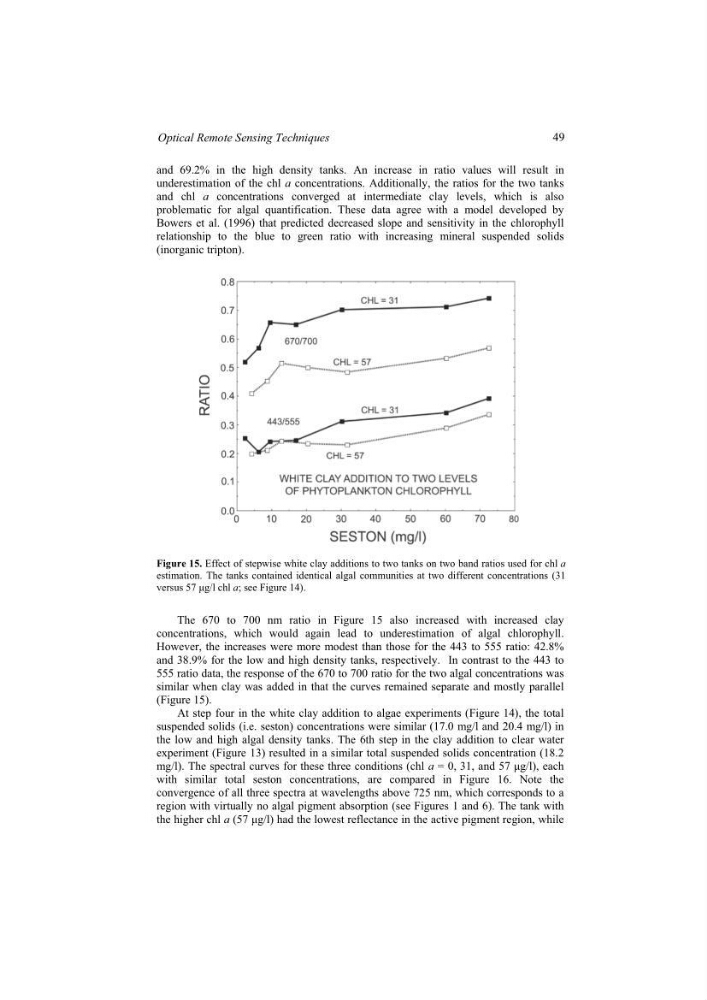
and 69.2% in the high density tanks. An increase in ratio values will result in
underestimation of the chl a concentrations. Additionally, the ratios for the two tanks
and chl a concentrations converged at intermediate clay levels, which is also
problematic for algal quantification. These data agree with a model developed by
Bowers et al. (1996) that predicted decreased slope and sensitivity in the chlorophyll
relationship to the blue to green ratio with increasing mineral suspended solids
(inorganic tripton).
Figure 15. Effect of stepwise white clay additions to two tanks on two band ratios used for chl a
estimation. The tanks contained identical algal communities at two different concentrations (31
versus 57 µg/l chl a; see Figure 14).
The 670 to 700 nm ratio in Figure 15 also increased with increased clay
concentrations, which would again lead to underestimation of algal chlorophyll.
However, the increases were more modest than those for the 443 to 555 ratio: 42.8%
and 38.9% for the low and high density tanks, respectively. In contrast to the 443 to
555 ratio data, the response of the 670 to 700 ratio for the two algal concentrations was
similar when clay was added in that the curves remained separate and mostly parallel
(Figure 15).
At step four in the white clay addition to algae experiments (Figure 14), the total
suspended solids (i.e. seston) concentrations were similar (17.0 mg/l and 20.4 mg/l) in
the low and high algal density tanks. The 6th step in the clay addition to clear water
experiment (Figure 13) resulted in a similar total suspended solids concentration (18.2
mg/l). The spectral curves for these three conditions (chl a = 0, 31, and 57 µg/l), each
with similar total seston concentrations, are compared in Figure 16. Note the
convergence of all three spectra at wavelengths above 725 nm, which corresponds to a
region with virtually no algal pigment absorption (see Figures 1 and 6). The tank with
the higher chl a (57 µg/l) had the lowest reflectance in the active pigment region, while
49
Optical Remote Sensing Techniques
underestimation of the chl a concentrations. Additionally, the ratios for the two tanks
and chl a concentrations converged at intermediate clay levels, which is also
problematic for algal quantification. These data agree with a model developed by
Bowers et al. (1996) that predicted decreased slope and sensitivity in the chlorophyll
relationship to the blue to green ratio with increasing mineral suspended solids
(inorganic tripton).
Figure 15. Effect of stepwise white clay additions to two tanks on two band ratios used for chl a
estimation. The tanks contained identical algal communities at two different concentrations (31
versus 57 µg/l chl a; see Figure 14).
The 670 to 700 nm ratio in Figure 15 also increased with increased clay
concentrations, which would again lead to underestimation of algal chlorophyll.
However, the increases were more modest than those for the 443 to 555 ratio: 42.8%
and 38.9% for the low and high density tanks, respectively. In contrast to the 443 to
555 ratio data, the response of the 670 to 700 ratio for the two algal concentrations was
similar when clay was added in that the curves remained separate and mostly parallel
(Figure 15).
At step four in the white clay addition to algae experiments (Figure 14), the total
suspended solids (i.e. seston) concentrations were similar (17.0 mg/l and 20.4 mg/l) in
the low and high algal density tanks. The 6th step in the clay addition to clear water
experiment (Figure 13) resulted in a similar total suspended solids concentration (18.2
mg/l). The spectral curves for these three conditions (chl a = 0, 31, and 57 µg/l), each
with similar total seston concentrations, are compared in Figure 16. Note the
convergence of all three spectra at wavelengths above 725 nm, which corresponds to a
region with virtually no algal pigment absorption (see Figures 1 and 6). The tank with
the higher chl a (57 µg/l) had the lowest reflectance in the active pigment region, while
49
Optical Remote Sensing Techniques