

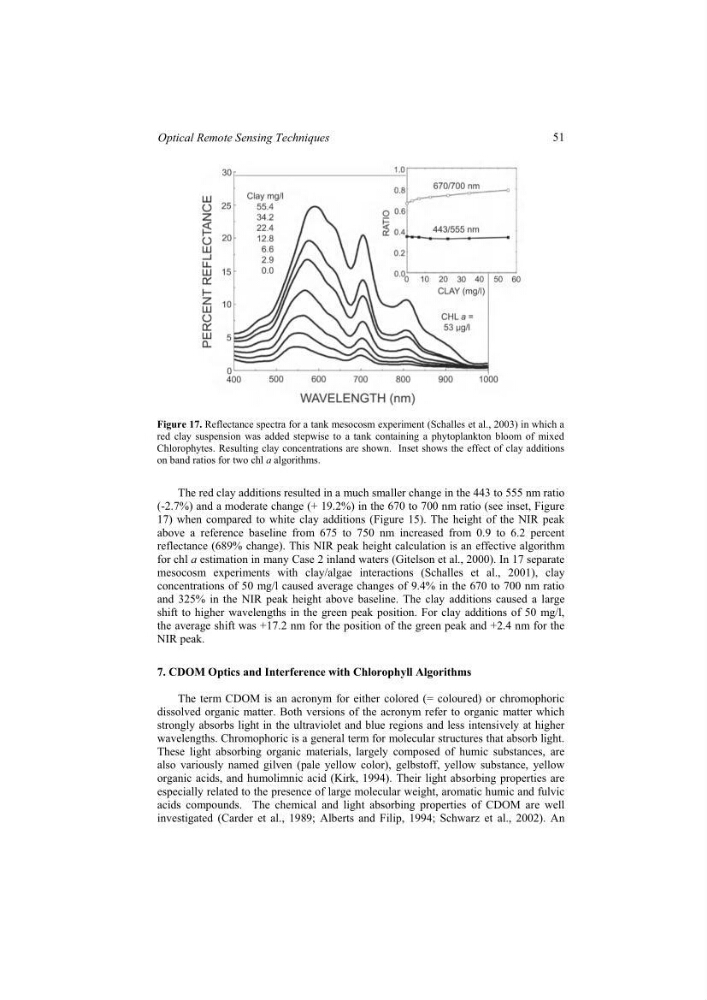
Figure 17. Reflectance spectra for a tank mesocosm experiment (Schalles et al., 2003) in which a
red clay suspension was added stepwise to a tank containing a phytoplankton bloom of mixed
Chlorophytes. Resulting clay concentrations are shown. Inset shows the effect of clay additions
on band ratios for two chl a algorithms.
The red clay additions resulted in a much smaller change in the 443 to 555 nm ratio
(-2.7%) and a moderate change (+ 19.2%) in the 670 to 700 nm ratio (see inset, Figure
17) when compared to white clay additions (Figure 15). The height of the NIR peak
above a reference baseline from 675 to 750 nm increased from 0.9 to 6.2 percent
reflectance (689% change). This NIR peak height calculation is an effective algorithm
for chl a estimation in many Case 2 inland waters (Gitelson et al., 2000). In 17 separate
mesocosm experiments with clay/algae interactions (Schalles et al., 2001), clay
concentrations of 50 mg/l caused average changes of 9.4% in the 670 to 700 nm ratio
and 325% in the NIR peak height above baseline. The clay additions caused a large
shift to higher wavelengths in the green peak position. For clay additions of 50 mg/l,
the average shift was +17.2 nm for the position of the green peak and +2.4 nm for the
NIR peak.
7. CDOM Optics and Interference with Chlorophyll Algorithms
The term CDOM is an acronym for either colored (= coloured) or chromophoric
dissolved organic matter. Both versions of the acronym refer to organic matter which
strongly absorbs light in the ultraviolet and blue regions and less intensively at higher
wavelengths. Chromophoric is a general term for molecular structures that absorb light.
These light absorbing organic materials, largely composed of humic substances, are
also variously named gilven (pale yellow color), gelbstoff, yellow substance, yellow
organic acids, and humolimnic acid (Kirk, 1994). Their light absorbing properties are
especially related to the presence of large molecular weight, aromatic humic and fulvic
acids compounds. The chemical and light absorbing properties of CDOM are well
investigated (Carder et al., 1989; Alberts and Filip, 1994; Schwarz et al., 2002). An
51
Optical Remote Sensing Techniques
red clay suspension was added stepwise to a tank containing a phytoplankton bloom of mixed
Chlorophytes. Resulting clay concentrations are shown. Inset shows the effect of clay additions
on band ratios for two chl a algorithms.
The red clay additions resulted in a much smaller change in the 443 to 555 nm ratio
(-2.7%) and a moderate change (+ 19.2%) in the 670 to 700 nm ratio (see inset, Figure
17) when compared to white clay additions (Figure 15). The height of the NIR peak
above a reference baseline from 675 to 750 nm increased from 0.9 to 6.2 percent
reflectance (689% change). This NIR peak height calculation is an effective algorithm
for chl a estimation in many Case 2 inland waters (Gitelson et al., 2000). In 17 separate
mesocosm experiments with clay/algae interactions (Schalles et al., 2001), clay
concentrations of 50 mg/l caused average changes of 9.4% in the 670 to 700 nm ratio
and 325% in the NIR peak height above baseline. The clay additions caused a large
shift to higher wavelengths in the green peak position. For clay additions of 50 mg/l,
the average shift was +17.2 nm for the position of the green peak and +2.4 nm for the
NIR peak.
7. CDOM Optics and Interference with Chlorophyll Algorithms
The term CDOM is an acronym for either colored (= coloured) or chromophoric
dissolved organic matter. Both versions of the acronym refer to organic matter which
strongly absorbs light in the ultraviolet and blue regions and less intensively at higher
wavelengths. Chromophoric is a general term for molecular structures that absorb light.
These light absorbing organic materials, largely composed of humic substances, are
also variously named gilven (pale yellow color), gelbstoff, yellow substance, yellow
organic acids, and humolimnic acid (Kirk, 1994). Their light absorbing properties are
especially related to the presence of large molecular weight, aromatic humic and fulvic
acids compounds. The chemical and light absorbing properties of CDOM are well
investigated (Carder et al., 1989; Alberts and Filip, 1994; Schwarz et al., 2002). An
51
Optical Remote Sensing Techniques