

4.2 BENTHIC PROCESS MEASUREMENTS
The Submersible Habitat for Assessing Reef Quality (SHARQ) was deployed over
various habitats in the study area during June 27-July 1, 2000, May 30-June 2, 2001,
and July 12-13, 2002, to measure diurnal spring-summer rates of calcification,
photosynthesis, and respiration (Yates and Halley, 2003). The SHARQ is a large (4.9
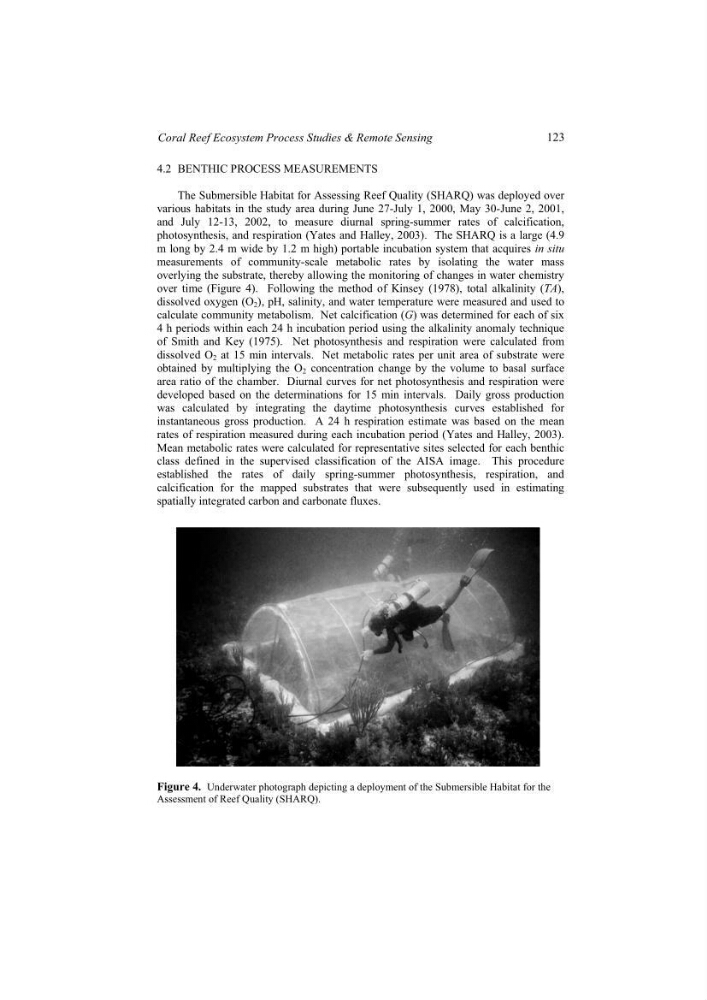
m long by 2.4 m wide by 1.2 m high) portable incubation system that acquires in situ
measurements of community-scale metabolic rates by isolating the water mass
overlying the substrate, thereby allowing the monitoring of changes in water chemistry
over time (Figure 4). Following the method of Kinsey (1978), total alkalinity (TA),
dissolved oxygen (O 2 ), pH, salinity, and water temperature were measured and used to
calculate community metabolism. Net calcification (G) was determined for each of six
4 h periods within each 24 h incubation period using the alkalinity anomaly technique
of Smith and Key (1975). Net photosynthesis and respiration were calculated from
dissolved O 2 at 15 min intervals. Net metabolic rates per unit area of substrate were
obtained by multiplying the O 2 concentration change by the volume to basal surface
area ratio of the chamber. Diurnal curves for net photosynthesis and respiration were
developed based on the determinations for 15 min intervals. Daily gross production
was calculated by integrating the daytime photosynthesis curves established for
instantaneous gross production. A 24 h respiration estimate was based on the mean
rates of respiration measured during each incubation period (Yates and Halley, 2003).
Mean metabolic rates were calculated for representative sites selected for each benthic
class defined in the supervised classification of the AISA image. This procedure
established the rates of daily spring-summer photosynthesis, respiration, and
calcification for the mapped substrates that were subsequently used in estimating
spatially integrated carbon and carbonate fluxes.
Figure 4. Underwater photograph depicting a deployment of the Submersible Habitat for the
Assessment of Reef Quality (SHARQ).
123
Coral Reef Ecosystem Process Studies & Remote Sensing
The Submersible Habitat for Assessing Reef Quality (SHARQ) was deployed over
various habitats in the study area during June 27-July 1, 2000, May 30-June 2, 2001,
and July 12-13, 2002, to measure diurnal spring-summer rates of calcification,
photosynthesis, and respiration (Yates and Halley, 2003). The SHARQ is a large (4.9
m long by 2.4 m wide by 1.2 m high) portable incubation system that acquires in situ
measurements of community-scale metabolic rates by isolating the water mass
overlying the substrate, thereby allowing the monitoring of changes in water chemistry
over time (Figure 4). Following the method of Kinsey (1978), total alkalinity (TA),
dissolved oxygen (O 2 ), pH, salinity, and water temperature were measured and used to
calculate community metabolism. Net calcification (G) was determined for each of six
4 h periods within each 24 h incubation period using the alkalinity anomaly technique
of Smith and Key (1975). Net photosynthesis and respiration were calculated from
dissolved O 2 at 15 min intervals. Net metabolic rates per unit area of substrate were
obtained by multiplying the O 2 concentration change by the volume to basal surface
area ratio of the chamber. Diurnal curves for net photosynthesis and respiration were
developed based on the determinations for 15 min intervals. Daily gross production
was calculated by integrating the daytime photosynthesis curves established for
instantaneous gross production. A 24 h respiration estimate was based on the mean
rates of respiration measured during each incubation period (Yates and Halley, 2003).
Mean metabolic rates were calculated for representative sites selected for each benthic
class defined in the supervised classification of the AISA image. This procedure
established the rates of daily spring-summer photosynthesis, respiration, and
calcification for the mapped substrates that were subsequently used in estimating
spatially integrated carbon and carbonate fluxes.
Figure 4. Underwater photograph depicting a deployment of the Submersible Habitat for the
Assessment of Reef Quality (SHARQ).
123
Coral Reef Ecosystem Process Studies & Remote Sensing