

1997) or the Bouée pour l’acquisition de Séries Optiques â Long Terme
(BOUSOULLE) mooring (Antoine et al. 2008). Then from L t , the calibrated total
reflectance (q t = pL t /(F o cosh o )) is calculated where F o is the time-dependent solar
irradiance and h o is the solar zenith angle. After adjustment for gaseous absorption,
q t (k) is used in Eq. 7.6 to derive R rs (k) through atmospheric correction.
Whitecap (q wc ) and sun glint (q g ) contributions to q t are first estimated using
surface wind and solar/viewing geometry (Gordon and Wang 1994b; Frouin et al.
1996; Wang and Bailey 2001), and then removed from q t . For a known solar/
viewing geometry at a given location (satellite image pixel) and surface pressure
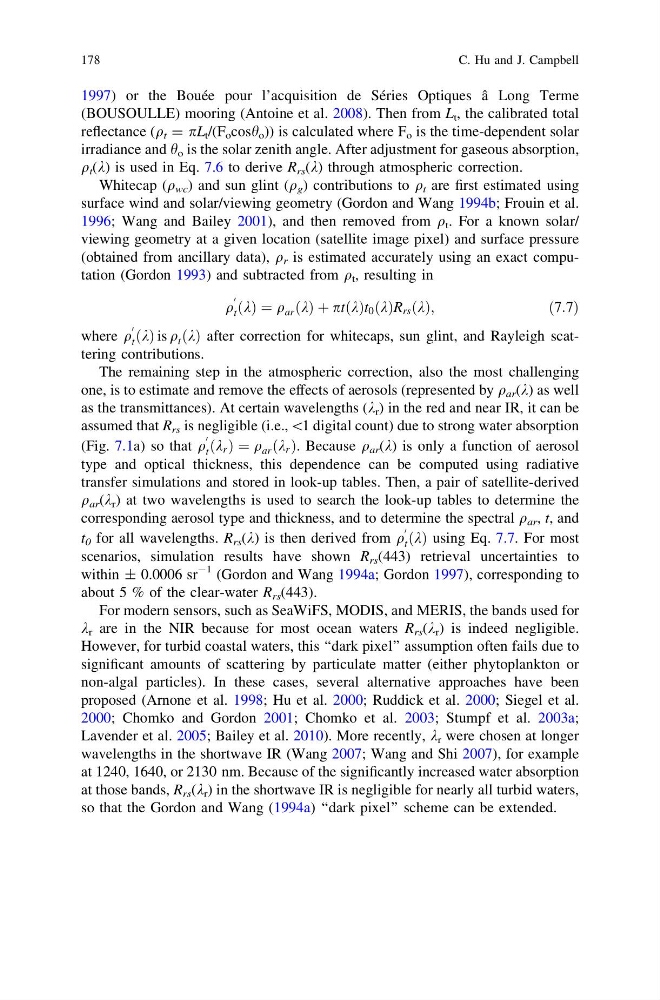
(obtained from ancillary data), q r is estimated accurately using an exact computation (Gordon 1993) and subtracted from q t , resulting in
q
0
t k
ð Þ ¼ q ar k
ð Þ þ pt k
ð Þt 0 k
ð ÞR rs k
ð Þ;
ð7:7Þ
where q
0
t k
ð Þ is q t k
ð Þ after correction for whitecaps, sun glint, and Rayleigh scattering contributions.
The remaining step in the atmospheric correction, also the most challenging
one, is to estimate and remove the effects of aerosols (represented by q ar (k) as well
as the transmittances). At certain wavelengths (k r ) in the red and near IR, it can be
assumed that R rs is negligible (i.e.,\1 digital count) due to strong water absorption
(Fig. 7.1a) so that q
0
t k r
ð Þ ¼ q ar k r
ð Þ. Because q ar (k) is only a function of aerosol
type and optical thickness, this dependence can be computed using radiative
transfer simulations and stored in look-up tables. Then, a pair of satellite-derived
q ar (k r ) at two wavelengths is used to search the look-up tables to determine the
corresponding aerosol type and thickness, and to determine the spectral q ar , t, and
t 0 for all wavelengths. R rs (k) is then derived from q
0
t k
ð Þ using Eq. 7.7. For most
scenarios, simulation results have shown R rs (443) retrieval uncertainties to
within ± 0.0006 sr
-1 (Gordon and Wang 1994a; Gordon 1997), corresponding to
about 5 % of the clear-water R rs (443).
For modern sensors, such as SeaWiFS, MODIS, and MERIS, the bands used for
k r are in the NIR because for most ocean waters R rs (k r ) is indeed negligible.
However, for turbid coastal waters, this ‘‘dark pixel’’ assumption often fails due to
significant amounts of scattering by particulate matter (either phytoplankton or
non-algal particles). In these cases, several alternative approaches have been
proposed (Arnone et al. 1998; Hu et al. 2000; Ruddick et al. 2000; Siegel et al.
2000; Chomko and Gordon 2001; Chomko et al. 2003; Stumpf et al. 2003a;
Lavender et al. 2005; Bailey et al. 2010). More recently, k r were chosen at longer
wavelengths in the shortwave IR (Wang 2007; Wang and Shi 2007), for example
at 1240, 1640, or 2130 nm. Because of the significantly increased water absorption
at those bands, R rs (k r ) in the shortwave IR is negligible for nearly all turbid waters,
so that the Gordon and Wang (1994a) ‘‘dark pixel’’ scheme can be extended.
178
C. Hu and J. Campbell
(BOUSOULLE) mooring (Antoine et al. 2008). Then from L t , the calibrated total
reflectance (q t = pL t /(F o cosh o )) is calculated where F o is the time-dependent solar
irradiance and h o is the solar zenith angle. After adjustment for gaseous absorption,
q t (k) is used in Eq. 7.6 to derive R rs (k) through atmospheric correction.
Whitecap (q wc ) and sun glint (q g ) contributions to q t are first estimated using
surface wind and solar/viewing geometry (Gordon and Wang 1994b; Frouin et al.
1996; Wang and Bailey 2001), and then removed from q t . For a known solar/
viewing geometry at a given location (satellite image pixel) and surface pressure
(obtained from ancillary data), q r is estimated accurately using an exact computation (Gordon 1993) and subtracted from q t , resulting in
q
0
t k
ð Þ ¼ q ar k
ð Þ þ pt k
ð Þt 0 k
ð ÞR rs k
ð Þ;
ð7:7Þ
where q
0
t k
ð Þ is q t k
ð Þ after correction for whitecaps, sun glint, and Rayleigh scattering contributions.
The remaining step in the atmospheric correction, also the most challenging
one, is to estimate and remove the effects of aerosols (represented by q ar (k) as well
as the transmittances). At certain wavelengths (k r ) in the red and near IR, it can be
assumed that R rs is negligible (i.e.,\1 digital count) due to strong water absorption
(Fig. 7.1a) so that q
0
t k r
ð Þ ¼ q ar k r
ð Þ. Because q ar (k) is only a function of aerosol
type and optical thickness, this dependence can be computed using radiative
transfer simulations and stored in look-up tables. Then, a pair of satellite-derived
q ar (k r ) at two wavelengths is used to search the look-up tables to determine the
corresponding aerosol type and thickness, and to determine the spectral q ar , t, and
t 0 for all wavelengths. R rs (k) is then derived from q
0
t k
ð Þ using Eq. 7.7. For most
scenarios, simulation results have shown R rs (443) retrieval uncertainties to
within ± 0.0006 sr
-1 (Gordon and Wang 1994a; Gordon 1997), corresponding to
about 5 % of the clear-water R rs (443).
For modern sensors, such as SeaWiFS, MODIS, and MERIS, the bands used for
k r are in the NIR because for most ocean waters R rs (k r ) is indeed negligible.
However, for turbid coastal waters, this ‘‘dark pixel’’ assumption often fails due to
significant amounts of scattering by particulate matter (either phytoplankton or
non-algal particles). In these cases, several alternative approaches have been
proposed (Arnone et al. 1998; Hu et al. 2000; Ruddick et al. 2000; Siegel et al.
2000; Chomko and Gordon 2001; Chomko et al. 2003; Stumpf et al. 2003a;
Lavender et al. 2005; Bailey et al. 2010). More recently, k r were chosen at longer
wavelengths in the shortwave IR (Wang 2007; Wang and Shi 2007), for example
at 1240, 1640, or 2130 nm. Because of the significantly increased water absorption
at those bands, R rs (k r ) in the shortwave IR is negligible for nearly all turbid waters,
so that the Gordon and Wang (1994a) ‘‘dark pixel’’ scheme can be extended.
178
C. Hu and J. Campbell