

(December–March), the majority of the U.S. terrestrial ecosystems is nearly carbon neutral or slightly releases carbon. This is because the canopies of the terrestrial ecosystems are largely dormant in the winter with photosynthesis
approaching 0 and ecosystem respiration exceeding photosynthesis.
In the spring (March–May), the onset of the growing season starts in the Gulf
Coast region, and then progresses to north. In March, ecosystems in some areas,
including the Gulf Coast, coastal Pacific Northwest, and California, slightly absorb
carbon from the atmosphere because of the dominance of evergreen forests and mild
temperatures in these areas (Waring and Franklin 1979; Anthoni et al. 2002). In May,
the majority of eastern U.S. and many regions in the West assimilate carbon. The
Midwestern region including the Upper Great Lakes region and the northern Great
Plains still releases carbon. This region is dominated by croplands with most crops
planted between April and June (Shroyer et al. 1996), and crops are sparse in the
beginning of the growing season and ecosystem respiration exceeds GPP.
In the summer, the entire eastern U.S. assimilates carbon from the atmosphere.
Croplands in the Midwest generally exhibit higher net carbon uptake than eastern
forests. The majority of the West except the coastal Pacific Northwest and central
California is nearly carbon neutral. Some areas in the west release carbon. The fall
months (September–November) are the transition from the summer to the winter.
Most ecosystems absorb less carbon in the fall than in the summer months as
vegetation begins to the senesce and days become shorter.
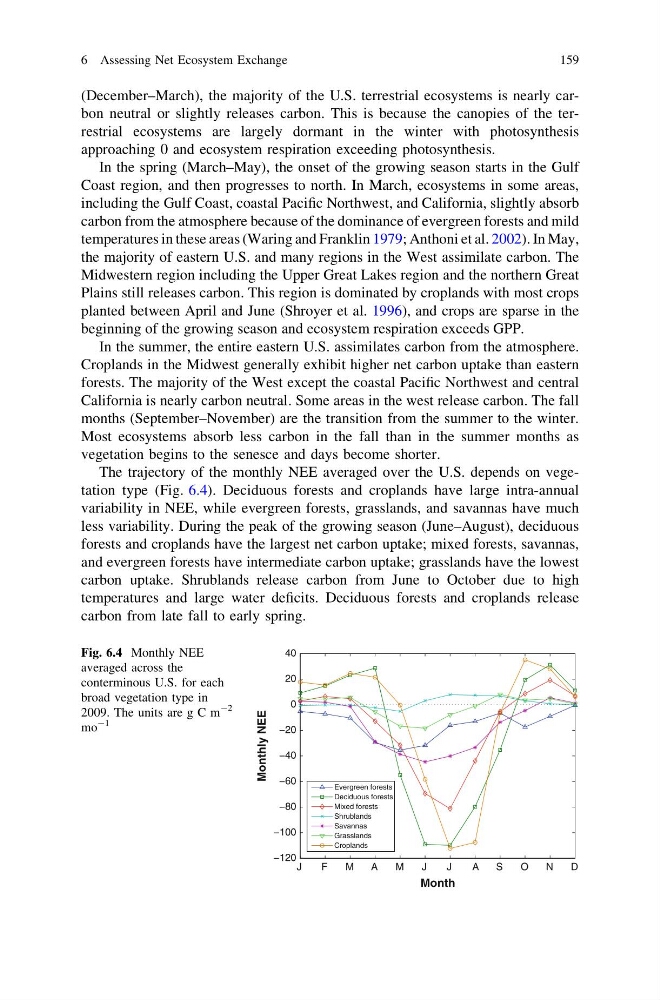
The trajectory of the monthly NEE averaged over the U.S. depends on vegetation type (Fig. 6.4). Deciduous forests and croplands have large intra-annual
variability in NEE, while evergreen forests, grasslands, and savannas have much
less variability. During the peak of the growing season (June–August), deciduous
forests and croplands have the largest net carbon uptake; mixed forests, savannas,
and evergreen forests have intermediate carbon uptake; grasslands have the lowest
carbon uptake. Shrublands release carbon from June to October due to high
temperatures and large water deficits. Deciduous forests and croplands release
carbon from late fall to early spring.
J
F
M
A
M
J
J
A
S
O
N
D
−120
−100
−80
−60
−40
−20
0
20
40
Month
Monthly NEE
Evergreen forests
Deciduous forests
Mixed forests
Shrublands
Savannas
Grasslands
Croplands
Fig. 6.4 Monthly NEE
averaged across the
conterminous U.S. for each
broad vegetation type in
2009. The units are g C m
-2
mo
-1
6 Assessing Net Ecosystem Exchange
159
approaching 0 and ecosystem respiration exceeding photosynthesis.
In the spring (March–May), the onset of the growing season starts in the Gulf
Coast region, and then progresses to north. In March, ecosystems in some areas,
including the Gulf Coast, coastal Pacific Northwest, and California, slightly absorb
carbon from the atmosphere because of the dominance of evergreen forests and mild
temperatures in these areas (Waring and Franklin 1979; Anthoni et al. 2002). In May,
the majority of eastern U.S. and many regions in the West assimilate carbon. The
Midwestern region including the Upper Great Lakes region and the northern Great
Plains still releases carbon. This region is dominated by croplands with most crops
planted between April and June (Shroyer et al. 1996), and crops are sparse in the
beginning of the growing season and ecosystem respiration exceeds GPP.
In the summer, the entire eastern U.S. assimilates carbon from the atmosphere.
Croplands in the Midwest generally exhibit higher net carbon uptake than eastern
forests. The majority of the West except the coastal Pacific Northwest and central
California is nearly carbon neutral. Some areas in the west release carbon. The fall
months (September–November) are the transition from the summer to the winter.
Most ecosystems absorb less carbon in the fall than in the summer months as
vegetation begins to the senesce and days become shorter.
The trajectory of the monthly NEE averaged over the U.S. depends on vegetation type (Fig. 6.4). Deciduous forests and croplands have large intra-annual
variability in NEE, while evergreen forests, grasslands, and savannas have much
less variability. During the peak of the growing season (June–August), deciduous
forests and croplands have the largest net carbon uptake; mixed forests, savannas,
and evergreen forests have intermediate carbon uptake; grasslands have the lowest
carbon uptake. Shrublands release carbon from June to October due to high
temperatures and large water deficits. Deciduous forests and croplands release
carbon from late fall to early spring.
J
F
M
A
M
J
J
A
S
O
N
D
−120
−100
−80
−60
−40
−20
0
20
40
Month
Monthly NEE
Evergreen forests
Deciduous forests
Mixed forests
Shrublands
Savannas
Grasslands
Croplands
Fig. 6.4 Monthly NEE
averaged across the
conterminous U.S. for each
broad vegetation type in
2009. The units are g C m
-2
mo
-1
6 Assessing Net Ecosystem Exchange
159