

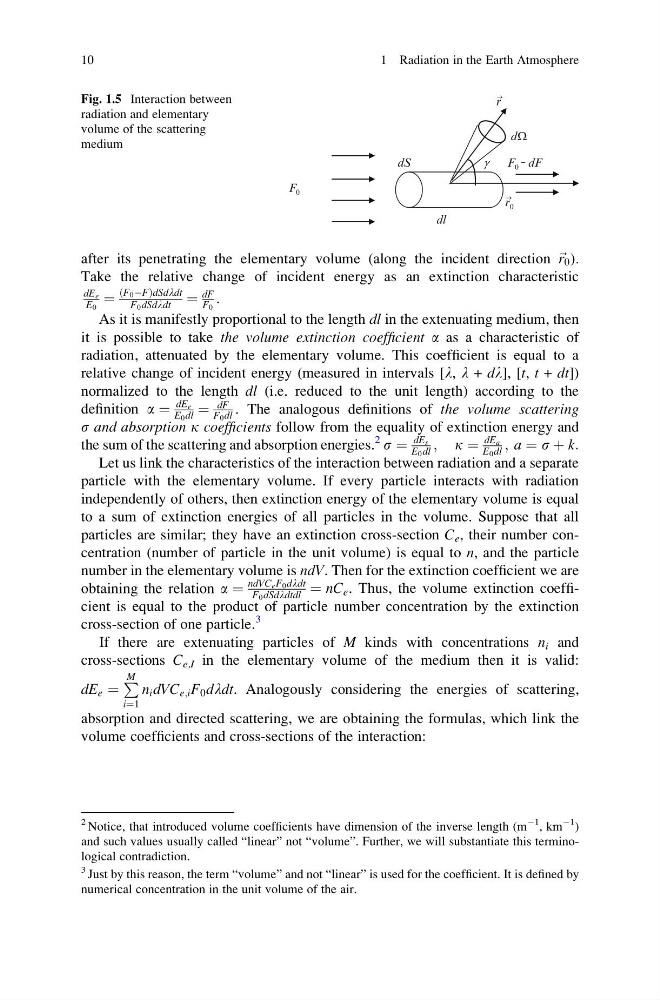
after its penetrating the elementary volume (along the incident direction ~ r 0 ).
Take the relative change of incident energy as an extinction characteristic
dE e
E 0
¼
ðF0ÀFÞdSdldt
F 0 dSdldt ¼
dF
F 0
.
As it is manifestly proportional to the length dl in the extenuating medium, then
it is possible to take the volume extinction coefficient a as a characteristic of
radiation, attenuated by the elementary volume. This coefficient is equal to a
relative change of incident energy (measured in intervals [l, l + dl], [t, t + dt])
normalized to the length dl (i.e. reduced to the unit length) according to the
definition a ¼
dE e
E 0 dl ¼
dF
F 0 dl . The analogous definitions of the volume scattering
s and absorption k coefficients follow from the equality of extinction energy and
the sum of the scattering and absorption energies.
2 s ¼
dEs
E0dl ; k ¼
dE a
E0dl ; a ¼ s þ k:
Let us link the characteristics of the interaction between radiation and a separate
particle with the elementary volume. If every particle interacts with radiation
independently of others, then extinction energy of the elementary volume is equal
to a sum of extinction energies of all particles in the volume. Suppose that all
particles are similar; they have an extinction cross-section C e , their number concentration (number of particle in the unit volume) is equal to n, and the particle
number in the elementary volume is ndV. Then for the extinction coefficient we are
obtaining the relation a ¼
ndVCeF0dldt
F 0 dSdldtdl ¼ nC e . Thus, the volume extinction coefficient is equal to the product of particle number concentration by the extinction
cross-section of one particle.
3
If there are extenuating particles of M kinds with concentrations n i and
cross-sections C e,I in the elementary volume of the medium then it is valid:
dE e ¼
P M
i¼1
n i dVC e;i F 0 dldt. Analogously considering the energies of scattering,
absorption and directed scattering, we are obtaining the formulas, which link the
volume coefficients and cross-sections of the interaction:
r
dW
dS
g
F 0 dF
F 0
r 0
dl
®
®
Fig. 1.5 Interaction between
radiation and elementary
volume of the scattering
medium
2 Notice, that introduced volume coefficients have dimension of the inverse length (m
À1
, km
À1 )
and such values usually called “linear” not “volume”. Further, we will substantiate this terminological contradiction.
3 Just by this reason, the term “volume” and not “linear” is used for the coefficient. It is defined by
numerical concentration in the unit volume of the air.
10
1 Radiation in the Earth Atmosphere
Take the relative change of incident energy as an extinction characteristic
dE e
E 0
¼
ðF0ÀFÞdSdldt
F 0 dSdldt ¼
dF
F 0
.
As it is manifestly proportional to the length dl in the extenuating medium, then
it is possible to take the volume extinction coefficient a as a characteristic of
radiation, attenuated by the elementary volume. This coefficient is equal to a
relative change of incident energy (measured in intervals [l, l + dl], [t, t + dt])
normalized to the length dl (i.e. reduced to the unit length) according to the
definition a ¼
dE e
E 0 dl ¼
dF
F 0 dl . The analogous definitions of the volume scattering
s and absorption k coefficients follow from the equality of extinction energy and
the sum of the scattering and absorption energies.
2 s ¼
dEs
E0dl ; k ¼
dE a
E0dl ; a ¼ s þ k:
Let us link the characteristics of the interaction between radiation and a separate
particle with the elementary volume. If every particle interacts with radiation
independently of others, then extinction energy of the elementary volume is equal
to a sum of extinction energies of all particles in the volume. Suppose that all
particles are similar; they have an extinction cross-section C e , their number concentration (number of particle in the unit volume) is equal to n, and the particle
number in the elementary volume is ndV. Then for the extinction coefficient we are
obtaining the relation a ¼
ndVCeF0dldt
F 0 dSdldtdl ¼ nC e . Thus, the volume extinction coefficient is equal to the product of particle number concentration by the extinction
cross-section of one particle.
3
If there are extenuating particles of M kinds with concentrations n i and
cross-sections C e,I in the elementary volume of the medium then it is valid:
dE e ¼
P M
i¼1
n i dVC e;i F 0 dldt. Analogously considering the energies of scattering,
absorption and directed scattering, we are obtaining the formulas, which link the
volume coefficients and cross-sections of the interaction:
r
dW
dS
g
F 0 dF
F 0
r 0
dl
®
®
Fig. 1.5 Interaction between
radiation and elementary
volume of the scattering
medium
2 Notice, that introduced volume coefficients have dimension of the inverse length (m
À1
, km
À1 )
and such values usually called “linear” not “volume”. Further, we will substantiate this terminological contradiction.
3 Just by this reason, the term “volume” and not “linear” is used for the coefficient. It is defined by
numerical concentration in the unit volume of the air.
10
1 Radiation in the Earth Atmosphere