

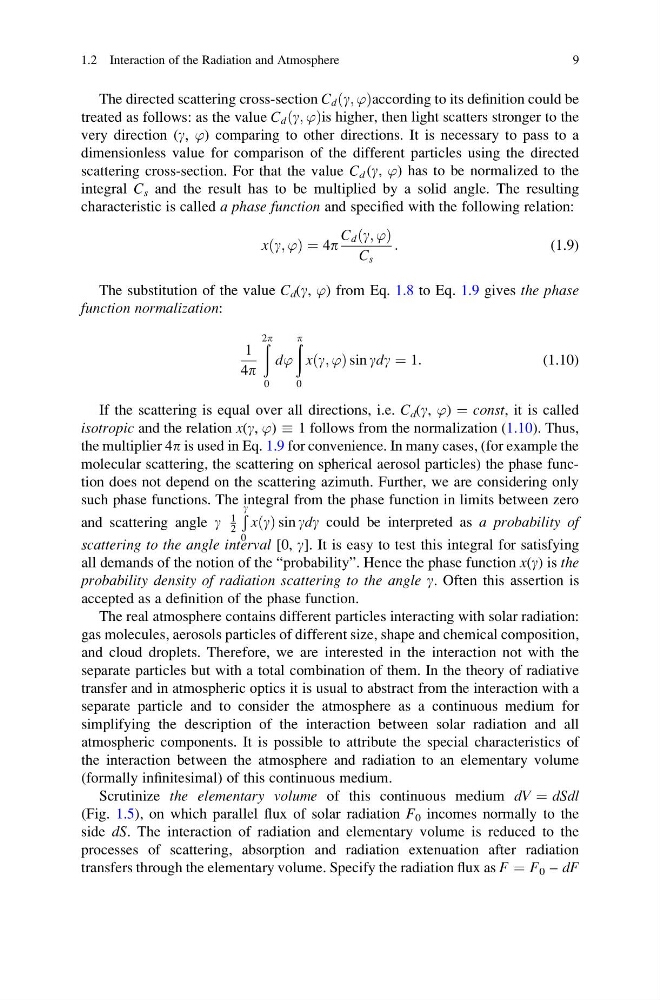
The directed scattering cross-section C d ðg; ’Þaccording to its definition could be
treated as follows: as the value C d ðg; ’Þis higher, then light scatters stronger to the
very direction (g, ’) comparing to other directions. It is necessary to pass to a
dimensionless value for comparison of the different particles using the directed
scattering cross-section. For that the value C d (g, ’) has to be normalized to the
integral C s and the result has to be multiplied by a solid angle. The resulting
characteristic is called a phase function and specified with the following relation:
xðg; ’Þ ¼ 4p
C d ðg; ’Þ
C s
:
(1.9)
The substitution of the value C d (g, ’) from Eq. 1.8 to Eq. 1.9 gives the phase
function normalization:
1
4p
ð
2p
0
d’
ð p
0
xðg; ’Þ sin gdg ¼ 1:
(1.10)
If the scattering is equal over all directions, i.e. C d (g, ’) ¼ const, it is called
isotropic and the relation x(g, ’) 1 follows from the normalization (1.10). Thus,
the multiplier 4p is used in Eq. 1.9 for convenience. In many cases, (for example the
molecular scattering, the scattering on spherical aerosol particles) the phase function does not depend on the scattering azimuth. Further, we are considering only
such phase functions. The integral from the phase function in limits between zero
and scattering angle g
1
2
Ð g
0
xðgÞ sin gdg could be interpreted as a probability of
scattering to the angle interval [0, g]. It is easy to test this integral for satisfying
all demands of the notion of the “probability”. Hence the phase function x(g) is the
probability density of radiation scattering to the angle g. Often this assertion is
accepted as a definition of the phase function.
The real atmosphere contains different particles interacting with solar radiation:
gas molecules, aerosols particles of different size, shape and chemical composition,
and cloud droplets. Therefore, we are interested in the interaction not with the
separate particles but with a total combination of them. In the theory of radiative
transfer and in atmospheric optics it is usual to abstract from the interaction with a
separate particle and to consider the atmosphere as a continuous medium for
simplifying the description of the interaction between solar radiation and all
atmospheric components. It is possible to attribute the special characteristics of
the interaction between the atmosphere and radiation to an elementary volume
(formally infinitesimal) of this continuous medium.
Scrutinize the elementary volume of this continuous medium dV ¼ dSdl
(Fig. 1.5), on which parallel flux of solar radiation F 0 incomes normally to the
side dS. The interaction of radiation and elementary volume is reduced to the
processes of scattering, absorption and radiation extenuation after radiation
transfers through the elementary volume. Specify the radiation flux as F ¼ F 0 – dF
1.2 Interaction of the Radiation and Atmosphere
9
treated as follows: as the value C d ðg; ’Þis higher, then light scatters stronger to the
very direction (g, ’) comparing to other directions. It is necessary to pass to a
dimensionless value for comparison of the different particles using the directed
scattering cross-section. For that the value C d (g, ’) has to be normalized to the
integral C s and the result has to be multiplied by a solid angle. The resulting
characteristic is called a phase function and specified with the following relation:
xðg; ’Þ ¼ 4p
C d ðg; ’Þ
C s
:
(1.9)
The substitution of the value C d (g, ’) from Eq. 1.8 to Eq. 1.9 gives the phase
function normalization:
1
4p
ð
2p
0
d’
ð p
0
xðg; ’Þ sin gdg ¼ 1:
(1.10)
If the scattering is equal over all directions, i.e. C d (g, ’) ¼ const, it is called
isotropic and the relation x(g, ’) 1 follows from the normalization (1.10). Thus,
the multiplier 4p is used in Eq. 1.9 for convenience. In many cases, (for example the
molecular scattering, the scattering on spherical aerosol particles) the phase function does not depend on the scattering azimuth. Further, we are considering only
such phase functions. The integral from the phase function in limits between zero
and scattering angle g
1
2
Ð g
0
xðgÞ sin gdg could be interpreted as a probability of
scattering to the angle interval [0, g]. It is easy to test this integral for satisfying
all demands of the notion of the “probability”. Hence the phase function x(g) is the
probability density of radiation scattering to the angle g. Often this assertion is
accepted as a definition of the phase function.
The real atmosphere contains different particles interacting with solar radiation:
gas molecules, aerosols particles of different size, shape and chemical composition,
and cloud droplets. Therefore, we are interested in the interaction not with the
separate particles but with a total combination of them. In the theory of radiative
transfer and in atmospheric optics it is usual to abstract from the interaction with a
separate particle and to consider the atmosphere as a continuous medium for
simplifying the description of the interaction between solar radiation and all
atmospheric components. It is possible to attribute the special characteristics of
the interaction between the atmosphere and radiation to an elementary volume
(formally infinitesimal) of this continuous medium.
Scrutinize the elementary volume of this continuous medium dV ¼ dSdl
(Fig. 1.5), on which parallel flux of solar radiation F 0 incomes normally to the
side dS. The interaction of radiation and elementary volume is reduced to the
processes of scattering, absorption and radiation extenuation after radiation
transfers through the elementary volume. Specify the radiation flux as F ¼ F 0 – dF
1.2 Interaction of the Radiation and Atmosphere
9