

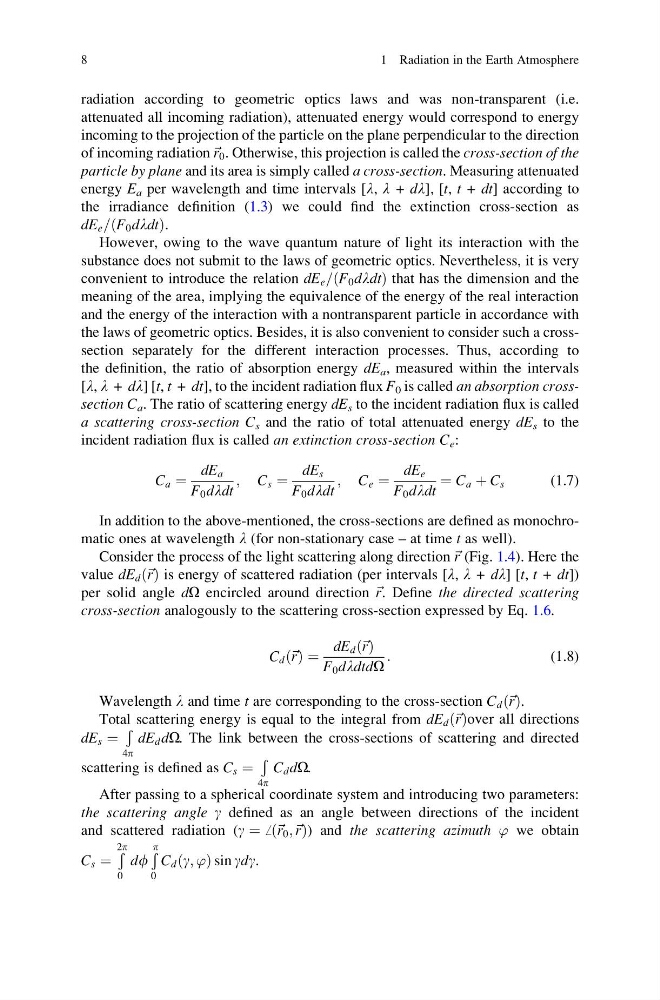
radiation according to geometric optics laws and was non-transparent (i.e.
attenuated all incoming radiation), attenuated energy would correspond to energy
incoming to the projection of the particle on the plane perpendicular to the direction
of incoming radiation ~ r 0 . Otherwise, this projection is called the cross-section of the
particle by plane and its area is simply called a cross-section. Measuring attenuated
energy E a per wavelength and time intervals [l, l + dl], [t, t + dt] according to
the irradiance definition (1.3) we could find the extinction cross-section as
dE e F 0 dldt
ð
Þ
=
.
However, owing to the wave quantum nature of light its interaction with the
substance does not submit to the laws of geometric optics. Nevertheless, it is very
convenient to introduce the relation dE e F 0 dldt
ð
Þ
=
that has the dimension and the
meaning of the area, implying the equivalence of the energy of the real interaction
and the energy of the interaction with a nontransparent particle in accordance with
the laws of geometric optics. Besides, it is also convenient to consider such a crosssection separately for the different interaction processes. Thus, according to
the definition, the ratio of absorption energy dE a , measured within the intervals
[l, l + dl] [t, t + dt], to the incident radiation flux F 0 is called an absorption crosssection C a . The ratio of scattering energy dE s to the incident radiation flux is called
a scattering cross-section C s and the ratio of total attenuated energy dE s to the
incident radiation flux is called an extinction cross-section C e :
C a ¼
dE a
F 0 dldt
; C s ¼
dE s
F 0 dldt
; C e ¼
dE e
F 0 dldt
¼ C a þ C s
(1.7)
In addition to the above-mentioned, the cross-sections are defined as monochromatic ones at wavelength l (for non-stationary case – at time t as well).
Consider the process of the light scattering along direction ~ r (Fig. 1.4). Here the
value dE d ð~ rÞ is energy of scattered radiation (per intervals [l, l + dl] [t, t + dt])
per solid angle dO encircled around direction ~ r. Define the directed scattering
cross-section analogously to the scattering cross-section expressed by Eq. 1.6.
C d ð~ rÞ ¼
dE d ð~ rÞ
F 0 dldtdO
:
(1.8)
Wavelength l and time t are corresponding to the cross-section C d ð~ rÞ.
Total scattering energy is equal to the integral from dE d ð~ rÞover all directions
dE s ¼
Ð
4p
dE d dO. The link between the cross-sections of scattering and directed
scattering is defined as C s ¼
Ð
4p
C d dO.
After passing to a spherical coordinate system and introducing two parameters:
the scattering angle g defined as an angle between directions of the incident
and scattered radiation (g ¼ ffð~ r 0 ;~ rÞ) and the scattering azimuth ’ we obtain
C s ¼
Ð
2p
0
df
Ð p
0
C d ðg; ’Þ sin gdg.
8
1 Radiation in the Earth Atmosphere
attenuated all incoming radiation), attenuated energy would correspond to energy
incoming to the projection of the particle on the plane perpendicular to the direction
of incoming radiation ~ r 0 . Otherwise, this projection is called the cross-section of the
particle by plane and its area is simply called a cross-section. Measuring attenuated
energy E a per wavelength and time intervals [l, l + dl], [t, t + dt] according to
the irradiance definition (1.3) we could find the extinction cross-section as
dE e F 0 dldt
ð
Þ
=
.
However, owing to the wave quantum nature of light its interaction with the
substance does not submit to the laws of geometric optics. Nevertheless, it is very
convenient to introduce the relation dE e F 0 dldt
ð
Þ
=
that has the dimension and the
meaning of the area, implying the equivalence of the energy of the real interaction
and the energy of the interaction with a nontransparent particle in accordance with
the laws of geometric optics. Besides, it is also convenient to consider such a crosssection separately for the different interaction processes. Thus, according to
the definition, the ratio of absorption energy dE a , measured within the intervals
[l, l + dl] [t, t + dt], to the incident radiation flux F 0 is called an absorption crosssection C a . The ratio of scattering energy dE s to the incident radiation flux is called
a scattering cross-section C s and the ratio of total attenuated energy dE s to the
incident radiation flux is called an extinction cross-section C e :
C a ¼
dE a
F 0 dldt
; C s ¼
dE s
F 0 dldt
; C e ¼
dE e
F 0 dldt
¼ C a þ C s
(1.7)
In addition to the above-mentioned, the cross-sections are defined as monochromatic ones at wavelength l (for non-stationary case – at time t as well).
Consider the process of the light scattering along direction ~ r (Fig. 1.4). Here the
value dE d ð~ rÞ is energy of scattered radiation (per intervals [l, l + dl] [t, t + dt])
per solid angle dO encircled around direction ~ r. Define the directed scattering
cross-section analogously to the scattering cross-section expressed by Eq. 1.6.
C d ð~ rÞ ¼
dE d ð~ rÞ
F 0 dldtdO
:
(1.8)
Wavelength l and time t are corresponding to the cross-section C d ð~ rÞ.
Total scattering energy is equal to the integral from dE d ð~ rÞover all directions
dE s ¼
Ð
4p
dE d dO. The link between the cross-sections of scattering and directed
scattering is defined as C s ¼
Ð
4p
C d dO.
After passing to a spherical coordinate system and introducing two parameters:
the scattering angle g defined as an angle between directions of the incident
and scattered radiation (g ¼ ffð~ r 0 ;~ rÞ) and the scattering azimuth ’ we obtain
C s ¼
Ð
2p
0
df
Ð p
0
C d ðg; ’Þ sin gdg.
8
1 Radiation in the Earth Atmosphere