

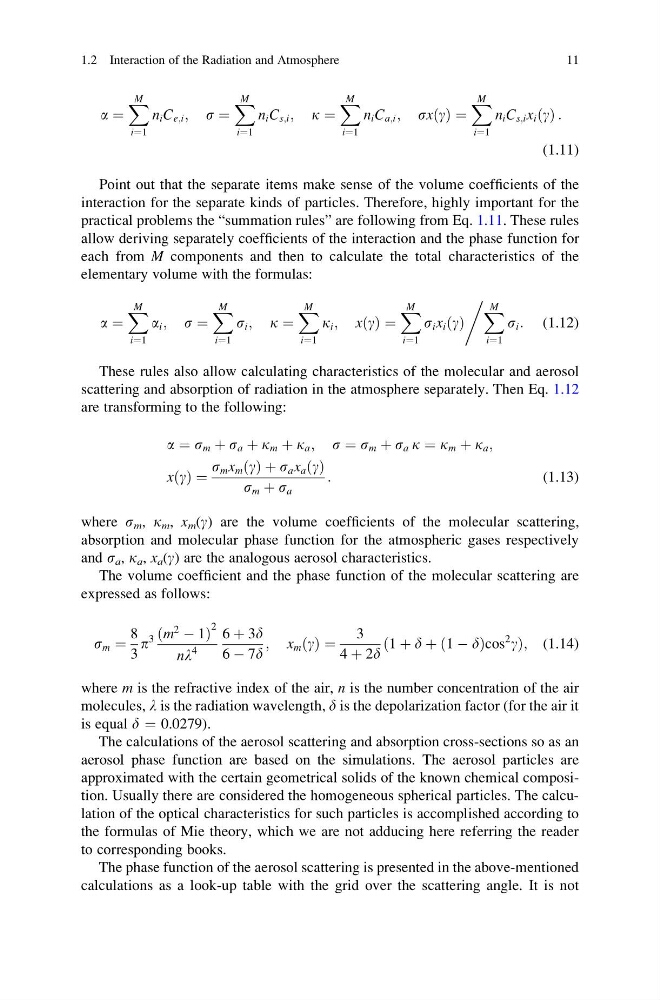
a ¼
X M
i¼1
n i C e;i ; s ¼
X M
i¼1
n i C s;i ; k ¼
X M
i¼1
n i C a;i ; sxðgÞ ¼
X M
i¼1
n i C s;i x i ðgÞ :
(1.11)
Point out that the separate items make sense of the volume coefficients of the
interaction for the separate kinds of particles. Therefore, highly important for the
practical problems the “summation rules” are following from Eq. 1.11. These rules
allow deriving separately coefficients of the interaction and the phase function for
each from M components and then to calculate the total characteristics of the
elementary volume with the formulas:
a ¼
X M
i¼1
a i ; s ¼
X M
i¼1
s i ; k ¼
X M
i¼1
k i ; xðgÞ ¼
X M
i¼1
s i x i ðgÞ
X M
i¼1
s i
,
: (1.12)
These rules also allow calculating characteristics of the molecular and aerosol
scattering and absorption of radiation in the atmosphere separately. Then Eq. 1.12
are transforming to the following:
a ¼ s m þ s a þ k m þ k a ; s ¼ s m þ s a k ¼ k m þ k a ;
xðgÞ ¼
s m x m ðgÞ þ s a x a ðgÞ
s m þ s a
:
(1.13)
where s m , k m , x m (g) are the volume coefficients of the molecular scattering,
absorption and molecular phase function for the atmospheric gases respectively
and s a , k a , x a (g) are the analogous aerosol characteristics.
The volume coefficient and the phase function of the molecular scattering are
expressed as follows:
s m ¼
8
3
p
3 ðm
2
À 1Þ
2
nl
4
6 þ 3d
6 À 7d
; x m ðgÞ ¼
3
4 þ 2d
ð1 þ d þ ð1 À dÞcos
2 gÞ; (1.14)
where m is the refractive index of the air, n is the number concentration of the air
molecules, l is the radiation wavelength, d is the depolarization factor (for the air it
is equal d ¼ 0.0279).
The calculations of the aerosol scattering and absorption cross-sections so as an
aerosol phase function are based on the simulations. The aerosol particles are
approximated with the certain geometrical solids of the known chemical composition. Usually there are considered the homogeneous spherical particles. The calculation of the optical characteristics for such particles is accomplished according to
the formulas of Mie theory, which we are not adducing here referring the reader
to corresponding books.
The phase function of the aerosol scattering is presented in the above-mentioned
calculations as a look-up table with the grid over the scattering angle. It is not
1.2 Interaction of the Radiation and Atmosphere
11
X M
i¼1
n i C e;i ; s ¼
X M
i¼1
n i C s;i ; k ¼
X M
i¼1
n i C a;i ; sxðgÞ ¼
X M
i¼1
n i C s;i x i ðgÞ :
(1.11)
Point out that the separate items make sense of the volume coefficients of the
interaction for the separate kinds of particles. Therefore, highly important for the
practical problems the “summation rules” are following from Eq. 1.11. These rules
allow deriving separately coefficients of the interaction and the phase function for
each from M components and then to calculate the total characteristics of the
elementary volume with the formulas:
a ¼
X M
i¼1
a i ; s ¼
X M
i¼1
s i ; k ¼
X M
i¼1
k i ; xðgÞ ¼
X M
i¼1
s i x i ðgÞ
X M
i¼1
s i
,
: (1.12)
These rules also allow calculating characteristics of the molecular and aerosol
scattering and absorption of radiation in the atmosphere separately. Then Eq. 1.12
are transforming to the following:
a ¼ s m þ s a þ k m þ k a ; s ¼ s m þ s a k ¼ k m þ k a ;
xðgÞ ¼
s m x m ðgÞ þ s a x a ðgÞ
s m þ s a
:
(1.13)
where s m , k m , x m (g) are the volume coefficients of the molecular scattering,
absorption and molecular phase function for the atmospheric gases respectively
and s a , k a , x a (g) are the analogous aerosol characteristics.
The volume coefficient and the phase function of the molecular scattering are
expressed as follows:
s m ¼
8
3
p
3 ðm
2
À 1Þ
2
nl
4
6 þ 3d
6 À 7d
; x m ðgÞ ¼
3
4 þ 2d
ð1 þ d þ ð1 À dÞcos
2 gÞ; (1.14)
where m is the refractive index of the air, n is the number concentration of the air
molecules, l is the radiation wavelength, d is the depolarization factor (for the air it
is equal d ¼ 0.0279).
The calculations of the aerosol scattering and absorption cross-sections so as an
aerosol phase function are based on the simulations. The aerosol particles are
approximated with the certain geometrical solids of the known chemical composition. Usually there are considered the homogeneous spherical particles. The calculation of the optical characteristics for such particles is accomplished according to
the formulas of Mie theory, which we are not adducing here referring the reader
to corresponding books.
The phase function of the aerosol scattering is presented in the above-mentioned
calculations as a look-up table with the grid over the scattering angle. It is not
1.2 Interaction of the Radiation and Atmosphere
11