

tg’ n ¼
u
w
;
u ¼ ðcos # 1 À cos # 2 Þðcos # 1 sin # 2 sin ’ 2 À sin # 1 cos # 2 sin ’ 1 Þ
À sin # 1 sin # 2 sinð’ 1 À ’ 2 Þðsin # 1 cos ’ 1 À sin # 2 cos ’ 2 Þ
w ¼ ðcos # 2 À cos # 1 Þðsin # 1 cos # 2 cos ’ 1 À cos # 1 sin # 2 cos ’ 2 Þ
þ sin # 1 sin # 2 sinð’ 1 À ’ 2 Þðsin # 1 sin ’ 1 À sin # 2 sin ’ 2 Þ;
(15.7)
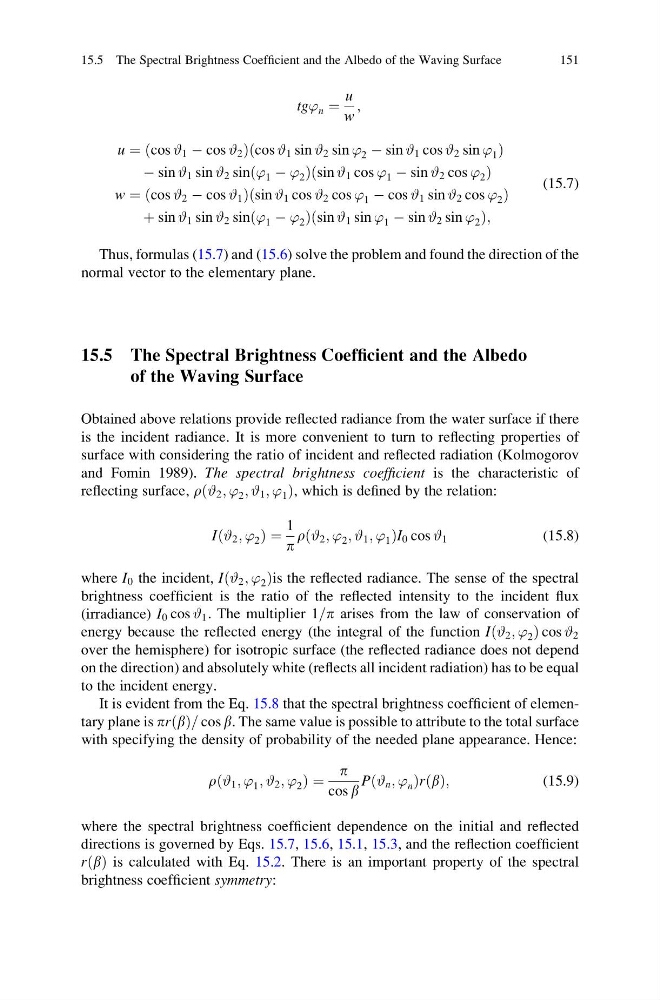
Thus, formulas (15.7) and (15.6) solve the problem and found the direction of the
normal vector to the elementary plane.
15.5 The Spectral Brightness Coefficient and the Albedo
of the Waving Surface
Obtained above relations provide reflected radiance from the water surface if there
is the incident radiance. It is more convenient to turn to reflecting properties of
surface with considering the ratio of incident and reflected radiation (Kolmogorov
and Fomin 1989). The spectral brightness coefficient is the characteristic of
reflecting surface, rð# 2 ; ’ 2 ; # 1 ; ’ 1 Þ, which is defined by the relation:
Ið# 2 ; ’ 2 Þ ¼
1
p
rð# 2 ; ’ 2 ; # 1 ; ’ 1 ÞI 0 cos # 1
(15.8)
where I 0 the incident, Ið# 2 ; ’ 2 Þis the reflected radiance. The sense of the spectral
brightness coefficient is the ratio of the reflected intensity to the incident flux
(irradiance) I 0 cos # 1 . The multiplier 1=p arises from the law of conservation of
energy because the reflected energy (the integral of the function Ið# 2 ; ’ 2 Þ cos # 2
over the hemisphere) for isotropic surface (the reflected radiance does not depend
on the direction) and absolutely white (reflects all incident radiation) has to be equal
to the incident energy.
It is evident from the Eq. 15.8 that the spectral brightness coefficient of elementary plane is prðbÞ= cos b. The same value is possible to attribute to the total surface
with specifying the density of probability of the needed plane appearance. Hence:
rð# 1 ; ’ 1 ; # 2 ; ’ 2 Þ ¼
p
cos b
Pð# n ; ’ n ÞrðbÞ;
(15.9)
where the spectral brightness coefficient dependence on the initial and reflected
directions is governed by Eqs. 15.7, 15.6, 15.1, 15.3, and the reflection coefficient
rðbÞ is calculated with Eq. 15.2. There is an important property of the spectral
brightness coefficient symmetry:
15.5 The Spectral Brightness Coefficient and the Albedo of the Waving Surface
151
u
w
;
u ¼ ðcos # 1 À cos # 2 Þðcos # 1 sin # 2 sin ’ 2 À sin # 1 cos # 2 sin ’ 1 Þ
À sin # 1 sin # 2 sinð’ 1 À ’ 2 Þðsin # 1 cos ’ 1 À sin # 2 cos ’ 2 Þ
w ¼ ðcos # 2 À cos # 1 Þðsin # 1 cos # 2 cos ’ 1 À cos # 1 sin # 2 cos ’ 2 Þ
þ sin # 1 sin # 2 sinð’ 1 À ’ 2 Þðsin # 1 sin ’ 1 À sin # 2 sin ’ 2 Þ;
(15.7)
Thus, formulas (15.7) and (15.6) solve the problem and found the direction of the
normal vector to the elementary plane.
15.5 The Spectral Brightness Coefficient and the Albedo
of the Waving Surface
Obtained above relations provide reflected radiance from the water surface if there
is the incident radiance. It is more convenient to turn to reflecting properties of
surface with considering the ratio of incident and reflected radiation (Kolmogorov
and Fomin 1989). The spectral brightness coefficient is the characteristic of
reflecting surface, rð# 2 ; ’ 2 ; # 1 ; ’ 1 Þ, which is defined by the relation:
Ið# 2 ; ’ 2 Þ ¼
1
p
rð# 2 ; ’ 2 ; # 1 ; ’ 1 ÞI 0 cos # 1
(15.8)
where I 0 the incident, Ið# 2 ; ’ 2 Þis the reflected radiance. The sense of the spectral
brightness coefficient is the ratio of the reflected intensity to the incident flux
(irradiance) I 0 cos # 1 . The multiplier 1=p arises from the law of conservation of
energy because the reflected energy (the integral of the function Ið# 2 ; ’ 2 Þ cos # 2
over the hemisphere) for isotropic surface (the reflected radiance does not depend
on the direction) and absolutely white (reflects all incident radiation) has to be equal
to the incident energy.
It is evident from the Eq. 15.8 that the spectral brightness coefficient of elementary plane is prðbÞ= cos b. The same value is possible to attribute to the total surface
with specifying the density of probability of the needed plane appearance. Hence:
rð# 1 ; ’ 1 ; # 2 ; ’ 2 Þ ¼
p
cos b
Pð# n ; ’ n ÞrðbÞ;
(15.9)
where the spectral brightness coefficient dependence on the initial and reflected
directions is governed by Eqs. 15.7, 15.6, 15.1, 15.3, and the reflection coefficient
rðbÞ is calculated with Eq. 15.2. There is an important property of the spectral
brightness coefficient symmetry:
15.5 The Spectral Brightness Coefficient and the Albedo of the Waving Surface
151