

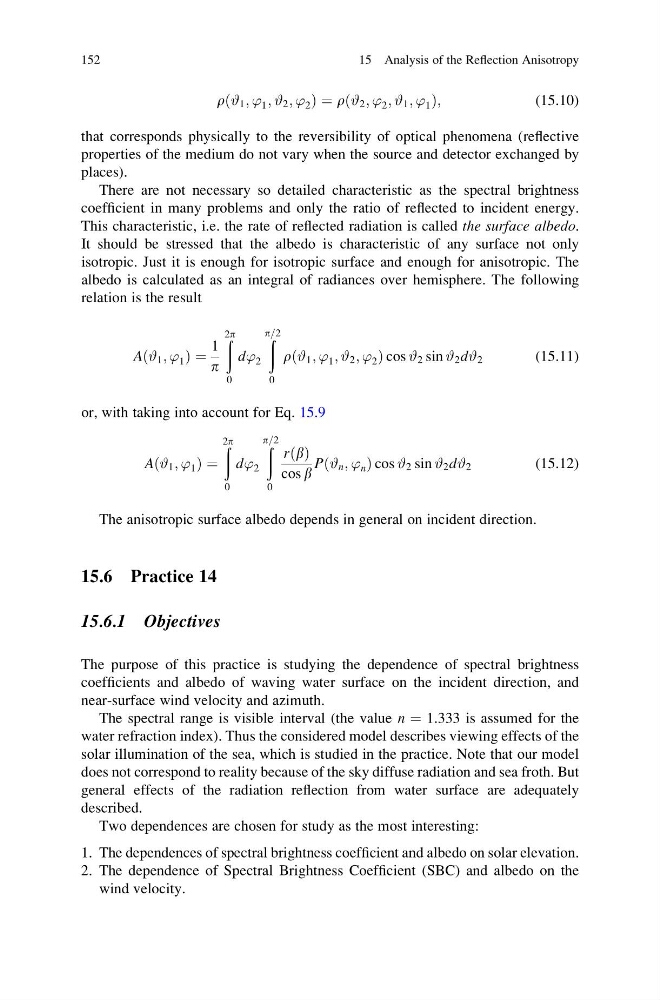
rð# 1 ; ’ 1 ; # 2 ; ’ 2 Þ ¼ rð# 2 ; ’ 2 ; # 1 ; ’ 1 Þ;
(15.10)
that corresponds physically to the reversibility of optical phenomena (reflective
properties of the medium do not vary when the source and detector exchanged by
places).
There are not necessary so detailed characteristic as the spectral brightness
coefficient in many problems and only the ratio of reflected to incident energy.
This characteristic, i.e. the rate of reflected radiation is called the surface albedo.
It should be stressed that the albedo is characteristic of any surface not only
isotropic. Just it is enough for isotropic surface and enough for anisotropic. The
albedo is calculated as an integral of radiances over hemisphere. The following
relation is the result
Að# 1 ; ’ 1 Þ ¼
1
p
ð
2p
0
d’ 2
ð
p=2
0
rð# 1 ; ’ 1 ; # 2 ; ’ 2 Þ cos # 2 sin # 2 d# 2
(15.11)
or, with taking into account for Eq. 15.9
Að# 1 ; ’ 1 Þ ¼
ð
2p
0
d’ 2
ð
p=2
0
rðbÞ
cos b
Pð# n ; ’ n Þ cos # 2 sin # 2 d# 2
(15.12)
The anisotropic surface albedo depends in general on incident direction.
15.6 Practice 14
15.6.1 Objectives
The purpose of this practice is studying the dependence of spectral brightness
coefficients and albedo of waving water surface on the incident direction, and
near-surface wind velocity and azimuth.
The spectral range is visible interval (the value n ¼ 1.333 is assumed for the
water refraction index). Thus the considered model describes viewing effects of the
solar illumination of the sea, which is studied in the practice. Note that our model
does not correspond to reality because of the sky diffuse radiation and sea froth. But
general effects of the radiation reflection from water surface are adequately
described.
Two dependences are chosen for study as the most interesting:
1. The dependences of spectral brightness coefficient and albedo on solar elevation.
2. The dependence of Spectral Brightness Coefficient (SBC) and albedo on the
wind velocity.
152
15 Analysis of the Reflection Anisotropy
(15.10)
that corresponds physically to the reversibility of optical phenomena (reflective
properties of the medium do not vary when the source and detector exchanged by
places).
There are not necessary so detailed characteristic as the spectral brightness
coefficient in many problems and only the ratio of reflected to incident energy.
This characteristic, i.e. the rate of reflected radiation is called the surface albedo.
It should be stressed that the albedo is characteristic of any surface not only
isotropic. Just it is enough for isotropic surface and enough for anisotropic. The
albedo is calculated as an integral of radiances over hemisphere. The following
relation is the result
Að# 1 ; ’ 1 Þ ¼
1
p
ð
2p
0
d’ 2
ð
p=2
0
rð# 1 ; ’ 1 ; # 2 ; ’ 2 Þ cos # 2 sin # 2 d# 2
(15.11)
or, with taking into account for Eq. 15.9
Að# 1 ; ’ 1 Þ ¼
ð
2p
0
d’ 2
ð
p=2
0
rðbÞ
cos b
Pð# n ; ’ n Þ cos # 2 sin # 2 d# 2
(15.12)
The anisotropic surface albedo depends in general on incident direction.
15.6 Practice 14
15.6.1 Objectives
The purpose of this practice is studying the dependence of spectral brightness
coefficients and albedo of waving water surface on the incident direction, and
near-surface wind velocity and azimuth.
The spectral range is visible interval (the value n ¼ 1.333 is assumed for the
water refraction index). Thus the considered model describes viewing effects of the
solar illumination of the sea, which is studied in the practice. Note that our model
does not correspond to reality because of the sky diffuse radiation and sea froth. But
general effects of the radiation reflection from water surface are adequately
described.
Two dependences are chosen for study as the most interesting:
1. The dependences of spectral brightness coefficient and albedo on solar elevation.
2. The dependence of Spectral Brightness Coefficient (SBC) and albedo on the
wind velocity.
152
15 Analysis of the Reflection Anisotropy