

where b is the incident radiation angle, n is the refraction coefficient of the surface
matter. Here the radiation falls from the air, which refraction coefficient is equal to
one unit. Then multiply the incident radiance to the expression (15.2) to obtain the
reflected radiance.
15.4 Determining the Orientation of Elementary Plane
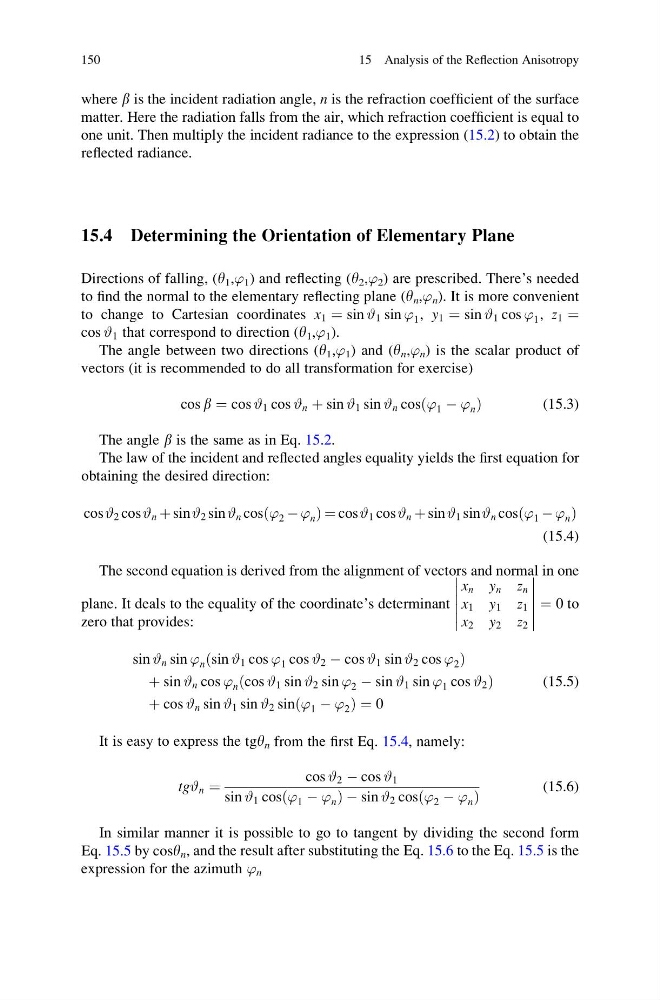
Directions of falling, (y 1 ,’ 1 ) and reflecting (y 2 ,’ 2 ) are prescribed. There’s needed
to find the normal to the elementary reflecting plane (y n ,’ n ). It is more convenient
to change to Cartesian coordinates x 1 ¼ sin # 1 sin ’ 1 , y 1 ¼ sin # 1 cos ’ 1 , z 1 ¼
cos # 1 that correspond to direction (y 1 ,’ 1 ).
The angle between two directions (y 1 ,’ 1 ) and (y n ,’ n ) is the scalar product of
vectors (it is recommended to do all transformation for exercise)
cos b ¼ cos # 1 cos # n þ sin # 1 sin # n cosð’ 1 À ’ n Þ
(15.3)
The angle b is the same as in Eq. 15.2.
The law of the incident and reflected angles equality yields the first equation for
obtaining the desired direction:
cos # 2 cos # n þ sin # 2 sin # n cosð’ 2 À ’ n Þ ¼ cos # 1 cos # n þ sin # 1 sin # n cosð’ 1 À ’ n Þ
(15.4)
The second equation is derived from the alignment of vectors and normal in one
plane. It deals to the equality of the coordinate’s determinant
x n y n z n
x 1 y 1 z 1
x 2 y 2 z 2
¼ 0 to
zero that provides:
sin # n sin ’ n ðsin # 1 cos ’ 1 cos # 2 À cos # 1 sin # 2 cos ’ 2 Þ
þ sin # n cos ’ n ðcos # 1 sin # 2 sin ’ 2 À sin # 1 sin ’ 1 cos # 2 Þ
þ cos # n sin # 1 sin # 2 sinð’ 1 À ’ 2 Þ ¼ 0
(15.5)
It is easy to express the tgy n from the first Eq. 15.4, namely:
tg# n ¼
cos # 2 À cos # 1
sin # 1 cosð’ 1 À ’ n Þ À sin # 2 cosð’ 2 À ’ n Þ
(15.6)
In similar manner it is possible to go to tangent by dividing the second form
Eq. 15.5 by cosy n , and the result after substituting the Eq. 15.6 to the Eq. 15.5 is the
expression for the azimuth ’ n
150
15 Analysis of the Reflection Anisotropy
matter. Here the radiation falls from the air, which refraction coefficient is equal to
one unit. Then multiply the incident radiance to the expression (15.2) to obtain the
reflected radiance.
15.4 Determining the Orientation of Elementary Plane
Directions of falling, (y 1 ,’ 1 ) and reflecting (y 2 ,’ 2 ) are prescribed. There’s needed
to find the normal to the elementary reflecting plane (y n ,’ n ). It is more convenient
to change to Cartesian coordinates x 1 ¼ sin # 1 sin ’ 1 , y 1 ¼ sin # 1 cos ’ 1 , z 1 ¼
cos # 1 that correspond to direction (y 1 ,’ 1 ).
The angle between two directions (y 1 ,’ 1 ) and (y n ,’ n ) is the scalar product of
vectors (it is recommended to do all transformation for exercise)
cos b ¼ cos # 1 cos # n þ sin # 1 sin # n cosð’ 1 À ’ n Þ
(15.3)
The angle b is the same as in Eq. 15.2.
The law of the incident and reflected angles equality yields the first equation for
obtaining the desired direction:
cos # 2 cos # n þ sin # 2 sin # n cosð’ 2 À ’ n Þ ¼ cos # 1 cos # n þ sin # 1 sin # n cosð’ 1 À ’ n Þ
(15.4)
The second equation is derived from the alignment of vectors and normal in one
plane. It deals to the equality of the coordinate’s determinant
x n y n z n
x 1 y 1 z 1
x 2 y 2 z 2
¼ 0 to
zero that provides:
sin # n sin ’ n ðsin # 1 cos ’ 1 cos # 2 À cos # 1 sin # 2 cos ’ 2 Þ
þ sin # n cos ’ n ðcos # 1 sin # 2 sin ’ 2 À sin # 1 sin ’ 1 cos # 2 Þ
þ cos # n sin # 1 sin # 2 sinð’ 1 À ’ 2 Þ ¼ 0
(15.5)
It is easy to express the tgy n from the first Eq. 15.4, namely:
tg# n ¼
cos # 2 À cos # 1
sin # 1 cosð’ 1 À ’ n Þ À sin # 2 cosð’ 2 À ’ n Þ
(15.6)
In similar manner it is possible to go to tangent by dividing the second form
Eq. 15.5 by cosy n , and the result after substituting the Eq. 15.6 to the Eq. 15.5 is the
expression for the azimuth ’ n
150
15 Analysis of the Reflection Anisotropy