

Parameters: wind velocity n [m/s] near surface and wind direction azimuth ’ n ,
are included in the Eq. 15.1. The Cox-Munk function (15.1) has been obtained with
approximating measured declinations of sea waves. It seems a somewhat unwieldy,
however it is simple because it is the two-dimensional normal distribution
(the exponential) with certain corrections for taking into account real observations
(items multiplied to the exponent). It is clear that in computer realization of the
algorithm the unwieldiness of the Eq. 15.1 is not a problem.
Let the incident radiation with the initial zenith angle ϑ 1 and azimuth ’ 1 fall to
the surface. Then desired reflected radiance has the direction with the nadir angle
ϑ 2 and azimuth ’ 2 is found after three operations:
1. determining the elementary plane orientation (ϑ n ,’ n ) which reflects the light
from the initial direction (ϑ 1 ,’ 1 ) to the direction (ϑ 2 ,’ 2 );
2. calculating the reflection coefficient for this initial angle;
3. multiplying it to the probability density (15.1), incident radiance, and
normalizing multipliers.
15.3 Laws of the Ideal Mirror Reflection
Consider the physical problem – calculating the reflection coefficient. Let the
radiation fall to the ideal plane boarder of two media. Then the interaction between
the radiation and surface is described by the following laws:
1. Incident radiation divided to two parts: reflected with direction from the surface
to the first medium and the refracted with direction from the surface to the
second medium.
2. Frequencies of the incident, reflected, and refracted radiation is equal.
3. Vectors of the incident, reflected, and refracted radiation and the normal to the
surface are in one plane.
4. The reflected angle is equal to the incident angle.
5. The law determining the refraction angle (remember it as an exercise).
Note that these laws have been firstly obtained experimentally but they might
be proved strictly theoretically. The same theory ascertains qualified relations
between incident, reflected, and refracted radiances, and provides the expression
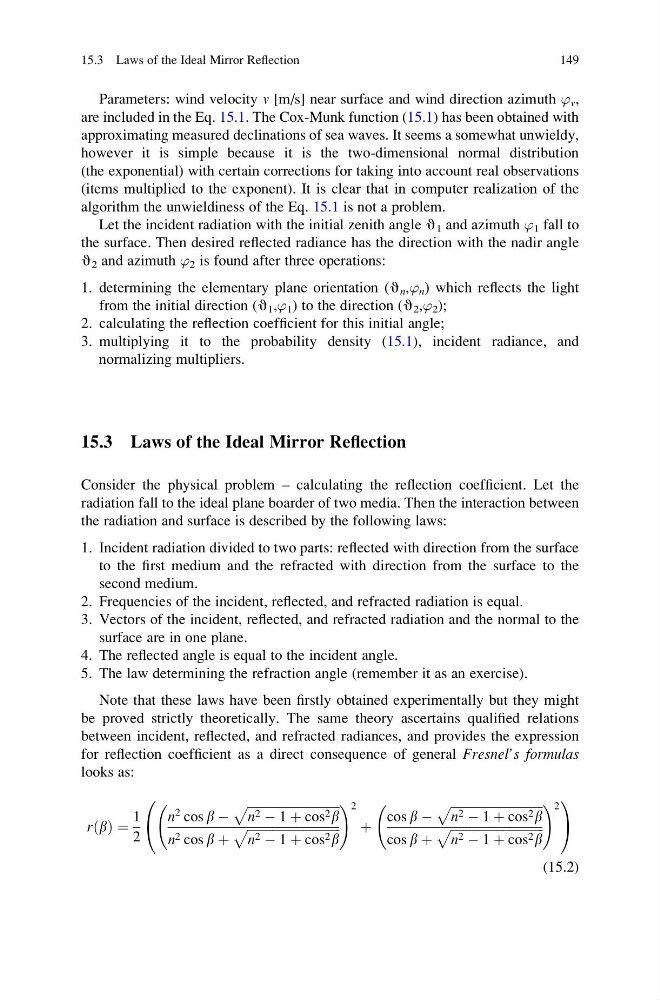
for reflection coefficient as a direct consequence of general Fresnel’s formulas
looks as:
rðbÞ ¼
1
2
n
2 cos b À
ffiffiffiffiffiffiffiffiffiffiffiffiffiffiffiffiffiffiffiffiffiffiffiffiffiffiffiffiffi ffi
n 2 À 1 þ cos 2 b
p
n 2 cos b þ
ffiffiffiffiffiffiffiffiffiffiffiffiffiffiffiffiffiffiffiffiffiffiffiffiffiffiffiffiffi ffi
n 2 À 1 þ cos 2 b
p
! 2
þ
cos b À
ffiffiffiffiffiffiffiffiffiffiffiffiffiffiffiffiffiffiffiffiffiffiffiffiffiffiffiffiffi ffi
n 2 À 1 þ cos 2 b
p
cos b þ
ffiffiffiffiffiffiffiffiffiffiffiffiffiffiffiffiffiffiffiffiffiffiffiffiffiffiffiffiffi ffi
n 2 À 1 þ cos 2 b
p
! 2
0
@
1
A
(15.2)
15.3 Laws of the Ideal Mirror Reflection
149
are included in the Eq. 15.1. The Cox-Munk function (15.1) has been obtained with
approximating measured declinations of sea waves. It seems a somewhat unwieldy,
however it is simple because it is the two-dimensional normal distribution
(the exponential) with certain corrections for taking into account real observations
(items multiplied to the exponent). It is clear that in computer realization of the
algorithm the unwieldiness of the Eq. 15.1 is not a problem.
Let the incident radiation with the initial zenith angle ϑ 1 and azimuth ’ 1 fall to
the surface. Then desired reflected radiance has the direction with the nadir angle
ϑ 2 and azimuth ’ 2 is found after three operations:
1. determining the elementary plane orientation (ϑ n ,’ n ) which reflects the light
from the initial direction (ϑ 1 ,’ 1 ) to the direction (ϑ 2 ,’ 2 );
2. calculating the reflection coefficient for this initial angle;
3. multiplying it to the probability density (15.1), incident radiance, and
normalizing multipliers.
15.3 Laws of the Ideal Mirror Reflection
Consider the physical problem – calculating the reflection coefficient. Let the
radiation fall to the ideal plane boarder of two media. Then the interaction between
the radiation and surface is described by the following laws:
1. Incident radiation divided to two parts: reflected with direction from the surface
to the first medium and the refracted with direction from the surface to the
second medium.
2. Frequencies of the incident, reflected, and refracted radiation is equal.
3. Vectors of the incident, reflected, and refracted radiation and the normal to the
surface are in one plane.
4. The reflected angle is equal to the incident angle.
5. The law determining the refraction angle (remember it as an exercise).
Note that these laws have been firstly obtained experimentally but they might
be proved strictly theoretically. The same theory ascertains qualified relations
between incident, reflected, and refracted radiances, and provides the expression
for reflection coefficient as a direct consequence of general Fresnel’s formulas
looks as:
rðbÞ ¼
1
2
n
2 cos b À
ffiffiffiffiffiffiffiffiffiffiffiffiffiffiffiffiffiffiffiffiffiffiffiffiffiffiffiffiffi ffi
n 2 À 1 þ cos 2 b
p
n 2 cos b þ
ffiffiffiffiffiffiffiffiffiffiffiffiffiffiffiffiffiffiffiffiffiffiffiffiffiffiffiffiffi ffi
n 2 À 1 þ cos 2 b
p
! 2
þ
cos b À
ffiffiffiffiffiffiffiffiffiffiffiffiffiffiffiffiffiffiffiffiffiffiffiffiffiffiffiffiffi ffi
n 2 À 1 þ cos 2 b
p
cos b þ
ffiffiffiffiffiffiffiffiffiffiffiffiffiffiffiffiffiffiffiffiffiffiffiffiffiffiffiffiffi ffi
n 2 À 1 þ cos 2 b
p
! 2
0
@
1
A
(15.2)
15.3 Laws of the Ideal Mirror Reflection
149