

The water surface is the mostly anisotropic of the reflections. It is very close to
the plane i.e. ideally mirror, however waves disturb the idealization and transform
the reflection from water surface to anisotropic diffuse (quasi-mirror). A correct
consideration of the water surface is extremely important in many problems
because it takes about 75% of the global Earth surface.
15.2 Statistical Simulation of the Waving Water Surface
The following approach is used for mathematical modelling optical properties of
anisotropic surfaces. The surface is presented as the totality of elementary ideal
planes. Reflection from every plane is simulated in accordance with the laws of
ideal mirror reflection. The final reflected radiance is a sum over all planes.
Two types of models of water surfaces are possible for inclusion waves:
dynamical and statistical. Dynamical models input the planes position as the time
function. It corresponds to the real dynamics of reflection – in different time
moments differently oriented planes reflect the light (the glares effect leads to
twinkling when looking to the water). But the averaging picture is the most
interesting in many cases. There is the photographing of the water surface from
satellite or airplane board, the reflected radiance observation for example. The
mentioned dynamics are averaged because reflected light from many planes are
thrown to an instrument and separate glares are not distinguished. The most
important case of the surface statistical model is used, where the position of
separate planes is characterized by the function of probability density.
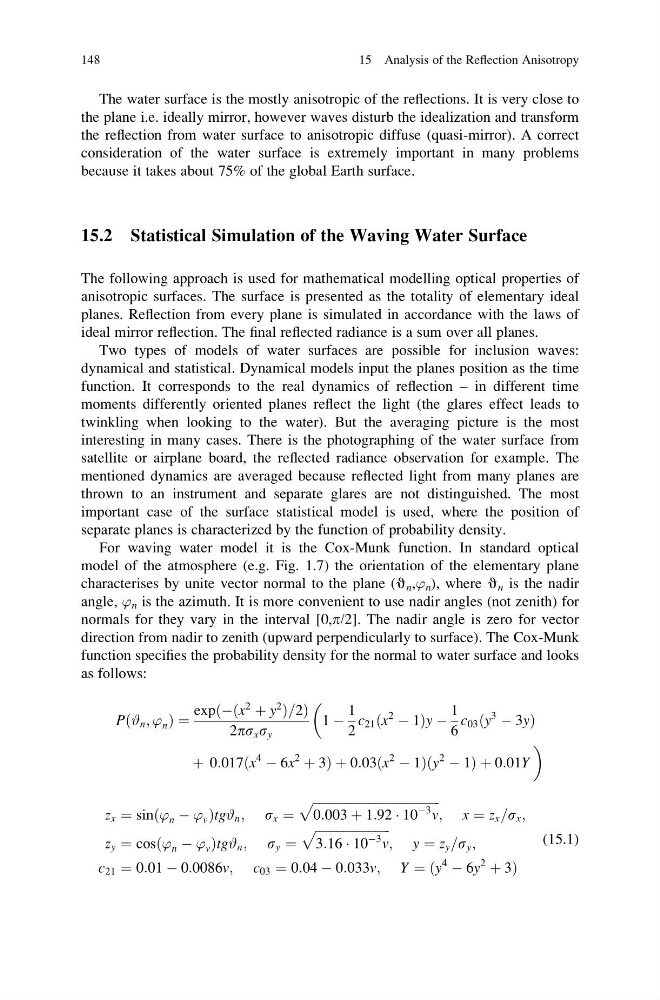
For waving water model it is the Cox-Munk function. In standard optical
model of the atmosphere (e.g. Fig. 1.7) the orientation of the elementary plane
characterises by unite vector normal to the plane (ϑ n ,’ n ), where ϑ n is the nadir
angle, ’ n is the azimuth. It is more convenient to use nadir angles (not zenith) for
normals for they vary in the interval [0,p/2]. The nadir angle is zero for vector
direction from nadir to zenith (upward perpendicularly to surface). The Cox-Munk
function specifies the probability density for the normal to water surface and looks
as follows:
Pð# n ; ’ n Þ ¼
expðÀðx
2
þ y
2
Þ=2Þ
2ps x s y
1 À
1
2
c 21 ðx
2
À 1Þy À
1
6
c 03 ðy
3
À 3yÞ
þ 0:017ðx
4
À 6x
2
þ 3Þ þ 0:03ðx
2
À 1Þðy
2
À 1Þ þ 0:01Y
z x ¼ sinð’ n À ’ v Þtg# n ; s x ¼
ffiffiffiffiffiffiffiffiffiffiffiffiffiffiffiffiffiffiffiffiffiffiffiffiffiffiffiffiffiffiffiffiffiffiffiffiffiffiffiffi ffi
0:003 þ 1:92 Á 10
À3 v
p
; x ¼ z x =s x ;
z y ¼ cosð’ n À ’ v Þtg# n ; s y ¼
ffiffiffiffiffiffiffiffiffiffiffiffiffiffiffiffiffiffiffiffiffiffiffi ffi
3:16 Á 10
À3 v
p
; y ¼ z y =s y ;
c 21 ¼ 0:01 À 0:0086v; c 03 ¼ 0:04 À 0:033v; Y ¼ ðy
4
À 6y
2
þ 3Þ
(15.1)
148
15 Analysis of the Reflection Anisotropy
the plane i.e. ideally mirror, however waves disturb the idealization and transform
the reflection from water surface to anisotropic diffuse (quasi-mirror). A correct
consideration of the water surface is extremely important in many problems
because it takes about 75% of the global Earth surface.
15.2 Statistical Simulation of the Waving Water Surface
The following approach is used for mathematical modelling optical properties of
anisotropic surfaces. The surface is presented as the totality of elementary ideal
planes. Reflection from every plane is simulated in accordance with the laws of
ideal mirror reflection. The final reflected radiance is a sum over all planes.
Two types of models of water surfaces are possible for inclusion waves:
dynamical and statistical. Dynamical models input the planes position as the time
function. It corresponds to the real dynamics of reflection – in different time
moments differently oriented planes reflect the light (the glares effect leads to
twinkling when looking to the water). But the averaging picture is the most
interesting in many cases. There is the photographing of the water surface from
satellite or airplane board, the reflected radiance observation for example. The
mentioned dynamics are averaged because reflected light from many planes are
thrown to an instrument and separate glares are not distinguished. The most
important case of the surface statistical model is used, where the position of
separate planes is characterized by the function of probability density.
For waving water model it is the Cox-Munk function. In standard optical
model of the atmosphere (e.g. Fig. 1.7) the orientation of the elementary plane
characterises by unite vector normal to the plane (ϑ n ,’ n ), where ϑ n is the nadir
angle, ’ n is the azimuth. It is more convenient to use nadir angles (not zenith) for
normals for they vary in the interval [0,p/2]. The nadir angle is zero for vector
direction from nadir to zenith (upward perpendicularly to surface). The Cox-Munk
function specifies the probability density for the normal to water surface and looks
as follows:
Pð# n ; ’ n Þ ¼
expðÀðx
2
þ y
2
Þ=2Þ
2ps x s y
1 À
1
2
c 21 ðx
2
À 1Þy À
1
6
c 03 ðy
3
À 3yÞ
þ 0:017ðx
4
À 6x
2
þ 3Þ þ 0:03ðx
2
À 1Þðy
2
À 1Þ þ 0:01Y
z x ¼ sinð’ n À ’ v Þtg# n ; s x ¼
ffiffiffiffiffiffiffiffiffiffiffiffiffiffiffiffiffiffiffiffiffiffiffiffiffiffiffiffiffiffiffiffiffiffiffiffiffiffiffiffi ffi
0:003 þ 1:92 Á 10
À3 v
p
; x ¼ z x =s x ;
z y ¼ cosð’ n À ’ v Þtg# n ; s y ¼
ffiffiffiffiffiffiffiffiffiffiffiffiffiffiffiffiffiffiffiffiffiffiffi ffi
3:16 Á 10
À3 v
p
; y ¼ z y =s y ;
c 21 ¼ 0:01 À 0:0086v; c 03 ¼ 0:04 À 0:033v; Y ¼ ðy
4
À 6y
2
þ 3Þ
(15.1)
148
15 Analysis of the Reflection Anisotropy