

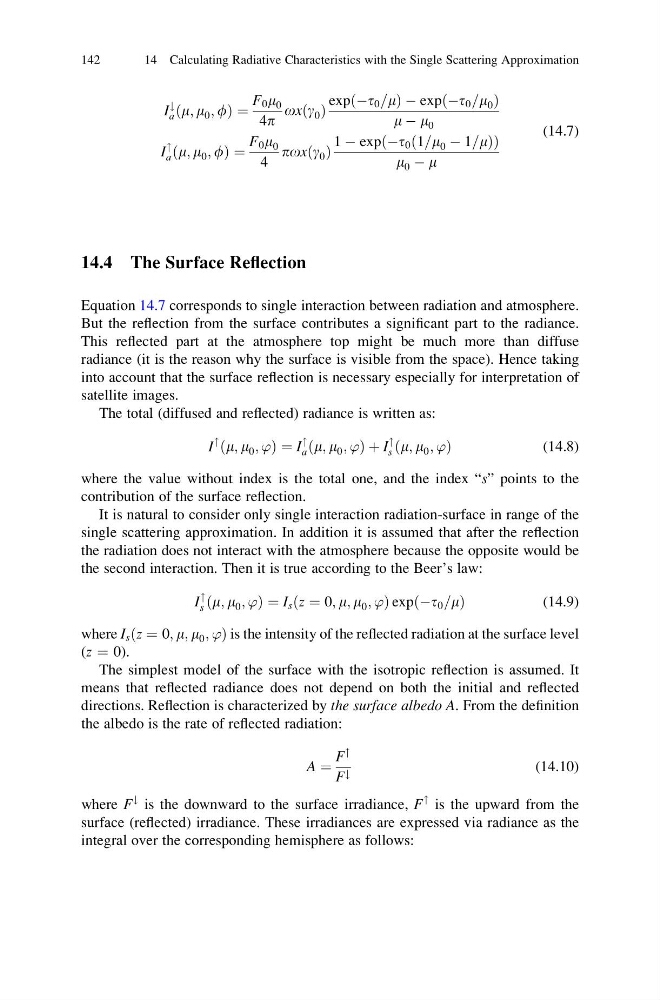
I
#
a ðm; m 0 ; fÞ ¼
F 0 m 0
4p
oxðg 0 Þ
expðÀt 0 =mÞ À exp Àt 0 =m 0
ð
Þ
m À m 0
I
"
a ðm; m 0 ; fÞ ¼
F 0 m 0
4
poxðg 0 Þ
1 À exp Àt 0 1=m 0 À 1=m
ð
Þ
ð
Þ
m 0 À m
(14.7)
14.4 The Surface Reflection
Equation 14.7 corresponds to single interaction between radiation and atmosphere.
But the reflection from the surface contributes a significant part to the radiance.
This reflected part at the atmosphere top might be much more than diffuse
radiance (it is the reason why the surface is visible from the space). Hence taking
into account that the surface reflection is necessary especially for interpretation of
satellite images.
The total (diffused and reflected) radiance is written as:
I
"
ðm; m 0 ; ’Þ ¼ I
"
a ðm; m 0 ; ’Þ þ I
"
s ðm; m 0 ; ’Þ
(14.8)
where the value without index is the total one, and the index “s” points to the
contribution of the surface reflection.
It is natural to consider only single interaction radiation-surface in range of the
single scattering approximation. In addition it is assumed that after the reflection
the radiation does not interact with the atmosphere because the opposite would be
the second interaction. Then it is true according to the Beer’s law:
I
"
s ðm; m 0 ; ’Þ ¼ I s ðz ¼ 0; m; m 0 ; ’Þ expðÀt 0 =mÞ
(14.9)
where I s ðz ¼ 0; m; m 0 ; ’Þ is the intensity of the reflected radiation at the surface level
(z ¼ 0).
The simplest model of the surface with the isotropic reflection is assumed. It
means that reflected radiance does not depend on both the initial and reflected
directions. Reflection is characterized by the surface albedo A. From the definition
the albedo is the rate of reflected radiation:
A ¼
F
"
F #
(14.10)
where F
# is the downward to the surface irradiance, F
" is the upward from the
surface (reflected) irradiance. These irradiances are expressed via radiance as the
integral over the corresponding hemisphere as follows:
142
14 Calculating Radiative Characteristics with the Single Scattering Approximation
#
a ðm; m 0 ; fÞ ¼
F 0 m 0
4p
oxðg 0 Þ
expðÀt 0 =mÞ À exp Àt 0 =m 0
ð
Þ
m À m 0
I
"
a ðm; m 0 ; fÞ ¼
F 0 m 0
4
poxðg 0 Þ
1 À exp Àt 0 1=m 0 À 1=m
ð
Þ
ð
Þ
m 0 À m
(14.7)
14.4 The Surface Reflection
Equation 14.7 corresponds to single interaction between radiation and atmosphere.
But the reflection from the surface contributes a significant part to the radiance.
This reflected part at the atmosphere top might be much more than diffuse
radiance (it is the reason why the surface is visible from the space). Hence taking
into account that the surface reflection is necessary especially for interpretation of
satellite images.
The total (diffused and reflected) radiance is written as:
I
"
ðm; m 0 ; ’Þ ¼ I
"
a ðm; m 0 ; ’Þ þ I
"
s ðm; m 0 ; ’Þ
(14.8)
where the value without index is the total one, and the index “s” points to the
contribution of the surface reflection.
It is natural to consider only single interaction radiation-surface in range of the
single scattering approximation. In addition it is assumed that after the reflection
the radiation does not interact with the atmosphere because the opposite would be
the second interaction. Then it is true according to the Beer’s law:
I
"
s ðm; m 0 ; ’Þ ¼ I s ðz ¼ 0; m; m 0 ; ’Þ expðÀt 0 =mÞ
(14.9)
where I s ðz ¼ 0; m; m 0 ; ’Þ is the intensity of the reflected radiation at the surface level
(z ¼ 0).
The simplest model of the surface with the isotropic reflection is assumed. It
means that reflected radiance does not depend on both the initial and reflected
directions. Reflection is characterized by the surface albedo A. From the definition
the albedo is the rate of reflected radiation:
A ¼
F
"
F #
(14.10)
where F
# is the downward to the surface irradiance, F
" is the upward from the
surface (reflected) irradiance. These irradiances are expressed via radiance as the
integral over the corresponding hemisphere as follows:
142
14 Calculating Radiative Characteristics with the Single Scattering Approximation