

Iðt; m; m 0 ; fÞ ¼
F 0
4pm
ð t
0
oðt
0
Þxðg 0 ; t
0
Þ exp À
t
0
m 0
À
t À t
0
m
dt
0 , for m > 0
Iðt; m; m 0 ; fÞ ¼ À
F 0
4pm
ð
t0
t
oðt
0
Þxðg 0 ; t
0
Þ exp À
t
0
m 0
À
t À t
0
m
dt
0
; for m < 0
8
> > > > > > <
> > > > > > :
(14.6)
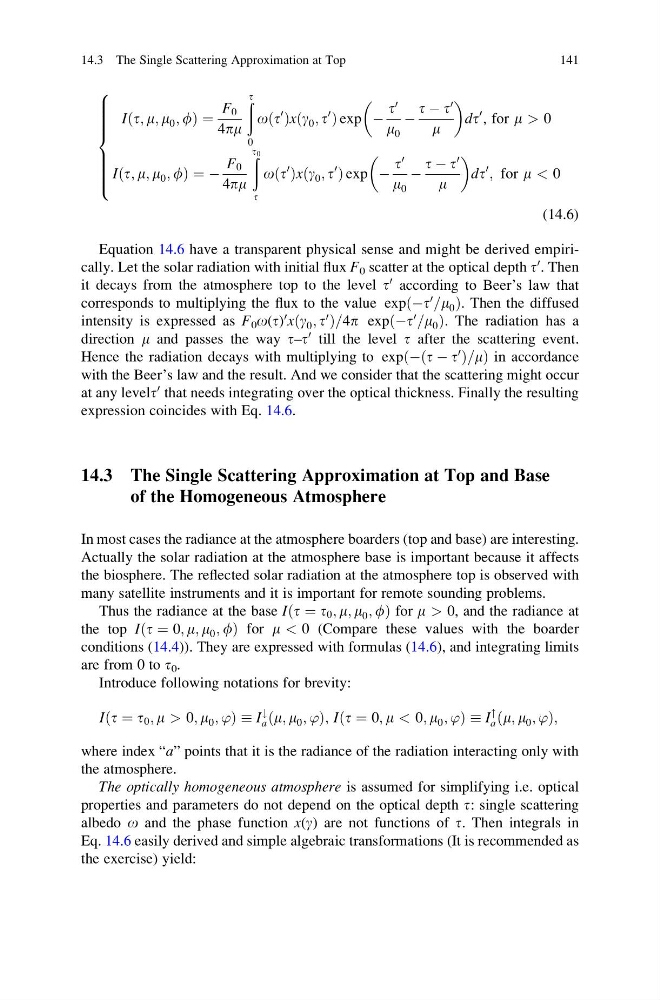
Equation 14.6 have a transparent physical sense and might be derived empirically. Let the solar radiation with initial flux F 0 scatter at the optical depth t
0 . Then
it decays from the atmosphere top to the level t
0 according to Beer’s law that
corresponds to multiplying the flux to the value expðÀt
0
=m 0 Þ. Then the diffused
intensity is expressed as F 0 o(t)
0 xðg 0 ; t
0
Þ=4p expðÀt
0
=m 0 Þ. The radiation has a
direction m and passes the way t–t
0 till the level t after the scattering event.
Hence the radiation decays with multiplying to expðÀðt À t
0
Þ=mÞ in accordance
with the Beer’s law and the result. And we consider that the scattering might occur
at any levelt
0 that needs integrating over the optical thickness. Finally the resulting
expression coincides with Eq. 14.6.
14.3 The Single Scattering Approximation at Top and Base
of the Homogeneous Atmosphere
In most cases the radiance at the atmosphere boarders (top and base) are interesting.
Actually the solar radiation at the atmosphere base is important because it affects
the biosphere. The reflected solar radiation at the atmosphere top is observed with
many satellite instruments and it is important for remote sounding problems.
Thus the radiance at the base Iðt ¼ t 0 ; m; m 0 ; fÞ for m > 0, and the radiance at
the top Iðt ¼ 0; m; m 0 ; fÞ for m < 0 (Compare these values with the boarder
conditions (14.4)). They are expressed with formulas (14.6), and integrating limits
are from 0 to t 0 .
Introduce following notations for brevity:
Iðt ¼ t 0 ; m > 0; m 0 ; ’Þ I
#
a ðm; m 0 ; ’Þ; Iðt ¼ 0; m < 0; m 0 ; ’Þ I
"
a ðm; m 0 ; ’Þ;
where index “a” points that it is the radiance of the radiation interacting only with
the atmosphere.
The optically homogeneous atmosphere is assumed for simplifying i.e. optical
properties and parameters do not depend on the optical depth t: single scattering
albedo o and the phase function x(g) are not functions of t. Then integrals in
Eq. 14.6 easily derived and simple algebraic transformations (It is recommended as
the exercise) yield:
14.3 The Single Scattering Approximation at Top
141
F 0
4pm
ð t
0
oðt
0
Þxðg 0 ; t
0
Þ exp À
t
0
m 0
À
t À t
0
m
dt
0 , for m > 0
Iðt; m; m 0 ; fÞ ¼ À
F 0
4pm
ð
t0
t
oðt
0
Þxðg 0 ; t
0
Þ exp À
t
0
m 0
À
t À t
0
m
dt
0
; for m < 0
8
> > > > > > <
> > > > > > :
(14.6)
Equation 14.6 have a transparent physical sense and might be derived empirically. Let the solar radiation with initial flux F 0 scatter at the optical depth t
0 . Then
it decays from the atmosphere top to the level t
0 according to Beer’s law that
corresponds to multiplying the flux to the value expðÀt
0
=m 0 Þ. Then the diffused
intensity is expressed as F 0 o(t)
0 xðg 0 ; t
0
Þ=4p expðÀt
0
=m 0 Þ. The radiation has a
direction m and passes the way t–t
0 till the level t after the scattering event.
Hence the radiation decays with multiplying to expðÀðt À t
0
Þ=mÞ in accordance
with the Beer’s law and the result. And we consider that the scattering might occur
at any levelt
0 that needs integrating over the optical thickness. Finally the resulting
expression coincides with Eq. 14.6.
14.3 The Single Scattering Approximation at Top and Base
of the Homogeneous Atmosphere
In most cases the radiance at the atmosphere boarders (top and base) are interesting.
Actually the solar radiation at the atmosphere base is important because it affects
the biosphere. The reflected solar radiation at the atmosphere top is observed with
many satellite instruments and it is important for remote sounding problems.
Thus the radiance at the base Iðt ¼ t 0 ; m; m 0 ; fÞ for m > 0, and the radiance at
the top Iðt ¼ 0; m; m 0 ; fÞ for m < 0 (Compare these values with the boarder
conditions (14.4)). They are expressed with formulas (14.6), and integrating limits
are from 0 to t 0 .
Introduce following notations for brevity:
Iðt ¼ t 0 ; m > 0; m 0 ; ’Þ I
#
a ðm; m 0 ; ’Þ; Iðt ¼ 0; m < 0; m 0 ; ’Þ I
"
a ðm; m 0 ; ’Þ;
where index “a” points that it is the radiance of the radiation interacting only with
the atmosphere.
The optically homogeneous atmosphere is assumed for simplifying i.e. optical
properties and parameters do not depend on the optical depth t: single scattering
albedo o and the phase function x(g) are not functions of t. Then integrals in
Eq. 14.6 easily derived and simple algebraic transformations (It is recommended as
the exercise) yield:
14.3 The Single Scattering Approximation at Top
141