

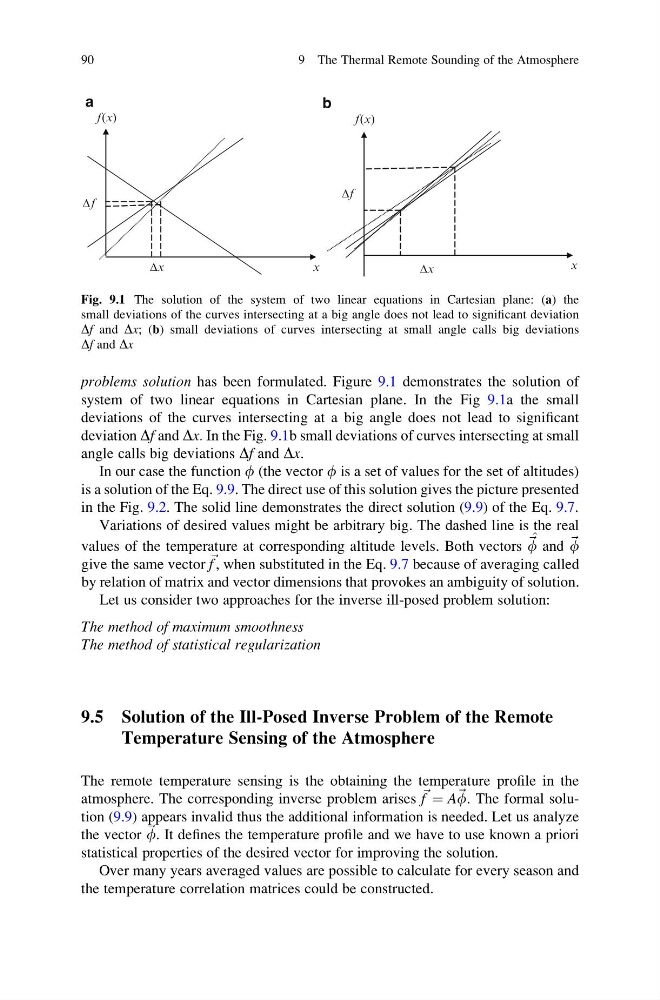
problems solution has been formulated. Figure 9.1 demonstrates the solution of
system of two linear equations in Cartesian plane. In the Fig 9.1a the small
deviations of the curves intersecting at a big angle does not lead to significant
deviation Df and Dx. In the Fig. 9.1b small deviations of curves intersecting at small
angle calls big deviations Df and Dx.
In our case the function f (the vector f is a set of values for the set of altitudes)
is a solution of the Eq. 9.9. The direct use of this solution gives the picture presented
in the Fig. 9.2. The solid line demonstrates the direct solution (9.9) of the Eq. 9.7.
Variations of desired values might be arbitrary big. The dashed line is the real
values of the temperature at corresponding altitude levels. Both vectors
^
~ f and ~ f
give the same vector ~ f , when substituted in the Eq. 9.7 because of averaging called
by relation of matrix and vector dimensions that provokes an ambiguity of solution.
Let us consider two approaches for the inverse ill-posed problem solution:
The method of maximum smoothness
The method of statistical regularization
9.5 Solution of the Ill-Posed Inverse Problem of the Remote
Temperature Sensing of the Atmosphere
The remote temperature sensing is the obtaining the temperature profile in the
atmosphere. The corresponding inverse problem arises ~ f ¼ A ~ f. The formal solution (9.9) appears invalid thus the additional information is needed. Let us analyze
the vector ~ f. It defines the temperature profile and we have to use known a priori
statistical properties of the desired vector for improving the solution.
Over many years averaged values are possible to calculate for every season and
the temperature correlation matrices could be constructed.
f(x)
f(x)
x
x
Dx
Df
Df
Dx
a
b
Fig. 9.1 The solution of the system of two linear equations in Cartesian plane: (a) the
small deviations of the curves intersecting at a big angle does not lead to significant deviation
Df and Dx; (b) small deviations of curves intersecting at small angle calls big deviations
Df and Dx
90
9 The Thermal Remote Sounding of the Atmosphere
system of two linear equations in Cartesian plane. In the Fig 9.1a the small
deviations of the curves intersecting at a big angle does not lead to significant
deviation Df and Dx. In the Fig. 9.1b small deviations of curves intersecting at small
angle calls big deviations Df and Dx.
In our case the function f (the vector f is a set of values for the set of altitudes)
is a solution of the Eq. 9.9. The direct use of this solution gives the picture presented
in the Fig. 9.2. The solid line demonstrates the direct solution (9.9) of the Eq. 9.7.
Variations of desired values might be arbitrary big. The dashed line is the real
values of the temperature at corresponding altitude levels. Both vectors
^
~ f and ~ f
give the same vector ~ f , when substituted in the Eq. 9.7 because of averaging called
by relation of matrix and vector dimensions that provokes an ambiguity of solution.
Let us consider two approaches for the inverse ill-posed problem solution:
The method of maximum smoothness
The method of statistical regularization
9.5 Solution of the Ill-Posed Inverse Problem of the Remote
Temperature Sensing of the Atmosphere
The remote temperature sensing is the obtaining the temperature profile in the
atmosphere. The corresponding inverse problem arises ~ f ¼ A ~ f. The formal solution (9.9) appears invalid thus the additional information is needed. Let us analyze
the vector ~ f. It defines the temperature profile and we have to use known a priori
statistical properties of the desired vector for improving the solution.
Over many years averaged values are possible to calculate for every season and
the temperature correlation matrices could be constructed.
f(x)
f(x)
x
x
Dx
Df
Df
Dx
a
b
Fig. 9.1 The solution of the system of two linear equations in Cartesian plane: (a) the
small deviations of the curves intersecting at a big angle does not lead to significant deviation
Df and Dx; (b) small deviations of curves intersecting at small angle calls big deviations
Df and Dx
90
9 The Thermal Remote Sounding of the Atmosphere