

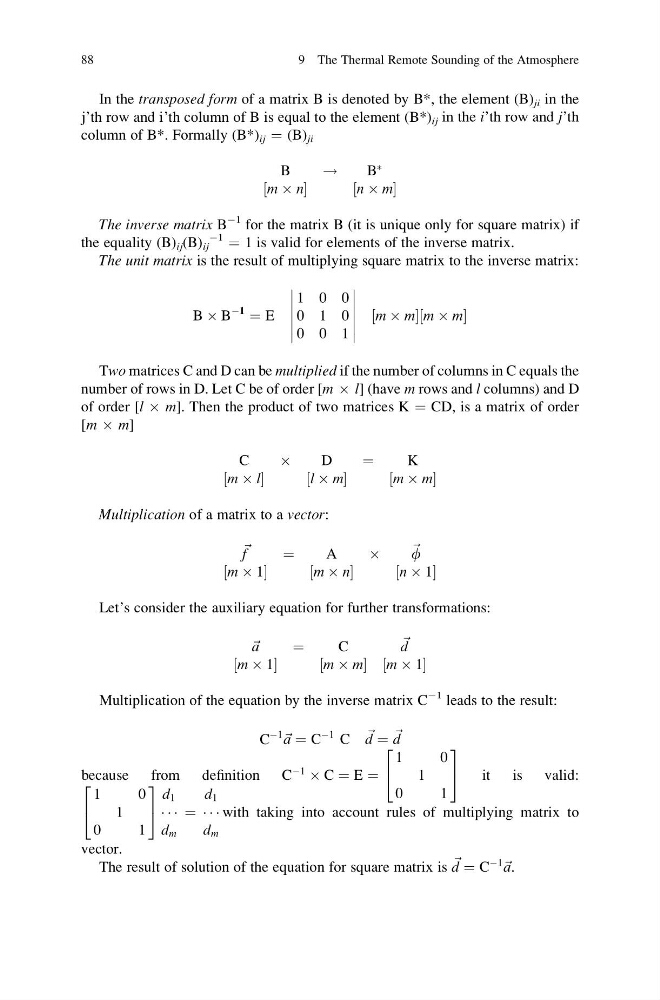
In the transposed form of a matrix B is denoted by B*, the element (B) ji in the
j’th row and i’th column of B is equal to the element (B*) ij in the i’th row and j’th
column of B*. Formally (B*) ij ¼ (B) ji
B
!
B
Ã
½m  n
n  m
½
The inverse matrix B
À1 for the matrix B (it is unique only for square matrix) if
the equality (B) ij (B) ij
À1 ¼ 1 is valid for elements of the inverse matrix.
The unit matrix is the result of multiplying square matrix to the inverse matrix:
B Â B
À1
¼ E
1 0 0
0 1 0
0 0 1
m  m
½
m  m
½
Two matrices C and D can be multiplied if the number of columns in C equals the
number of rows in D. Let C be of order [m  l] (have m rows and l columns) and D
of order [l  m]. Then the product of two matrices K ¼ CD, is a matrix of order
[m  m]
C
Â
D
¼
K
m  l
½
l  m
½
m  m
½
Multiplication of a matrix to a vector:
~ f
¼
A
Â
~ f
m  1
½
m  n
½
n  1
½
Let’s consider the auxiliary equation for further transformations:
~ a
¼
C
~
d
m  1
½
m  m
½
m  1
½
Multiplication of the equation by the inverse matrix C
À1 leads to the result:
C
À1
~ a ¼ C
À1 C ~
d ¼ ~
d
because from definition C
À1
 C ¼ E ¼
1
0
1
0
1
2
4
3
5 it is valid:
1
0
1
0
1
2
4
3
5
d 1
Á Á Á
d m
¼
d 1
Á Á Á
d m
with taking into account rules of multiplying matrix to
vector.
The result of solution of the equation for square matrix is ~
d ¼ C
À1
~ a.
88
9 The Thermal Remote Sounding of the Atmosphere
j’th row and i’th column of B is equal to the element (B*) ij in the i’th row and j’th
column of B*. Formally (B*) ij ¼ (B) ji
B
!
B
Ã
½m  n
n  m
½
The inverse matrix B
À1 for the matrix B (it is unique only for square matrix) if
the equality (B) ij (B) ij
À1 ¼ 1 is valid for elements of the inverse matrix.
The unit matrix is the result of multiplying square matrix to the inverse matrix:
B Â B
À1
¼ E
1 0 0
0 1 0
0 0 1
m  m
½
m  m
½
Two matrices C and D can be multiplied if the number of columns in C equals the
number of rows in D. Let C be of order [m  l] (have m rows and l columns) and D
of order [l  m]. Then the product of two matrices K ¼ CD, is a matrix of order
[m  m]
C
Â
D
¼
K
m  l
½
l  m
½
m  m
½
Multiplication of a matrix to a vector:
~ f
¼
A
Â
~ f
m  1
½
m  n
½
n  1
½
Let’s consider the auxiliary equation for further transformations:
~ a
¼
C
~
d
m  1
½
m  m
½
m  1
½
Multiplication of the equation by the inverse matrix C
À1 leads to the result:
C
À1
~ a ¼ C
À1 C ~
d ¼ ~
d
because from definition C
À1
 C ¼ E ¼
1
0
1
0
1
2
4
3
5 it is valid:
1
0
1
0
1
2
4
3
5
d 1
Á Á Á
d m
¼
d 1
Á Á Á
d m
with taking into account rules of multiplying matrix to
vector.
The result of solution of the equation for square matrix is ~
d ¼ C
À1
~ a.
88
9 The Thermal Remote Sounding of the Atmosphere