

DJ n
"
¼
X N
0
DT i Kðn; x i Þ; N ¼ 50
(9.6)
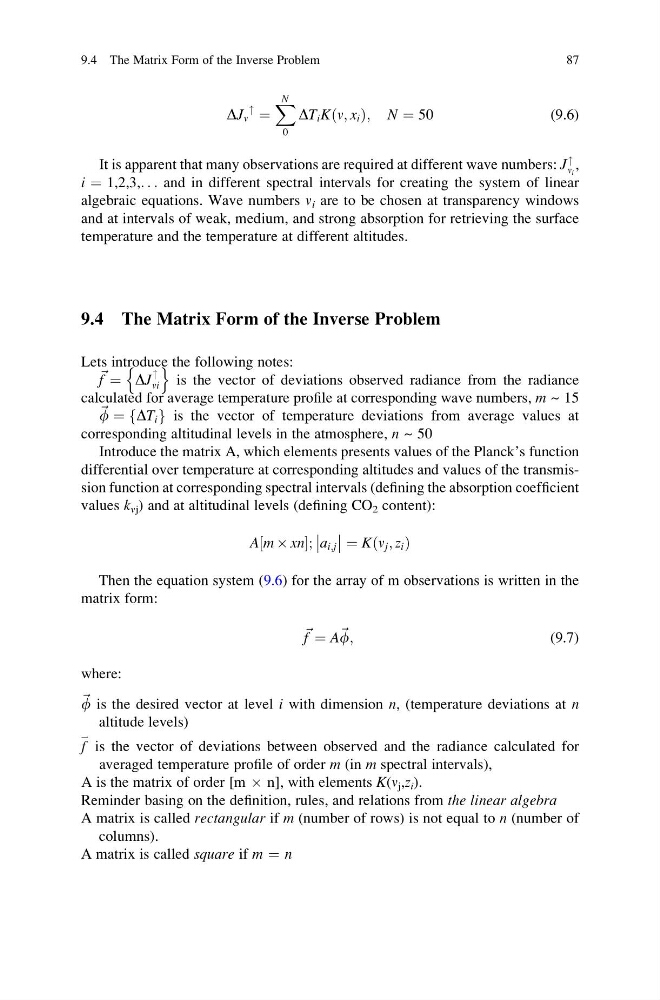
It is apparent that many observations are required at different wave numbers: J
"
n i
,
i ¼ 1,2,3,. . . and in different spectral intervals for creating the system of linear
algebraic equations. Wave numbers n i are to be chosen at transparency windows
and at intervals of weak, medium, and strong absorption for retrieving the surface
temperature and the temperature at different altitudes.
9.4 The Matrix Form of the Inverse Problem
Lets introduce the following notes:
~ f ¼ DJ
"
ni
n
o
is the vector of deviations observed radiance from the radiance
calculated for average temperature profile at corresponding wave numbers, m ~ 15
~ f ¼ DT i
f g is the vector of temperature deviations from average values at
corresponding altitudinal levels in the atmosphere, n ~ 50
Introduce the matrix A, which elements presents values of the Planck’s function
differential over temperature at corresponding altitudes and values of the transmission function at corresponding spectral intervals (defining the absorption coefficient
values k nj ) and at altitudinal levels (defining CO 2 content):
A m  xn
½
; a i;j
¼ Kðn j ; z i Þ
Then the equation system (9.6) for the array of m observations is written in the
matrix form:
~ f ¼ A ~ f;
(9.7)
where:
~ f is the desired vector at level i with dimension n, (temperature deviations at n
altitude levels)
f
*
is the vector of deviations between observed and the radiance calculated for
averaged temperature profile of order m (in m spectral intervals),
A is the matrix of order [m  n], with elements K(n j ,z i ).
Reminder basing on the definition, rules, and relations from the linear algebra
A matrix is called rectangular if m (number of rows) is not equal to n (number of
columns).
A matrix is called square if m ¼ n
9.4 The Matrix Form of the Inverse Problem
87
"
¼
X N
0
DT i Kðn; x i Þ; N ¼ 50
(9.6)
It is apparent that many observations are required at different wave numbers: J
"
n i
,
i ¼ 1,2,3,. . . and in different spectral intervals for creating the system of linear
algebraic equations. Wave numbers n i are to be chosen at transparency windows
and at intervals of weak, medium, and strong absorption for retrieving the surface
temperature and the temperature at different altitudes.
9.4 The Matrix Form of the Inverse Problem
Lets introduce the following notes:
~ f ¼ DJ
"
ni
n
o
is the vector of deviations observed radiance from the radiance
calculated for average temperature profile at corresponding wave numbers, m ~ 15
~ f ¼ DT i
f g is the vector of temperature deviations from average values at
corresponding altitudinal levels in the atmosphere, n ~ 50
Introduce the matrix A, which elements presents values of the Planck’s function
differential over temperature at corresponding altitudes and values of the transmission function at corresponding spectral intervals (defining the absorption coefficient
values k nj ) and at altitudinal levels (defining CO 2 content):
A m  xn
½
; a i;j
¼ Kðn j ; z i Þ
Then the equation system (9.6) for the array of m observations is written in the
matrix form:
~ f ¼ A ~ f;
(9.7)
where:
~ f is the desired vector at level i with dimension n, (temperature deviations at n
altitude levels)
f
*
is the vector of deviations between observed and the radiance calculated for
averaged temperature profile of order m (in m spectral intervals),
A is the matrix of order [m  n], with elements K(n j ,z i ).
Reminder basing on the definition, rules, and relations from the linear algebra
A matrix is called rectangular if m (number of rows) is not equal to n (number of
columns).
A matrix is called square if m ¼ n
9.4 The Matrix Form of the Inverse Problem
87