

13.3 VHF High Resolution Radar
13.3.1 System Overview
VHF radars can have wider bandwidths than HF radars because of their higher
operating frequencies. At these higher frequencies the range is normally reduced,
so a typical VHF system operating at 150 MHz, with 1.5 MHz bandwidth and
power output of 100 mW, has a maximum range of 4 km and spatial resolution in
the range direction of typically 100 m. With azimuthal resolution of about 5°, the
pixels are thus 100 9 100 m at a range of 1 km. These spatial parameters are ideal
for mapping currents in smaller areas, such as reef lagoons and channels.
As examples, the VHF WERA and SeaSonde systems operate at 40–50 MHz,
using phase and amplitude, respectively, to achieve the direction-finding
requirement. The PortMap system operates at 60–180 MHz and uses a hybrid
analysis of beam forming and phase direction-finding to determine the azimuth of
incoming echo energy. These systems are all relatively compact, and increasingly
so at higher frequencies, making them suitable for deployment where space is
limited. For applications to observe flow in and around offshore coral reefs, the
radar stations need to be mounted on an atoll or manmade platform.
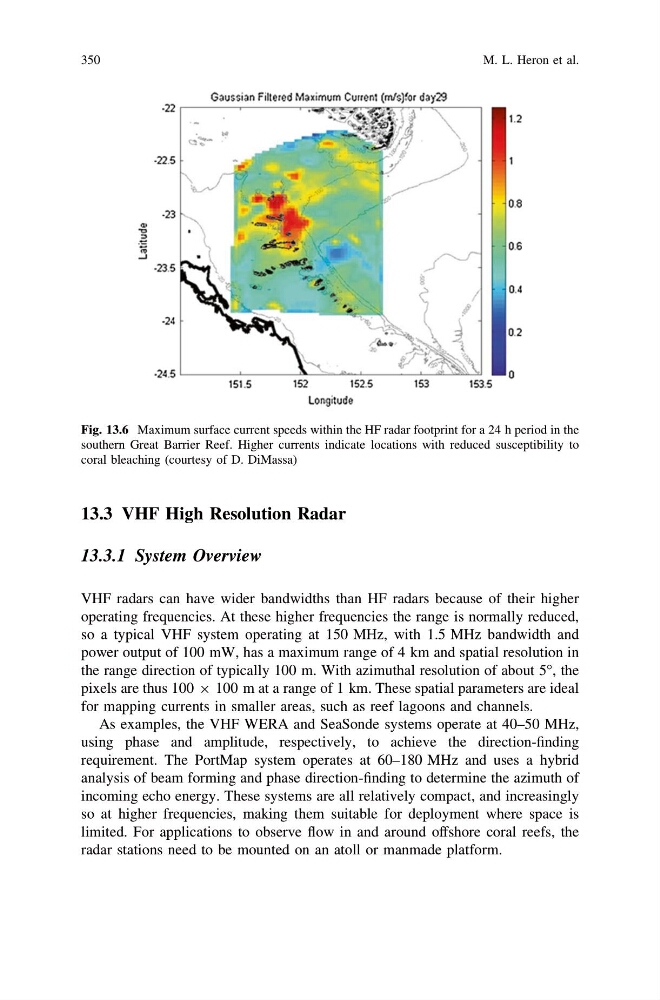
Fig. 13.6 Maximum surface current speeds within the HF radar footprint for a 24 h period in the
southern Great Barrier Reef. Higher currents indicate locations with reduced susceptibility to
coral bleaching (courtesy of D. DiMassa)
350
M. L. Heron et al.
13.3.1 System Overview
VHF radars can have wider bandwidths than HF radars because of their higher
operating frequencies. At these higher frequencies the range is normally reduced,
so a typical VHF system operating at 150 MHz, with 1.5 MHz bandwidth and
power output of 100 mW, has a maximum range of 4 km and spatial resolution in
the range direction of typically 100 m. With azimuthal resolution of about 5°, the
pixels are thus 100 9 100 m at a range of 1 km. These spatial parameters are ideal
for mapping currents in smaller areas, such as reef lagoons and channels.
As examples, the VHF WERA and SeaSonde systems operate at 40–50 MHz,
using phase and amplitude, respectively, to achieve the direction-finding
requirement. The PortMap system operates at 60–180 MHz and uses a hybrid
analysis of beam forming and phase direction-finding to determine the azimuth of
incoming echo energy. These systems are all relatively compact, and increasingly
so at higher frequencies, making them suitable for deployment where space is
limited. For applications to observe flow in and around offshore coral reefs, the
radar stations need to be mounted on an atoll or manmade platform.
Fig. 13.6 Maximum surface current speeds within the HF radar footprint for a 24 h period in the
southern Great Barrier Reef. Higher currents indicate locations with reduced susceptibility to
coral bleaching (courtesy of D. DiMassa)
350
M. L. Heron et al.