

Turbulent kinetic energy and coral bleaching One direct application of HF
ocean radar data to management challenges in coral reefs is the evaluation of
turbulent kinetic energy, and its relationship to coral bleaching. Most coral
bleaching occurs in conditions of low wind, current and waves, when the water
column becomes stratified and the upper layer temperature becomes critical due to
insolation. In a classic paper, Simpson and Hunter (1974) demonstrated that water
speed and water depth define a critical condition where the water column becomes
mixed by turbulent kinetic energy rather than remaining stratified. This has been
utilized by DiMassa et al. (2010) to define zones within an HF radar footprint that
may be classified as being mixed by turbulent kinetic energy during a 24 h period.
Zones classified in this way retain a mixing characteristic irrespective of wind or
waves, and are unlikely to suffer coral bleaching by a warm stratified layer forming
in the upper part of the water column. The relative susceptibility to coral bleaching
is a useful input to planning and management of coral reefs. The concept is
illustrated in Fig. 13.6 by a map of the maximum surface current speed during a
24 h period. DiMassa et al. (2011) extend this analysis by applying the SimpsonHunter criterion to also map the vertically mixed zones, providing further information on localized mixing regimes.
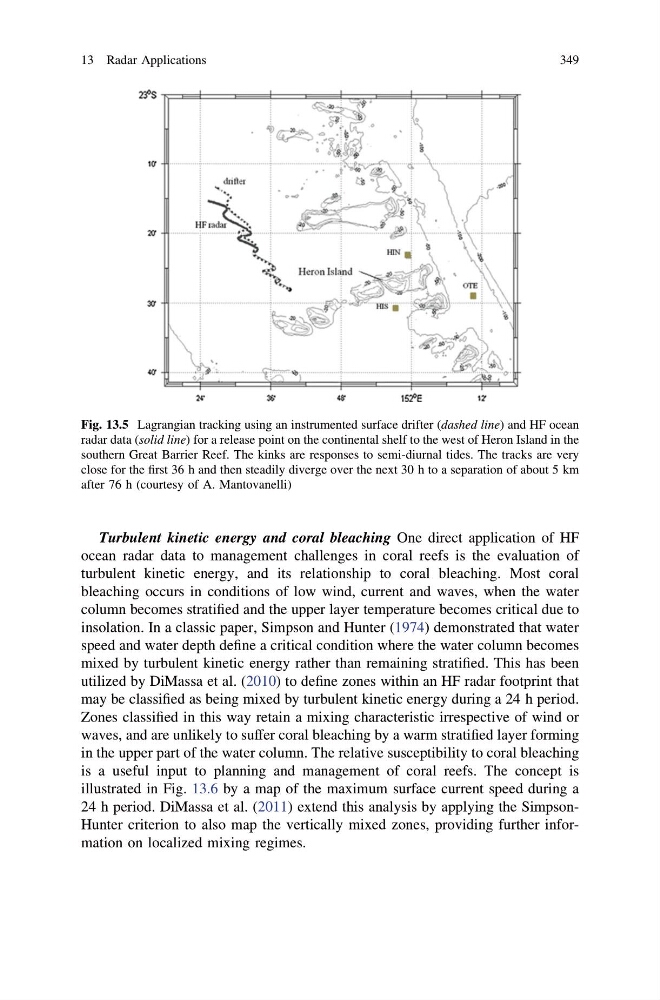
Fig. 13.5 Lagrangian tracking using an instrumented surface drifter (dashed line) and HF ocean
radar data (solid line) for a release point on the continental shelf to the west of Heron Island in the
southern Great Barrier Reef. The kinks are responses to semi-diurnal tides. The tracks are very
close for the first 36 h and then steadily diverge over the next 30 h to a separation of about 5 km
after 76 h (courtesy of A. Mantovanelli)
13 Radar Applications
349
ocean radar data to management challenges in coral reefs is the evaluation of
turbulent kinetic energy, and its relationship to coral bleaching. Most coral
bleaching occurs in conditions of low wind, current and waves, when the water
column becomes stratified and the upper layer temperature becomes critical due to
insolation. In a classic paper, Simpson and Hunter (1974) demonstrated that water
speed and water depth define a critical condition where the water column becomes
mixed by turbulent kinetic energy rather than remaining stratified. This has been
utilized by DiMassa et al. (2010) to define zones within an HF radar footprint that
may be classified as being mixed by turbulent kinetic energy during a 24 h period.
Zones classified in this way retain a mixing characteristic irrespective of wind or
waves, and are unlikely to suffer coral bleaching by a warm stratified layer forming
in the upper part of the water column. The relative susceptibility to coral bleaching
is a useful input to planning and management of coral reefs. The concept is
illustrated in Fig. 13.6 by a map of the maximum surface current speed during a
24 h period. DiMassa et al. (2011) extend this analysis by applying the SimpsonHunter criterion to also map the vertically mixed zones, providing further information on localized mixing regimes.
Fig. 13.5 Lagrangian tracking using an instrumented surface drifter (dashed line) and HF ocean
radar data (solid line) for a release point on the continental shelf to the west of Heron Island in the
southern Great Barrier Reef. The kinks are responses to semi-diurnal tides. The tracks are very
close for the first 36 h and then steadily diverge over the next 30 h to a separation of about 5 km
after 76 h (courtesy of A. Mantovanelli)
13 Radar Applications
349