

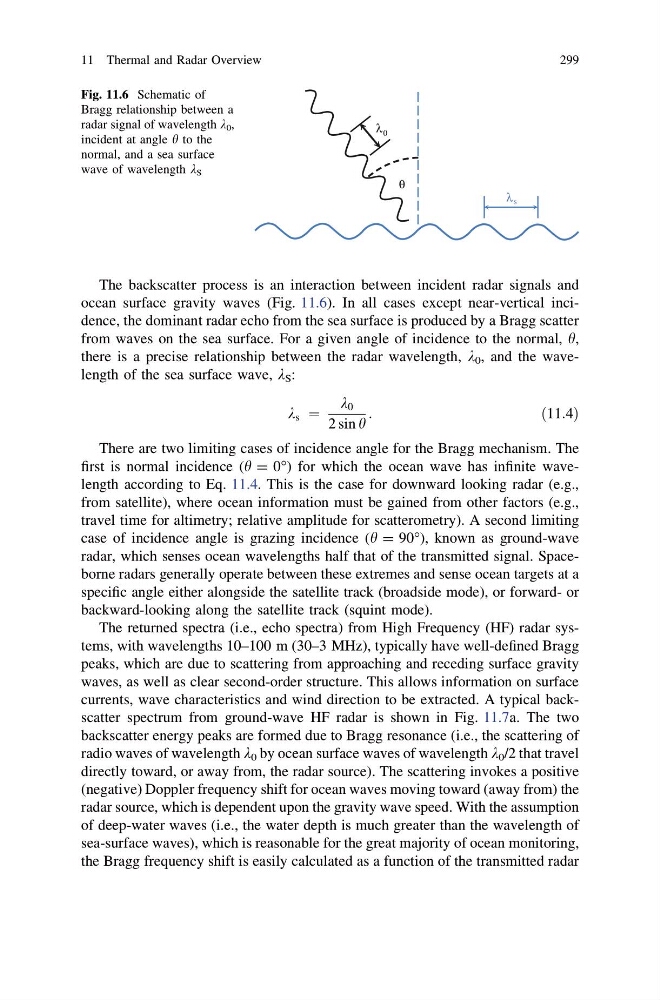
The backscatter process is an interaction between incident radar signals and
ocean surface gravity waves (Fig. 11.6). In all cases except near-vertical incidence, the dominant radar echo from the sea surface is produced by a Bragg scatter
from waves on the sea surface. For a given angle of incidence to the normal, h,
there is a precise relationship between the radar wavelength, k 0 , and the wavelength of the sea surface wave, k S :
k s ¼
k 0
2 sin h
:
ð11:4Þ
There are two limiting cases of incidence angle for the Bragg mechanism. The
first is normal incidence (h = 0°) for which the ocean wave has infinite wavelength according to Eq. 11.4. This is the case for downward looking radar (e.g.,
from satellite), where ocean information must be gained from other factors (e.g.,
travel time for altimetry; relative amplitude for scatterometry). A second limiting
case of incidence angle is grazing incidence (h = 90°), known as ground-wave
radar, which senses ocean wavelengths half that of the transmitted signal. Spaceborne radars generally operate between these extremes and sense ocean targets at a
specific angle either alongside the satellite track (broadside mode), or forward- or
backward-looking along the satellite track (squint mode).
The returned spectra (i.e., echo spectra) from High Frequency (HF) radar systems, with wavelengths 10–100 m (30–3 MHz), typically have well-defined Bragg
peaks, which are due to scattering from approaching and receding surface gravity
waves, as well as clear second-order structure. This allows information on surface
currents, wave characteristics and wind direction to be extracted. A typical backscatter spectrum from ground-wave HF radar is shown in Fig. 11.7a. The two
backscatter energy peaks are formed due to Bragg resonance (i.e., the scattering of
radio waves of wavelength k 0 by ocean surface waves of wavelength k 0 /2 that travel
directly toward, or away from, the radar source). The scattering invokes a positive
(negative) Doppler frequency shift for ocean waves moving toward (away from) the
radar source, which is dependent upon the gravity wave speed. With the assumption
of deep-water waves (i.e., the water depth is much greater than the wavelength of
sea-surface waves), which is reasonable for the great majority of ocean monitoring,
the Bragg frequency shift is easily calculated as a function of the transmitted radar
λ s
λ 0
θ
Fig. 11.6 Schematic of
Bragg relationship between a
radar signal of wavelength k 0 ,
incident at angle h to the
normal, and a sea surface
wave of wavelength k S
11 Thermal and Radar Overview
299
ocean surface gravity waves (Fig. 11.6). In all cases except near-vertical incidence, the dominant radar echo from the sea surface is produced by a Bragg scatter
from waves on the sea surface. For a given angle of incidence to the normal, h,
there is a precise relationship between the radar wavelength, k 0 , and the wavelength of the sea surface wave, k S :
k s ¼
k 0
2 sin h
:
ð11:4Þ
There are two limiting cases of incidence angle for the Bragg mechanism. The
first is normal incidence (h = 0°) for which the ocean wave has infinite wavelength according to Eq. 11.4. This is the case for downward looking radar (e.g.,
from satellite), where ocean information must be gained from other factors (e.g.,
travel time for altimetry; relative amplitude for scatterometry). A second limiting
case of incidence angle is grazing incidence (h = 90°), known as ground-wave
radar, which senses ocean wavelengths half that of the transmitted signal. Spaceborne radars generally operate between these extremes and sense ocean targets at a
specific angle either alongside the satellite track (broadside mode), or forward- or
backward-looking along the satellite track (squint mode).
The returned spectra (i.e., echo spectra) from High Frequency (HF) radar systems, with wavelengths 10–100 m (30–3 MHz), typically have well-defined Bragg
peaks, which are due to scattering from approaching and receding surface gravity
waves, as well as clear second-order structure. This allows information on surface
currents, wave characteristics and wind direction to be extracted. A typical backscatter spectrum from ground-wave HF radar is shown in Fig. 11.7a. The two
backscatter energy peaks are formed due to Bragg resonance (i.e., the scattering of
radio waves of wavelength k 0 by ocean surface waves of wavelength k 0 /2 that travel
directly toward, or away from, the radar source). The scattering invokes a positive
(negative) Doppler frequency shift for ocean waves moving toward (away from) the
radar source, which is dependent upon the gravity wave speed. With the assumption
of deep-water waves (i.e., the water depth is much greater than the wavelength of
sea-surface waves), which is reasonable for the great majority of ocean monitoring,
the Bragg frequency shift is easily calculated as a function of the transmitted radar
λ s
λ 0
θ
Fig. 11.6 Schematic of
Bragg relationship between a
radar signal of wavelength k 0 ,
incident at angle h to the
normal, and a sea surface
wave of wavelength k S
11 Thermal and Radar Overview
299