

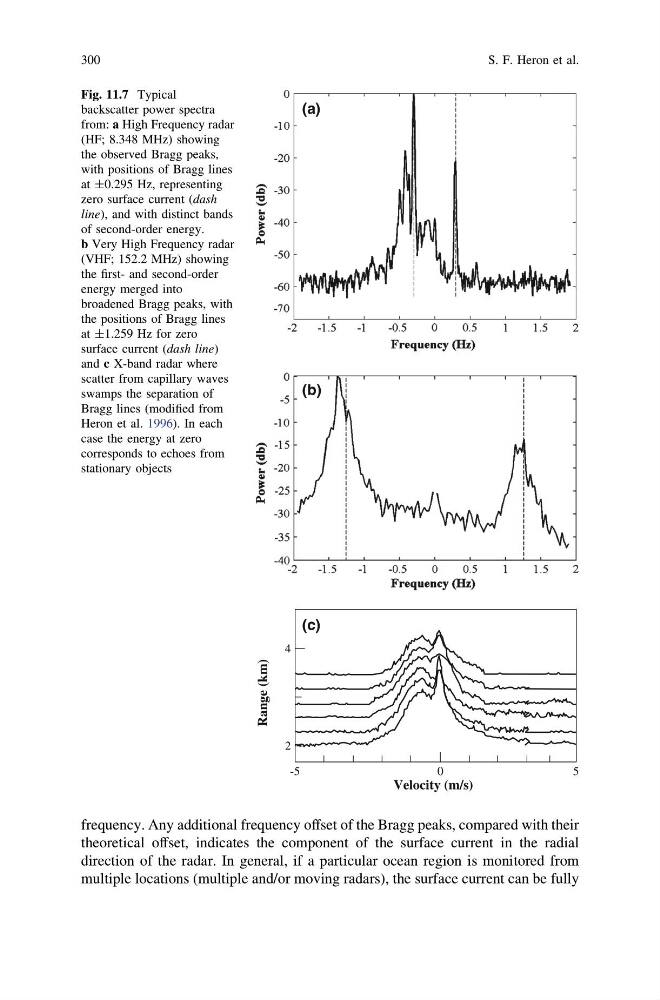
frequency. Any additional frequency offset of the Bragg peaks, compared with their
theoretical offset, indicates the component of the surface current in the radial
direction of the radar. In general, if a particular ocean region is monitored from
multiple locations (multiple and/or moving radars), the surface current can be fully
-5
5
0
2
4
Velocity (m/s)
Range (km)
(a)
(b)
(c)
Fig. 11.7 Typical
backscatter power spectra
from: a High Frequency radar
(HF; 8.348 MHz) showing
the observed Bragg peaks,
with positions of Bragg lines
at ±0.295 Hz, representing
zero surface current (dash
line), and with distinct bands
of second-order energy.
b Very High Frequency radar
(VHF; 152.2 MHz) showing
the first- and second-order
energy merged into
broadened Bragg peaks, with
the positions of Bragg lines
at ±1.259 Hz for zero
surface current (dash line)
and c X-band radar where
scatter from capillary waves
swamps the separation of
Bragg lines (modified from
Heron et al. 1996). In each
case the energy at zero
corresponds to echoes from
stationary objects
300
S. F. Heron et al.
theoretical offset, indicates the component of the surface current in the radial
direction of the radar. In general, if a particular ocean region is monitored from
multiple locations (multiple and/or moving radars), the surface current can be fully
-5
5
0
2
4
Velocity (m/s)
Range (km)
(a)
(b)
(c)
Fig. 11.7 Typical
backscatter power spectra
from: a High Frequency radar
(HF; 8.348 MHz) showing
the observed Bragg peaks,
with positions of Bragg lines
at ±0.295 Hz, representing
zero surface current (dash
line), and with distinct bands
of second-order energy.
b Very High Frequency radar
(VHF; 152.2 MHz) showing
the first- and second-order
energy merged into
broadened Bragg peaks, with
the positions of Bragg lines
at ±1.259 Hz for zero
surface current (dash line)
and c X-band radar where
scatter from capillary waves
swamps the separation of
Bragg lines (modified from
Heron et al. 1996). In each
case the energy at zero
corresponds to echoes from
stationary objects
300
S. F. Heron et al.