

corresponding temperature of the radiating object. For greybodies the emissivity
will scale the energy density given in Eq. 11.1.
There are two notable relationships that are derived from Planck’s Law. The
first of these produces the wavelength at which the peak energy density occurs,
determined by setting the derivative of Eq. 11.1 to zero. For high temperatures,
this results in Wien’s Displacement Law (Atkins 1994):
k max ¼
b
T
ð11:2Þ
where b = 2.898 9 10
-3 m K. This relationship indicates that a radiating body
with temperature of 5,700 K has peak energy at around 500 nm, characteristic of
our ‘‘yellow’’ Sun.
The second relationship derived from Planck’s Law provides the total energy of
radiation. This is obtained by integrating the energy density of Eq. 11.1 over all
wavelengths; the result is dependent only upon temperature (Atkins 1994):
E ¼ rT
4 :
ð11:3Þ
This relationship is commonly known as the Stefan-Boltzmann Law, where
r = 5.67 9 10
-8 W m
-2 K
-4 is the Stefan-Boltzmann constant.
For the purpose of thermal remote sensing, two regions of the electromagnetic
spectrum are employed (it should be noted that the exact boundaries between these
regions are somewhat arbitrary and vary between different applications). The first
region, the infrared, is immediately adjacent to visible light in the electromagnetic
spectrum (the name infrared literally refers to frequencies ‘‘below red’’; Fig. 11.2).
The entirety of this region covers wavelengths from approximately 700 nm to
1 mm (frequencies 400 THz to 300 GHz). Closest to the visible wavelengths, the
sub-region of ‘near infrared’ radiation (700 nm to *2.5 lm) shows similar
application in remote sensing as visible light in that it is reflected by target bodies.
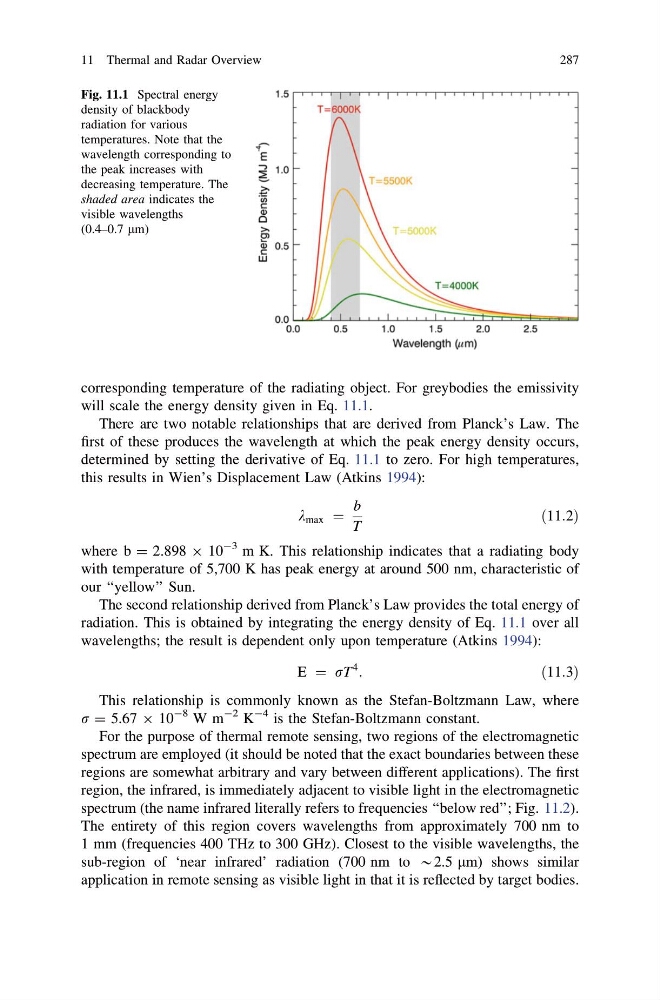
Fig. 11.1 Spectral energy
density of blackbody
radiation for various
temperatures. Note that the
wavelength corresponding to
the peak increases with
decreasing temperature. The
shaded area indicates the
visible wavelengths
(0.4–0.7 lm)
11 Thermal and Radar Overview
287
will scale the energy density given in Eq. 11.1.
There are two notable relationships that are derived from Planck’s Law. The
first of these produces the wavelength at which the peak energy density occurs,
determined by setting the derivative of Eq. 11.1 to zero. For high temperatures,
this results in Wien’s Displacement Law (Atkins 1994):
k max ¼
b
T
ð11:2Þ
where b = 2.898 9 10
-3 m K. This relationship indicates that a radiating body
with temperature of 5,700 K has peak energy at around 500 nm, characteristic of
our ‘‘yellow’’ Sun.
The second relationship derived from Planck’s Law provides the total energy of
radiation. This is obtained by integrating the energy density of Eq. 11.1 over all
wavelengths; the result is dependent only upon temperature (Atkins 1994):
E ¼ rT
4 :
ð11:3Þ
This relationship is commonly known as the Stefan-Boltzmann Law, where
r = 5.67 9 10
-8 W m
-2 K
-4 is the Stefan-Boltzmann constant.
For the purpose of thermal remote sensing, two regions of the electromagnetic
spectrum are employed (it should be noted that the exact boundaries between these
regions are somewhat arbitrary and vary between different applications). The first
region, the infrared, is immediately adjacent to visible light in the electromagnetic
spectrum (the name infrared literally refers to frequencies ‘‘below red’’; Fig. 11.2).
The entirety of this region covers wavelengths from approximately 700 nm to
1 mm (frequencies 400 THz to 300 GHz). Closest to the visible wavelengths, the
sub-region of ‘near infrared’ radiation (700 nm to *2.5 lm) shows similar
application in remote sensing as visible light in that it is reflected by target bodies.
Fig. 11.1 Spectral energy
density of blackbody
radiation for various
temperatures. Note that the
wavelength corresponding to
the peak increases with
decreasing temperature. The
shaded area indicates the
visible wavelengths
(0.4–0.7 lm)
11 Thermal and Radar Overview
287