

11.1 Introduction
The discovery of ‘‘calorific rays’’, now known as infrared radiation, by William
Herschel in 1800 was the first step in the development of the field of thermal
remote sensing. Following the landmark work of James Clerk Maxwell in electromagnetism during the 1860s and 1870s, passive sensing of emitted or reflected
radiation was augmented with the ability to undertake active sensing, wherein
radiation is produced and the backscatter measured. The development of Radio
Detection and Ranging (RADAR) in the lead-up to World War II was significant,
not only in determining the outcome of many battles, but in monitoring atmospheric conditions. From these and many other stepping stones, environmental
remote sensing has developed into an area upon which our society relies every day.
11.2 Thermal Overview
11.2.1 Thermal Physical Principles
Remote sensing of temperature is undertaken by passive detection of radiation
emitted by the source object. All objects with temperature above absolute zero
(i.e., 0 K = -273.15 °C) emit radiation. The efficiency of emission, or emissivity
(e), is defined as the ratio of energy radiated by a body to that of a perfect emitter
(blackbody) at the same temperature and is, therefore, unitless. By this definition,
the emissivity of a blackbody is e = 1. Emissivity can be a function of wavelength,
radiation angle and temperature; however, it is often assumed that the value is
constant for a particular material. It is of note that absorptivity, the efficiency of
radiation absorption, is equal to emissivity. By corollary, a blackbody is an object
that absorbs all radiation incident upon it (i.e., it reflects none), and a whitebody is
an object with e = 0 (i.e., a perfect reflector). Objects with emissivity between
these extremes are termed greybodies (e.g., the emissivity of water is around 0.96).
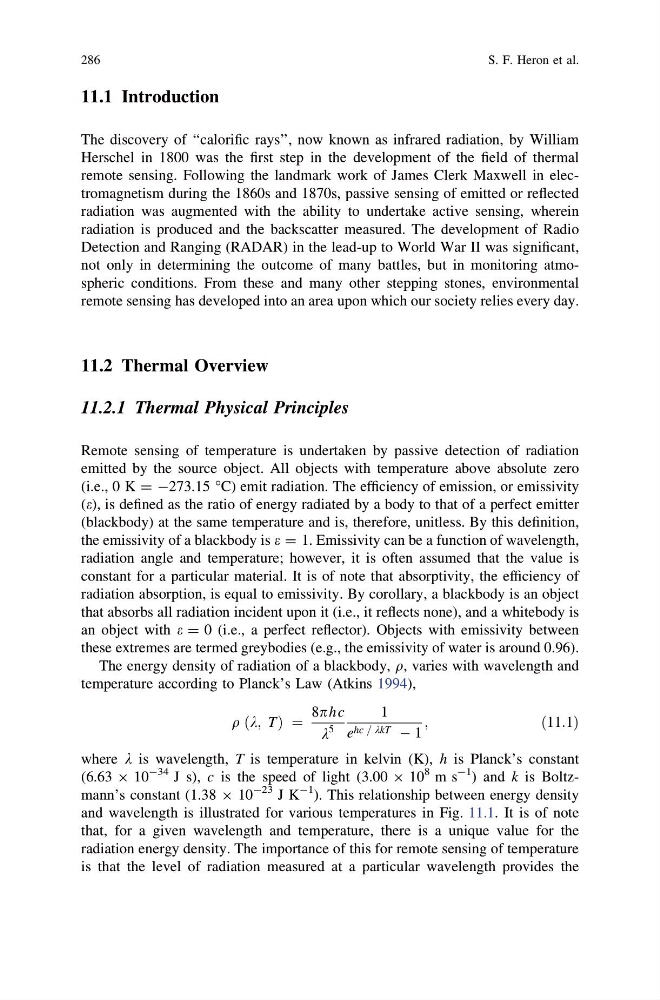
The energy density of radiation of a blackbody, q, varies with wavelength and
temperature according to Planck’s Law (Atkins 1994),
q k; T
ð
Þ ¼
8p hc
k
5
1
e hc = kkT À 1
;
ð11:1Þ
where k is wavelength, T is temperature in kelvin (K), h is Planck’s constant
(6.63 9 10
-34 J s), c is the speed of light (3.00 9 10
8 m s
-1
) and k is Boltzmann’s constant (1.38 9 10
-23 J K
-1 ). This relationship between energy density
and wavelength is illustrated for various temperatures in Fig. 11.1. It is of note
that, for a given wavelength and temperature, there is a unique value for the
radiation energy density. The importance of this for remote sensing of temperature
is that the level of radiation measured at a particular wavelength provides the
286
S. F. Heron et al.
The discovery of ‘‘calorific rays’’, now known as infrared radiation, by William
Herschel in 1800 was the first step in the development of the field of thermal
remote sensing. Following the landmark work of James Clerk Maxwell in electromagnetism during the 1860s and 1870s, passive sensing of emitted or reflected
radiation was augmented with the ability to undertake active sensing, wherein
radiation is produced and the backscatter measured. The development of Radio
Detection and Ranging (RADAR) in the lead-up to World War II was significant,
not only in determining the outcome of many battles, but in monitoring atmospheric conditions. From these and many other stepping stones, environmental
remote sensing has developed into an area upon which our society relies every day.
11.2 Thermal Overview
11.2.1 Thermal Physical Principles
Remote sensing of temperature is undertaken by passive detection of radiation
emitted by the source object. All objects with temperature above absolute zero
(i.e., 0 K = -273.15 °C) emit radiation. The efficiency of emission, or emissivity
(e), is defined as the ratio of energy radiated by a body to that of a perfect emitter
(blackbody) at the same temperature and is, therefore, unitless. By this definition,
the emissivity of a blackbody is e = 1. Emissivity can be a function of wavelength,
radiation angle and temperature; however, it is often assumed that the value is
constant for a particular material. It is of note that absorptivity, the efficiency of
radiation absorption, is equal to emissivity. By corollary, a blackbody is an object
that absorbs all radiation incident upon it (i.e., it reflects none), and a whitebody is
an object with e = 0 (i.e., a perfect reflector). Objects with emissivity between
these extremes are termed greybodies (e.g., the emissivity of water is around 0.96).
The energy density of radiation of a blackbody, q, varies with wavelength and
temperature according to Planck’s Law (Atkins 1994),
q k; T
ð
Þ ¼
8p hc
k
5
1
e hc = kkT À 1
;
ð11:1Þ
where k is wavelength, T is temperature in kelvin (K), h is Planck’s constant
(6.63 9 10
-34 J s), c is the speed of light (3.00 9 10
8 m s
-1
) and k is Boltzmann’s constant (1.38 9 10
-23 J K
-1 ). This relationship between energy density
and wavelength is illustrated for various temperatures in Fig. 11.1. It is of note
that, for a given wavelength and temperature, there is a unique value for the
radiation energy density. The importance of this for remote sensing of temperature
is that the level of radiation measured at a particular wavelength provides the
286
S. F. Heron et al.