

Most SSS systems are used primarily as imaging devices to detect rough features on the seafloor that generate strong scatter and acoustic shadows. The
intensity of backscattering from the seafloor is governed by the backscattering
coefficient, which is a ratio of the intensity of sound scattered per unit area, and the
intensity of the incident plane sound wave. Backscatter intensity is closely related
to differences in seafloor roughness, sound velocity and density across the seafloor.
Side scan data are therefore primarily represented as scaled (usually grey-scale)
images of backscatter intensity. The capacity of SSS to produce accurate sea
bottom topography is a function of the sonar operating frequency, the signal pulse
length, transmitted power, the transmission method and the receiver bandwidth.
The latest systems utilize image correcting techniques to compensate for variations
in the slant range, ship speed and signal amplitude.
New improvements in SSS allow production of high quality, high resolution
seafloor images through use of CHIRP technology, multi-ping technology, extra
long arrays and simultaneous dual frequency systems. A limitation in conventional
SSS is that the sonar has to wait until it receives the echo data from the farthest
range before the cycle can be repeated, which imposes an inherent limitation in the
towing speed. As a solution, CHIRP multi-ping systems use coded pulses. This
coding eliminates cross pulse interference and allows keeping track of the independent pulses. Therefore, these systems can transmit several coded pulses per
cycle, which makes it possible to tow the system at higher speeds without losing
resolution. Or, alternatively, at lower speeds higher resolution is achieved by
illuminating the seafloor with more pulses. A multi-ping system can be operated at
twice the speed of a conventional system without missing data and also has twice
the data density for equivalent tow speed. In such systems the operator can select
between High Definition Mode (HDM) or High Speed Mode (HSM) with towing
speeds up to 14 knots. Modern systems also have the ability to simultaneously use
two frequencies: a low frequency (300 kHz) to enhance range, and a high frequency (900 kHz) to enhance resolution (as much as 1 cm resolution across track).
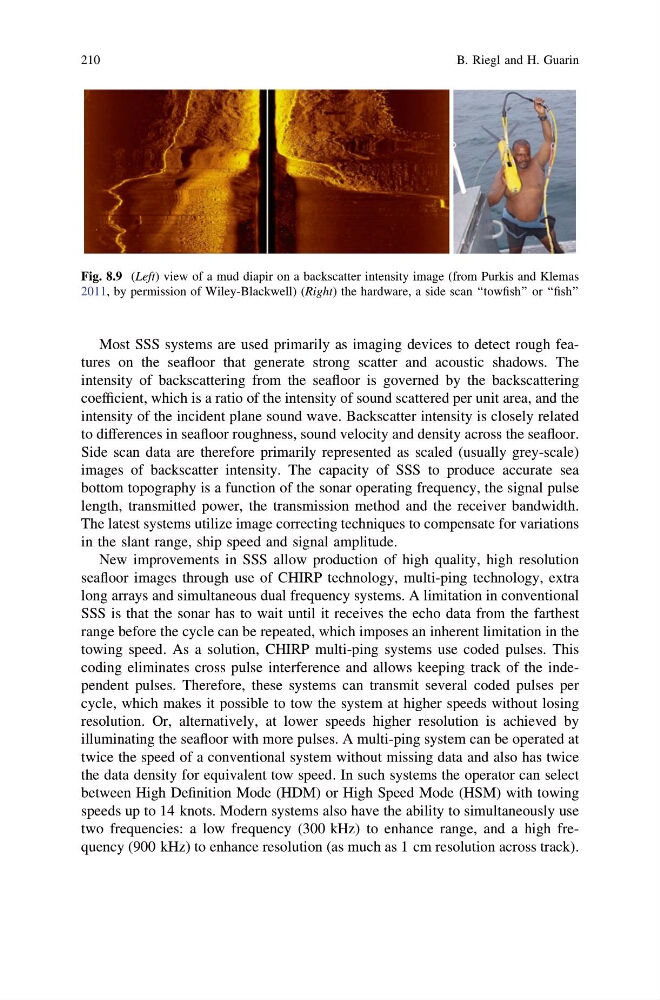
Fig. 8.9 (Left) view of a mud diapir on a backscatter intensity image (from Purkis and Klemas
2011, by permission of Wiley-Blackwell) (Right) the hardware, a side scan ‘‘towfish’’ or ‘‘fish’’
210
B. Riegl and H. Guarin
intensity of backscattering from the seafloor is governed by the backscattering
coefficient, which is a ratio of the intensity of sound scattered per unit area, and the
intensity of the incident plane sound wave. Backscatter intensity is closely related
to differences in seafloor roughness, sound velocity and density across the seafloor.
Side scan data are therefore primarily represented as scaled (usually grey-scale)
images of backscatter intensity. The capacity of SSS to produce accurate sea
bottom topography is a function of the sonar operating frequency, the signal pulse
length, transmitted power, the transmission method and the receiver bandwidth.
The latest systems utilize image correcting techniques to compensate for variations
in the slant range, ship speed and signal amplitude.
New improvements in SSS allow production of high quality, high resolution
seafloor images through use of CHIRP technology, multi-ping technology, extra
long arrays and simultaneous dual frequency systems. A limitation in conventional
SSS is that the sonar has to wait until it receives the echo data from the farthest
range before the cycle can be repeated, which imposes an inherent limitation in the
towing speed. As a solution, CHIRP multi-ping systems use coded pulses. This
coding eliminates cross pulse interference and allows keeping track of the independent pulses. Therefore, these systems can transmit several coded pulses per
cycle, which makes it possible to tow the system at higher speeds without losing
resolution. Or, alternatively, at lower speeds higher resolution is achieved by
illuminating the seafloor with more pulses. A multi-ping system can be operated at
twice the speed of a conventional system without missing data and also has twice
the data density for equivalent tow speed. In such systems the operator can select
between High Definition Mode (HDM) or High Speed Mode (HSM) with towing
speeds up to 14 knots. Modern systems also have the ability to simultaneously use
two frequencies: a low frequency (300 kHz) to enhance range, and a high frequency (900 kHz) to enhance resolution (as much as 1 cm resolution across track).
Fig. 8.9 (Left) view of a mud diapir on a backscatter intensity image (from Purkis and Klemas
2011, by permission of Wiley-Blackwell) (Right) the hardware, a side scan ‘‘towfish’’ or ‘‘fish’’
210
B. Riegl and H. Guarin