

8.3.3 Multi-Beam SONAR
Multi-beam SONAR systems (MBS) are essentially an extension of single-beam
systems that use an array of emitters (either a physical array or a virtual array
created by beam-forming) to generate a multitude of raypaths from several or
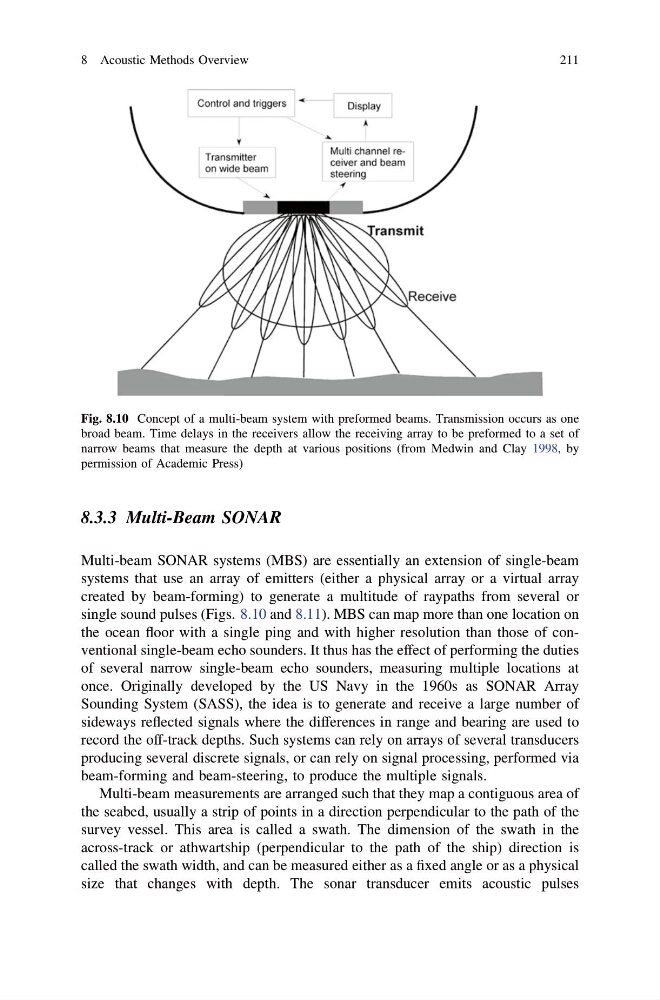
single sound pulses (Figs. 8.10 and 8.11). MBS can map more than one location on
the ocean floor with a single ping and with higher resolution than those of conventional single-beam echo sounders. It thus has the effect of performing the duties
of several narrow single-beam echo sounders, measuring multiple locations at
once. Originally developed by the US Navy in the 1960s as SONAR Array
Sounding System (SASS), the idea is to generate and receive a large number of
sideways reflected signals where the differences in range and bearing are used to
record the off-track depths. Such systems can rely on arrays of several transducers
producing several discrete signals, or can rely on signal processing, performed via
beam-forming and beam-steering, to produce the multiple signals.
Multi-beam measurements are arranged such that they map a contiguous area of
the seabed, usually a strip of points in a direction perpendicular to the path of the
survey vessel. This area is called a swath. The dimension of the swath in the
across-track or athwartship (perpendicular to the path of the ship) direction is
called the swath width, and can be measured either as a fixed angle or as a physical
size that changes with depth. The sonar transducer emits acoustic pulses
Fig. 8.10 Concept of a multi-beam system with preformed beams. Transmission occurs as one
broad beam. Time delays in the receivers allow the receiving array to be preformed to a set of
narrow beams that measure the depth at various positions (from Medwin and Clay 1998, by
permission of Academic Press)
8 Acoustic Methods Overview
211
Multi-beam SONAR systems (MBS) are essentially an extension of single-beam
systems that use an array of emitters (either a physical array or a virtual array
created by beam-forming) to generate a multitude of raypaths from several or
single sound pulses (Figs. 8.10 and 8.11). MBS can map more than one location on
the ocean floor with a single ping and with higher resolution than those of conventional single-beam echo sounders. It thus has the effect of performing the duties
of several narrow single-beam echo sounders, measuring multiple locations at
once. Originally developed by the US Navy in the 1960s as SONAR Array
Sounding System (SASS), the idea is to generate and receive a large number of
sideways reflected signals where the differences in range and bearing are used to
record the off-track depths. Such systems can rely on arrays of several transducers
producing several discrete signals, or can rely on signal processing, performed via
beam-forming and beam-steering, to produce the multiple signals.
Multi-beam measurements are arranged such that they map a contiguous area of
the seabed, usually a strip of points in a direction perpendicular to the path of the
survey vessel. This area is called a swath. The dimension of the swath in the
across-track or athwartship (perpendicular to the path of the ship) direction is
called the swath width, and can be measured either as a fixed angle or as a physical
size that changes with depth. The sonar transducer emits acoustic pulses
Fig. 8.10 Concept of a multi-beam system with preformed beams. Transmission occurs as one
broad beam. Time delays in the receivers allow the receiving array to be preformed to a set of
narrow beams that measure the depth at various positions (from Medwin and Clay 1998, by
permission of Academic Press)
8 Acoustic Methods Overview
211