

applications that can range from extremely wide beam and high frequency systems
for work in shallow water to high-energy and low-frequency systems for deepocean work, such as Geological Long Range Inclined Asdic (GLORIA), Towed
Ocean Bottom Instrument, (TOBI) and others.
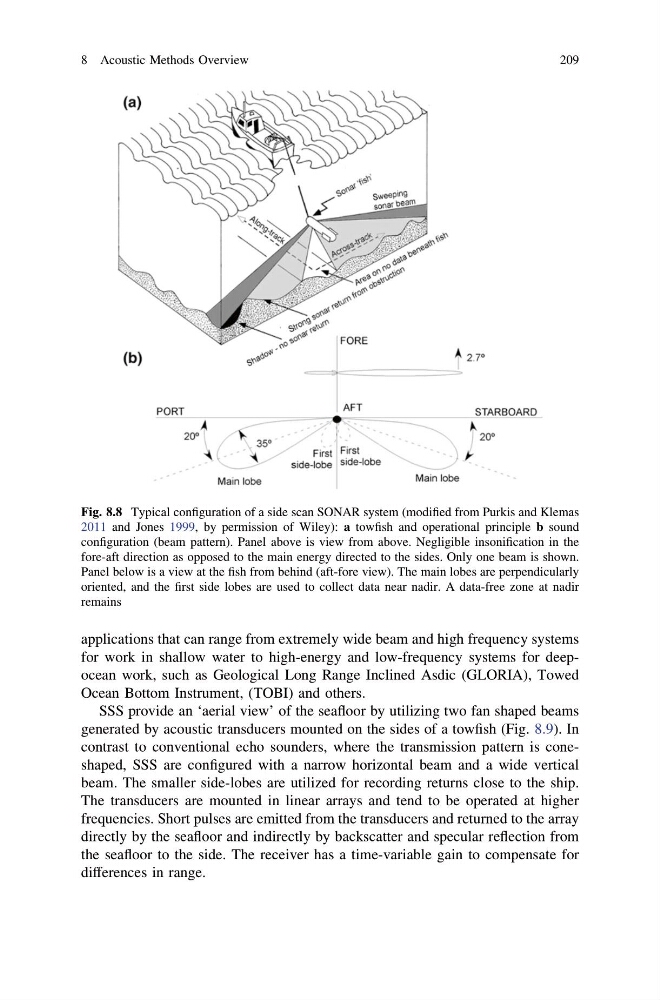
SSS provide an ‘aerial view’ of the seafloor by utilizing two fan shaped beams
generated by acoustic transducers mounted on the sides of a towfish (Fig. 8.9). In
contrast to conventional echo sounders, where the transmission pattern is coneshaped, SSS are configured with a narrow horizontal beam and a wide vertical
beam. The smaller side-lobes are utilized for recording returns close to the ship.
The transducers are mounted in linear arrays and tend to be operated at higher
frequencies. Short pulses are emitted from the transducers and returned to the array
directly by the seafloor and indirectly by backscatter and specular reflection from
the seafloor to the side. The receiver has a time-variable gain to compensate for
differences in range.
Fig. 8.8 Typical configuration of a side scan SONAR system (modified from Purkis and Klemas
2011 and Jones 1999, by permission of Wiley): a towfish and operational principle b sound
configuration (beam pattern). Panel above is view from above. Negligible insonification in the
fore-aft direction as opposed to the main energy directed to the sides. Only one beam is shown.
Panel below is a view at the fish from behind (aft-fore view). The main lobes are perpendicularly
oriented, and the first side lobes are used to collect data near nadir. A data-free zone at nadir
remains
8 Acoustic Methods Overview
209
for work in shallow water to high-energy and low-frequency systems for deepocean work, such as Geological Long Range Inclined Asdic (GLORIA), Towed
Ocean Bottom Instrument, (TOBI) and others.
SSS provide an ‘aerial view’ of the seafloor by utilizing two fan shaped beams
generated by acoustic transducers mounted on the sides of a towfish (Fig. 8.9). In
contrast to conventional echo sounders, where the transmission pattern is coneshaped, SSS are configured with a narrow horizontal beam and a wide vertical
beam. The smaller side-lobes are utilized for recording returns close to the ship.
The transducers are mounted in linear arrays and tend to be operated at higher
frequencies. Short pulses are emitted from the transducers and returned to the array
directly by the seafloor and indirectly by backscatter and specular reflection from
the seafloor to the side. The receiver has a time-variable gain to compensate for
differences in range.
Fig. 8.8 Typical configuration of a side scan SONAR system (modified from Purkis and Klemas
2011 and Jones 1999, by permission of Wiley): a towfish and operational principle b sound
configuration (beam pattern). Panel above is view from above. Negligible insonification in the
fore-aft direction as opposed to the main energy directed to the sides. Only one beam is shown.
Panel below is a view at the fish from behind (aft-fore view). The main lobes are perpendicularly
oriented, and the first side lobes are used to collect data near nadir. A data-free zone at nadir
remains
8 Acoustic Methods Overview
209