

7.3.2 Dempster-Shafer Method
The Dempster-Shafer (D-S) method is an example of decision-level data fusion. In
this method, Dempster and Shafer (Shafer 1976) present a generalization of the
Bayesian theory of uncertainty (Lowrance and Garvey 1982). The D-S method is
based on the concept that humans assign measures of belief according to combinations of all available evidence (i.e., according to multiple rather than single
events) (Hall 1992). In the D-S method, probability and uncertainty intervals are
used to determine the likelihood of a hypothesis based on a combination of several
decision variables. In remote sensing, for example, one sensor may be able to
provide information that can be used to distinguish the height of objects, whereas
information from another sensor may be able to distinguish only the shape of
objects. In the Bayesian approach, all unknown propositions (e.g., objects in the
environment) are assigned an equal a priori probability. When the number of
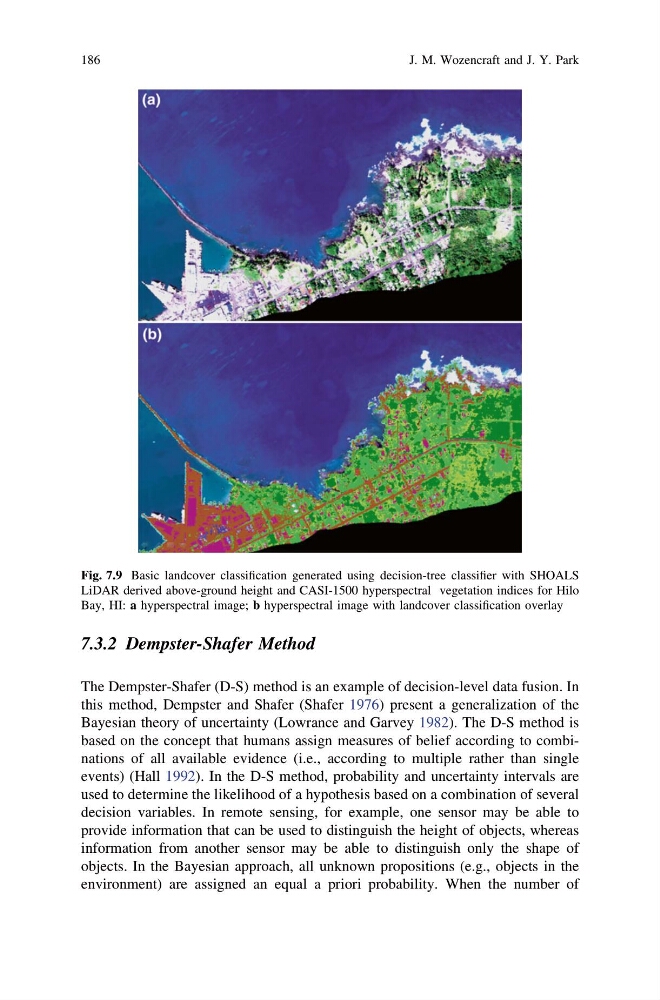
Fig. 7.9 Basic landcover classification generated using decision-tree classifier with SHOALS
LiDAR derived above-ground height and CASI-1500 hyperspectral vegetation indices for Hilo
Bay, HI: a hyperspectral image; b hyperspectral image with landcover classification overlay
186
J. M. Wozencraft and J. Y. Park
The Dempster-Shafer (D-S) method is an example of decision-level data fusion. In
this method, Dempster and Shafer (Shafer 1976) present a generalization of the
Bayesian theory of uncertainty (Lowrance and Garvey 1982). The D-S method is
based on the concept that humans assign measures of belief according to combinations of all available evidence (i.e., according to multiple rather than single
events) (Hall 1992). In the D-S method, probability and uncertainty intervals are
used to determine the likelihood of a hypothesis based on a combination of several
decision variables. In remote sensing, for example, one sensor may be able to
provide information that can be used to distinguish the height of objects, whereas
information from another sensor may be able to distinguish only the shape of
objects. In the Bayesian approach, all unknown propositions (e.g., objects in the
environment) are assigned an equal a priori probability. When the number of
Fig. 7.9 Basic landcover classification generated using decision-tree classifier with SHOALS
LiDAR derived above-ground height and CASI-1500 hyperspectral vegetation indices for Hilo
Bay, HI: a hyperspectral image; b hyperspectral image with landcover classification overlay
186
J. M. Wozencraft and J. Y. Park