

where O and S are the observed and simulated data, respectively, and n is the total
number of data records.
Monte Carlo simulation is a broad class of computational algorithms that rely on
repeated random sampling to obtain numerical results; typically one runs simulations many times over in order to obtain the distribution of an unknown probabilistic entity. In the structure of HYPE, there is a module of Monte Carlo simulation.
The work of modelers is to assign the intervals and tolerance values of calibrated
parameters. Then the parameters are automatic calibrated in the model with the task
of Monte Carlo simulation.
2.2.5 Climate Trends Analysis
The Mann Kendall test (MKT) was applied in this study to analyze the monotonic
trend of annual and monthly precipitation and mean temperature from Kyoto
station. MKT is a non-parametric statistical procedure used to test for trends in
time series data (Yu et al. 1993). The null hypothesis in the Mann-Kendall test is
that the data are independent and randomly ordered, i.e. there is no trend or serial
correlation structure in the time-series (Hamed and Rao 1998). For independent and
randomly ordered data in a time-series x i {x i , i ¼ 1, 2, . . ., n}, the null hypothesis H 0
is tested on the observations x i against the alternative hypothesis H 1 , where there is
an increasing or decreasing monotonic trend (Yu et al. 1993). According to the
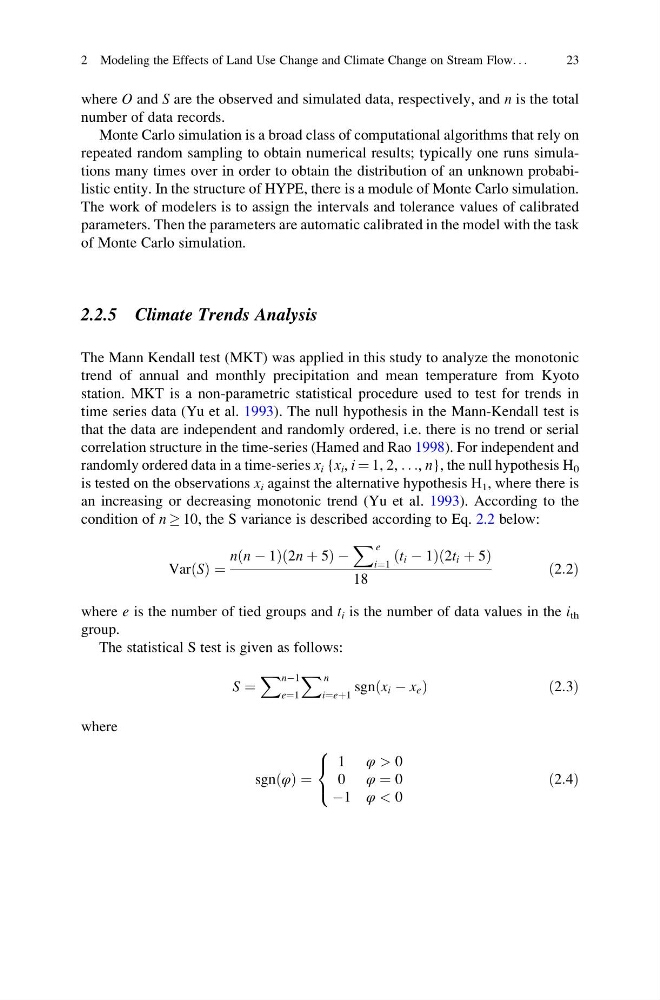
condition of n ! 10, the S variance is described according to Eq. 2.2 below:
Var S
ð Þ ¼
n n À 1
ð
Þ 2n þ 5
ð
ÞÀ
X e
i¼1
t i À 1
ð
Þ 2t i þ 5
ð
Þ
18
ð2:2Þ
where e is the number of tied groups and t i is the number of data values in the i th
group.
The statistical S test is given as follows:
S ¼
X nÀ1
e¼1
X n
i¼eþ1
sgn x i À x e
ð
Þ
ð2:3Þ
where
sgn φ
ð Þ ¼
1 φ > 0
0 φ ¼ 0
À1 φ < 0
8
<
:
ð2:4Þ
2 Modeling the Effects of Land Use Change and Climate Change on Stream Flow. . .
23
number of data records.
Monte Carlo simulation is a broad class of computational algorithms that rely on
repeated random sampling to obtain numerical results; typically one runs simulations many times over in order to obtain the distribution of an unknown probabilistic entity. In the structure of HYPE, there is a module of Monte Carlo simulation.
The work of modelers is to assign the intervals and tolerance values of calibrated
parameters. Then the parameters are automatic calibrated in the model with the task
of Monte Carlo simulation.
2.2.5 Climate Trends Analysis
The Mann Kendall test (MKT) was applied in this study to analyze the monotonic
trend of annual and monthly precipitation and mean temperature from Kyoto
station. MKT is a non-parametric statistical procedure used to test for trends in
time series data (Yu et al. 1993). The null hypothesis in the Mann-Kendall test is
that the data are independent and randomly ordered, i.e. there is no trend or serial
correlation structure in the time-series (Hamed and Rao 1998). For independent and
randomly ordered data in a time-series x i {x i , i ¼ 1, 2, . . ., n}, the null hypothesis H 0
is tested on the observations x i against the alternative hypothesis H 1 , where there is
an increasing or decreasing monotonic trend (Yu et al. 1993). According to the
condition of n ! 10, the S variance is described according to Eq. 2.2 below:
Var S
ð Þ ¼
n n À 1
ð
Þ 2n þ 5
ð
ÞÀ
X e
i¼1
t i À 1
ð
Þ 2t i þ 5
ð
Þ
18
ð2:2Þ
where e is the number of tied groups and t i is the number of data values in the i th
group.
The statistical S test is given as follows:
S ¼
X nÀ1
e¼1
X n
i¼eþ1
sgn x i À x e
ð
Þ
ð2:3Þ
where
sgn φ
ð Þ ¼
1 φ > 0
0 φ ¼ 0
À1 φ < 0
8
<
:
ð2:4Þ
2 Modeling the Effects of Land Use Change and Climate Change on Stream Flow. . .
23