

2.2.2 Model Description
The Hydrological Prediction for the Environment model (HYPE) was employed to
investigate and understand the influences of climate and land use changes on KRB
hydrology. HYPE is a process-based, temporally continuous, semi-distributed
hydrology model, which integrates landscape elements and hydrological components along the flow paths (Lindstrom et al. 2010; Str€ omqvist et al. 2012). It has
been applied in some regions of the world in a range of climate conditions and
resolutions and existing studies have shown that it performed well in simulating
stream flow (Str€ omqvist et al. 2009, 2012; Lindstrom et al. 2010; Arheimer
et al. 2012; Jiang et al. 2013; Jomaa et al. 2013; Donnelly et al. 2014).
HYPE shares some similarities to the HBV (Bergstr€ om 1976), VIC (Liang
et al. 1994) and SWAT (Arnold et al. 1998). The model partitions a basin into
multiple sub-basins, which are further subdivided into a set of hydrological
response units (HRUs) (Flu ¨gel 1995). HRU is determined by land use and soil
type or other landscape characteristics such as elevation and slope. In this study
HRUs are the combinations of land use and soils. Flows generated from each HRU
in a sub-watershed are summed and routed through channels. HYPE model is based
on the water balance in the soil profile and the simulating processes mainly include
snowmelt, infiltration, surface flow, evapotranspiration, percolation, tile drainage,
macro-pore flow and groundwater flow. The detailed calculation methods of each
model component can be found in literature (Lindstrom et al. 2010).
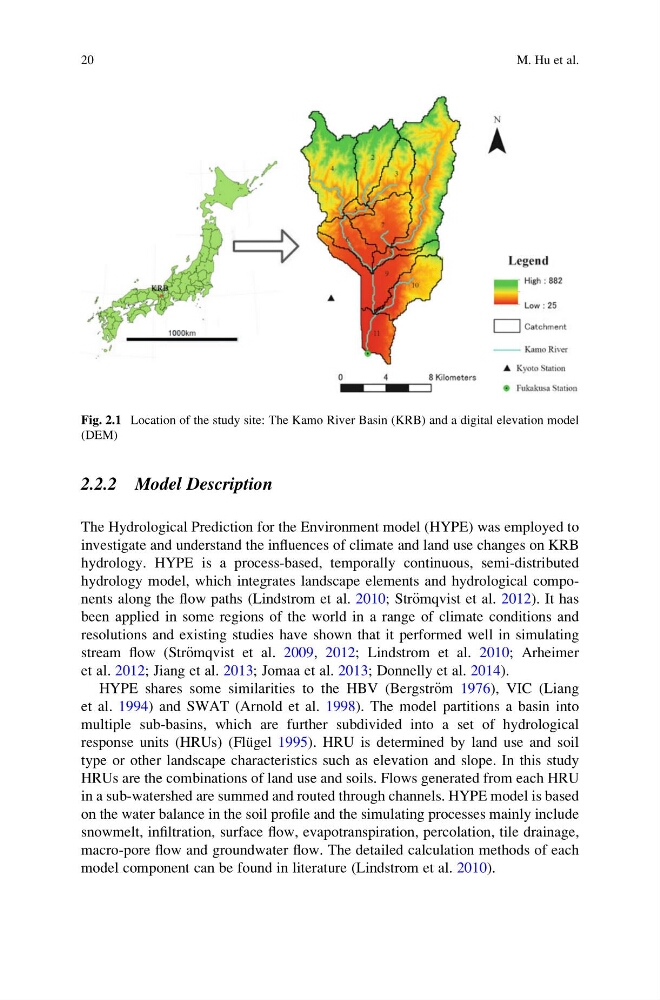
Fig. 2.1 Location of the study site: The Kamo River Basin (KRB) and a digital elevation model
(DEM)
20
M. Hu et al.
The Hydrological Prediction for the Environment model (HYPE) was employed to
investigate and understand the influences of climate and land use changes on KRB
hydrology. HYPE is a process-based, temporally continuous, semi-distributed
hydrology model, which integrates landscape elements and hydrological components along the flow paths (Lindstrom et al. 2010; Str€ omqvist et al. 2012). It has
been applied in some regions of the world in a range of climate conditions and
resolutions and existing studies have shown that it performed well in simulating
stream flow (Str€ omqvist et al. 2009, 2012; Lindstrom et al. 2010; Arheimer
et al. 2012; Jiang et al. 2013; Jomaa et al. 2013; Donnelly et al. 2014).
HYPE shares some similarities to the HBV (Bergstr€ om 1976), VIC (Liang
et al. 1994) and SWAT (Arnold et al. 1998). The model partitions a basin into
multiple sub-basins, which are further subdivided into a set of hydrological
response units (HRUs) (Flu ¨gel 1995). HRU is determined by land use and soil
type or other landscape characteristics such as elevation and slope. In this study
HRUs are the combinations of land use and soils. Flows generated from each HRU
in a sub-watershed are summed and routed through channels. HYPE model is based
on the water balance in the soil profile and the simulating processes mainly include
snowmelt, infiltration, surface flow, evapotranspiration, percolation, tile drainage,
macro-pore flow and groundwater flow. The detailed calculation methods of each
model component can be found in literature (Lindstrom et al. 2010).
Fig. 2.1 Location of the study site: The Kamo River Basin (KRB) and a digital elevation model
(DEM)
20
M. Hu et al.