

(BAU), to show the possible range of future land-use changes based on Yamagata
and Seya (2013) and Yamagata et al. (2013).
• Business-as-usual (BAU)
We assumed that the suburban development will continue to compare with other
scenarios.
• Climate change mitigation scenario (Mit.)
Regulations of land use will be introduced based on the concept of compact city.
The compact city is known as one of the climate change mitigation measures.
People will retreat from the suburbs and live in the city center and around train
stations.
• Climate change adaptation scenario (Ad.)
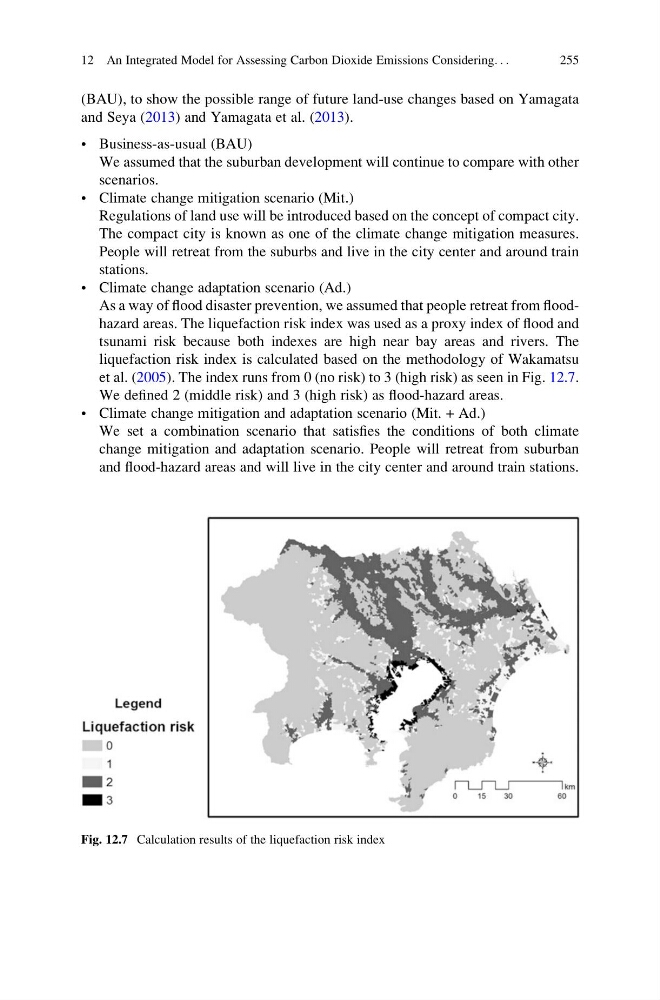
As a way of flood disaster prevention, we assumed that people retreat from floodhazard areas. The liquefaction risk index was used as a proxy index of flood and
tsunami risk because both indexes are high near bay areas and rivers. The
liquefaction risk index is calculated based on the methodology of Wakamatsu
et al. (2005). The index runs from 0 (no risk) to 3 (high risk) as seen in Fig. 12.7.
We defined 2 (middle risk) and 3 (high risk) as flood-hazard areas.
• Climate change mitigation and adaptation scenario (Mit. + Ad.)
We set a combination scenario that satisfies the conditions of both climate
change mitigation and adaptation scenario. People will retreat from suburban
and flood-hazard areas and will live in the city center and around train stations.
Fig. 12.7 Calculation results of the liquefaction risk index
12 An Integrated Model for Assessing Carbon Dioxide Emissions Considering. . .
255
and Seya (2013) and Yamagata et al. (2013).
• Business-as-usual (BAU)
We assumed that the suburban development will continue to compare with other
scenarios.
• Climate change mitigation scenario (Mit.)
Regulations of land use will be introduced based on the concept of compact city.
The compact city is known as one of the climate change mitigation measures.
People will retreat from the suburbs and live in the city center and around train
stations.
• Climate change adaptation scenario (Ad.)
As a way of flood disaster prevention, we assumed that people retreat from floodhazard areas. The liquefaction risk index was used as a proxy index of flood and
tsunami risk because both indexes are high near bay areas and rivers. The
liquefaction risk index is calculated based on the methodology of Wakamatsu
et al. (2005). The index runs from 0 (no risk) to 3 (high risk) as seen in Fig. 12.7.
We defined 2 (middle risk) and 3 (high risk) as flood-hazard areas.
• Climate change mitigation and adaptation scenario (Mit. + Ad.)
We set a combination scenario that satisfies the conditions of both climate
change mitigation and adaptation scenario. People will retreat from suburban
and flood-hazard areas and will live in the city center and around train stations.
Fig. 12.7 Calculation results of the liquefaction risk index
12 An Integrated Model for Assessing Carbon Dioxide Emissions Considering. . .
255