

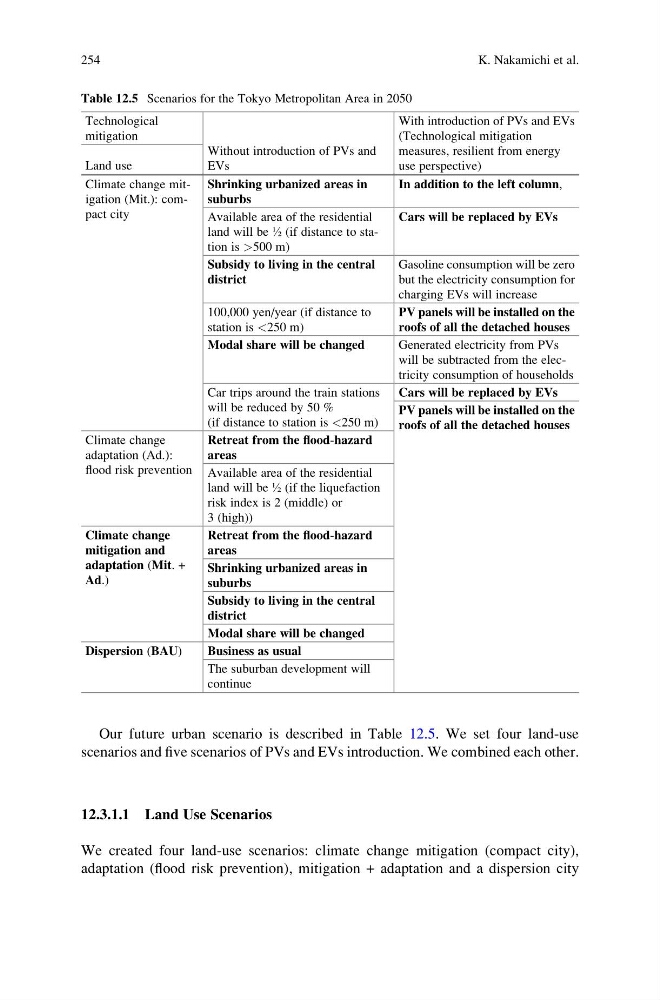
Our future urban scenario is described in Table 12.5. We set four land-use
scenarios and five scenarios of PVs and EVs introduction. We combined each other.
12.3.1.1 Land Use Scenarios
We created four land-use scenarios: climate change mitigation (compact city),
adaptation (flood risk prevention), mitigation + adaptation and a dispersion city
Table 12.5 Scenarios for the Tokyo Metropolitan Area in 2050
Technological
mitigation
Without introduction of PVs and
EVs
With introduction of PVs and EVs
(Technological mitigation
measures, resilient from energy
use perspective)
Land use
Climate change mitigation (Mit.): compact city
Shrinking urbanized areas in
suburbs
In addition to the left column,
Available area of the residential
land will be ½ (if distance to station is >500 m)
Cars will be replaced by EVs
Subsidy to living in the central
district
Gasoline consumption will be zero
but the electricity consumption for
charging EVs will increase
100,000 yen/year (if distance to
station is <250 m)
PV panels will be installed on the
roofs of all the detached houses
Modal share will be changed
Generated electricity from PVs
will be subtracted from the electricity consumption of households
Car trips around the train stations
will be reduced by 50 %
(if distance to station is <250 m)
Cars will be replaced by EVs
PV panels will be installed on the
roofs of all the detached houses
Climate change
adaptation (Ad.):
flood risk prevention
Retreat from the flood-hazard
areas
Available area of the residential
land will be ½ (if the liquefaction
risk index is 2 (middle) or
3 (high))
Climate change
mitigation and
adaptation (Mit. +
Ad.)
Retreat from the flood-hazard
areas
Shrinking urbanized areas in
suburbs
Subsidy to living in the central
district
Modal share will be changed
Dispersion (BAU)
Business as usual
The suburban development will
continue
254
K. Nakamichi et al.
scenarios and five scenarios of PVs and EVs introduction. We combined each other.
12.3.1.1 Land Use Scenarios
We created four land-use scenarios: climate change mitigation (compact city),
adaptation (flood risk prevention), mitigation + adaptation and a dispersion city
Table 12.5 Scenarios for the Tokyo Metropolitan Area in 2050
Technological
mitigation
Without introduction of PVs and
EVs
With introduction of PVs and EVs
(Technological mitigation
measures, resilient from energy
use perspective)
Land use
Climate change mitigation (Mit.): compact city
Shrinking urbanized areas in
suburbs
In addition to the left column,
Available area of the residential
land will be ½ (if distance to station is >500 m)
Cars will be replaced by EVs
Subsidy to living in the central
district
Gasoline consumption will be zero
but the electricity consumption for
charging EVs will increase
100,000 yen/year (if distance to
station is <250 m)
PV panels will be installed on the
roofs of all the detached houses
Modal share will be changed
Generated electricity from PVs
will be subtracted from the electricity consumption of households
Car trips around the train stations
will be reduced by 50 %
(if distance to station is <250 m)
Cars will be replaced by EVs
PV panels will be installed on the
roofs of all the detached houses
Climate change
adaptation (Ad.):
flood risk prevention
Retreat from the flood-hazard
areas
Available area of the residential
land will be ½ (if the liquefaction
risk index is 2 (middle) or
3 (high))
Climate change
mitigation and
adaptation (Mit. +
Ad.)
Retreat from the flood-hazard
areas
Shrinking urbanized areas in
suburbs
Subsidy to living in the central
district
Modal share will be changed
Dispersion (BAU)
Business as usual
The suburban development will
continue
254
K. Nakamichi et al.