

emissions. The obtained results suggest that climate change mitigation and adaptation can generate a synergistic effect from the viewpoint of CO 2 emissions.
Keywords Climate change mitigation and adaptation • Direct and indirect CO 2
emissions • Land-use scenario • Electric vehicles • Photovoltaic panels
12.1 Introduction
12.1.1 Climate Change Mitigation and Adaptation Options
Scientific forecasts predict that climate change will raise the risk of climate
disasters in the future. The 4th Assessment Report of Intergovernmental Panel on
Climate Change (IPCC 2007) emphasizes the importance of both climate change
mitigation and adaptation strategies in order to deal with the challenges of climate
change. Climate change mitigation options include not only a direct reduction of
greenhouse gases (GHGs) but also an enhancement of the carbon sinks of GHGs.
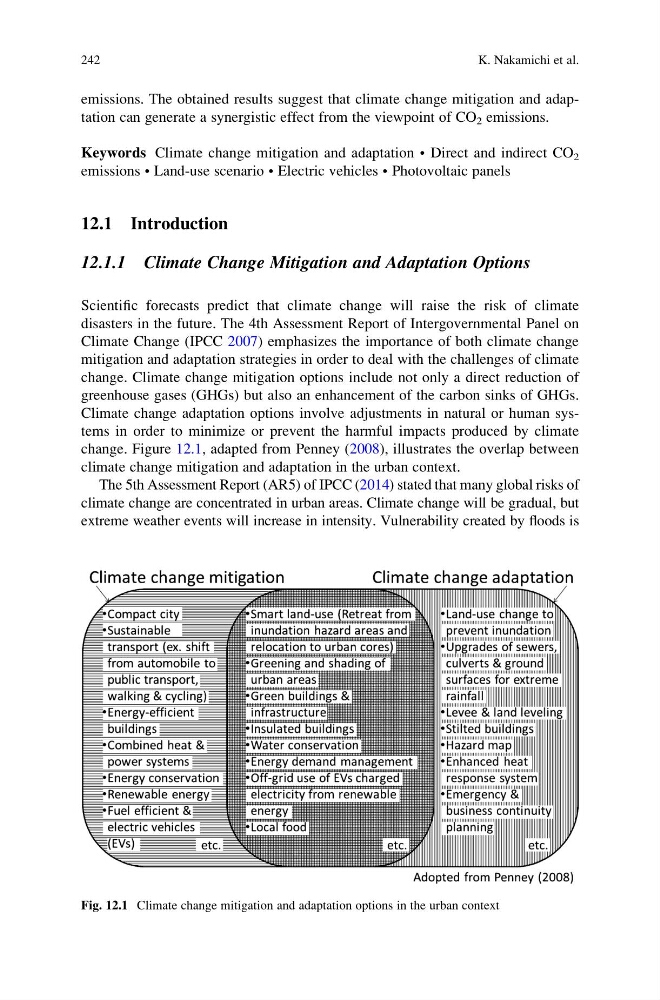
Climate change adaptation options involve adjustments in natural or human systems in order to minimize or prevent the harmful impacts produced by climate
change. Figure 12.1, adapted from Penney (2008), illustrates the overlap between
climate change mitigation and adaptation in the urban context.
The 5th Assessment Report (AR5) of IPCC (2014) stated that many global risks of
climate change are concentrated in urban areas. Climate change will be gradual, but
extreme weather events will increase in intensity. Vulnerability created by floods is
Fig. 12.1 Climate change mitigation and adaptation options in the urban context
242
K. Nakamichi et al.
Keywords Climate change mitigation and adaptation • Direct and indirect CO 2
emissions • Land-use scenario • Electric vehicles • Photovoltaic panels
12.1 Introduction
12.1.1 Climate Change Mitigation and Adaptation Options
Scientific forecasts predict that climate change will raise the risk of climate
disasters in the future. The 4th Assessment Report of Intergovernmental Panel on
Climate Change (IPCC 2007) emphasizes the importance of both climate change
mitigation and adaptation strategies in order to deal with the challenges of climate
change. Climate change mitigation options include not only a direct reduction of
greenhouse gases (GHGs) but also an enhancement of the carbon sinks of GHGs.
Climate change adaptation options involve adjustments in natural or human systems in order to minimize or prevent the harmful impacts produced by climate
change. Figure 12.1, adapted from Penney (2008), illustrates the overlap between
climate change mitigation and adaptation in the urban context.
The 5th Assessment Report (AR5) of IPCC (2014) stated that many global risks of
climate change are concentrated in urban areas. Climate change will be gradual, but
extreme weather events will increase in intensity. Vulnerability created by floods is
Fig. 12.1 Climate change mitigation and adaptation options in the urban context
242
K. Nakamichi et al.