

labels is independent of noise variance. Therefore, the number of unknown
parameters can be reduced.
2. The features are discriminative. The KPCA texture features are linear projections of image patches onto the leading principal axes. Since the principal axes
reveal the largest variations in patch stack, the corresponding PCs therefore
amount to linear texture patterns that reflect the greatest variations among
different sea ice types. The subspace with the largest variance is highly possibly
the subspace where sea ice classes demonstrate their differences. Suppose that
texture patterns are similar within a certain class, but are different among
different classes. Then the KPCA’s goal of seeking subspaces with large variances will naturally drive it to find the subspaces that are capable of revealing
between-class variations, instead of subspaces revealing within-class variations.
3. The features are compact. In KPCA domain, the signal is mainly captured by
several leading PCs, while the last PCs are primarily due to noise. Therefore,
dimension reduction can be achieved by preserving several leading PCs as
texture features. In practice, KPCA features z t include only the first several
PCs that explain a fixed amount (e.g. 80 %) of the data variance. Therefore, it
can help reduce the computation in Eq. (6.8), since z t has much lower dimensionality than y t . Moreover, due to the orthogonal constraint, the variables in z t
reflect mutually independent information, thus are capable of reducing information redundancy.
4. The features are adaptive. For predefined features, such as Gabor filter and
GLCM, it is always a hard task to select relevant texture features from all
available ones. But it is not the case for the KPCA features, because they are
totally data-driven and capable of automatically adapting to the “best” transformations of the pixel values.
Therefore, the KPCA local texture features are powerful for sea ice segmentation. While in this chapter we adopt KPCA features to be combined use with MRF
in a Bayesian framework for sea ice segmentation, it is also promising to combine
them with other clustering or classification techniques for other SAR applications.
6.5.2.3 Noise Distribution of KPCA Texture Features
Since the data likelihood in the MAP estimation is realized by KPCA texture
features, it is important to investigate the noise distribution of KPCA features.
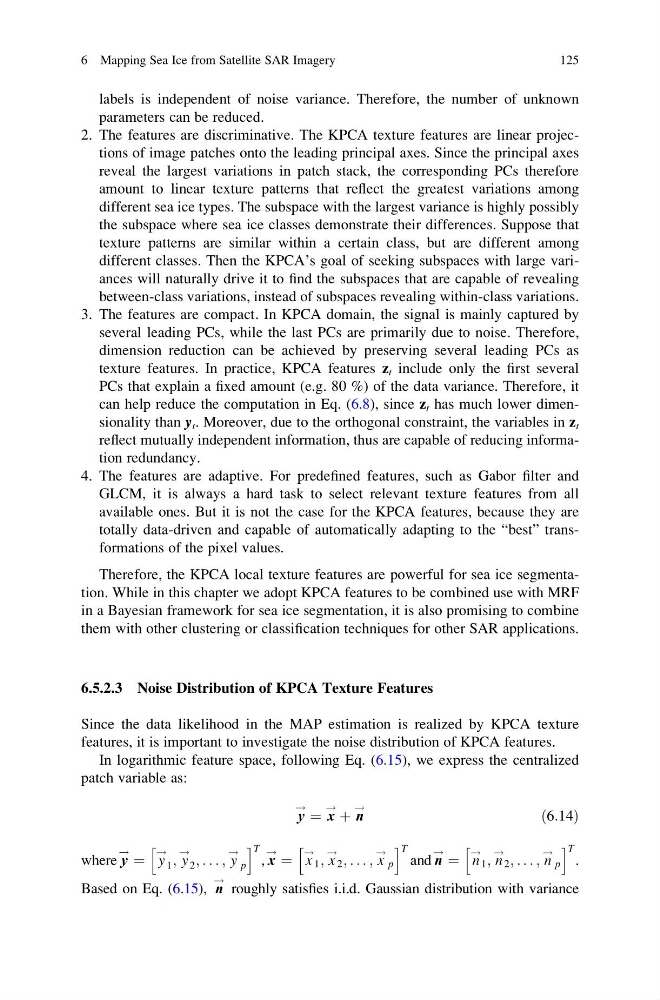
In logarithmic feature space, following Eq. (6.15), we express the centralized
patch variable as:
y
! ¼ x
! þ n
!
ð6:14Þ
where y
! ¼ y
!
1 ; y
!
2 ; . . . ; y
!
p
h
i T
, x
! ¼ x
!
1 ; x
!
2 ; . . . ; x
!
p
h
i T
and n
! ¼ n
!
1 ; n
!
2 ; . . . ; n
!
p
h
i T
.
Based on Eq. (6.15), n
! roughly satisfies i.i.d. Gaussian distribution with variance
6 Mapping Sea Ice from Satellite SAR Imagery
125
parameters can be reduced.
2. The features are discriminative. The KPCA texture features are linear projections of image patches onto the leading principal axes. Since the principal axes
reveal the largest variations in patch stack, the corresponding PCs therefore
amount to linear texture patterns that reflect the greatest variations among
different sea ice types. The subspace with the largest variance is highly possibly
the subspace where sea ice classes demonstrate their differences. Suppose that
texture patterns are similar within a certain class, but are different among
different classes. Then the KPCA’s goal of seeking subspaces with large variances will naturally drive it to find the subspaces that are capable of revealing
between-class variations, instead of subspaces revealing within-class variations.
3. The features are compact. In KPCA domain, the signal is mainly captured by
several leading PCs, while the last PCs are primarily due to noise. Therefore,
dimension reduction can be achieved by preserving several leading PCs as
texture features. In practice, KPCA features z t include only the first several
PCs that explain a fixed amount (e.g. 80 %) of the data variance. Therefore, it
can help reduce the computation in Eq. (6.8), since z t has much lower dimensionality than y t . Moreover, due to the orthogonal constraint, the variables in z t
reflect mutually independent information, thus are capable of reducing information redundancy.
4. The features are adaptive. For predefined features, such as Gabor filter and
GLCM, it is always a hard task to select relevant texture features from all
available ones. But it is not the case for the KPCA features, because they are
totally data-driven and capable of automatically adapting to the “best” transformations of the pixel values.
Therefore, the KPCA local texture features are powerful for sea ice segmentation. While in this chapter we adopt KPCA features to be combined use with MRF
in a Bayesian framework for sea ice segmentation, it is also promising to combine
them with other clustering or classification techniques for other SAR applications.
6.5.2.3 Noise Distribution of KPCA Texture Features
Since the data likelihood in the MAP estimation is realized by KPCA texture
features, it is important to investigate the noise distribution of KPCA features.
In logarithmic feature space, following Eq. (6.15), we express the centralized
patch variable as:
y
! ¼ x
! þ n
!
ð6:14Þ
where y
! ¼ y
!
1 ; y
!
2 ; . . . ; y
!
p
h
i T
, x
! ¼ x
!
1 ; x
!
2 ; . . . ; x
!
p
h
i T
and n
! ¼ n
!
1 ; n
!
2 ; . . . ; n
!
p
h
i T
.
Based on Eq. (6.15), n
! roughly satisfies i.i.d. Gaussian distribution with variance
6 Mapping Sea Ice from Satellite SAR Imagery
125