

statistical description of relationship among pixels in SAR image. Pixels that do not
belong to the same patch are considered uncorrelated. Hence the size of the patch
determines the scale of spatial patterns that can be described. Generally speaking,
bigger-sized patch considers larger-range correlations, and hence is more capable
of capturing larger-scale textural patterns in SAR image. However, for SAR sea ice
image that is usually devoid of strong texture pattern, small patch-size (e.g. 3 Â 3) is
sufficient.
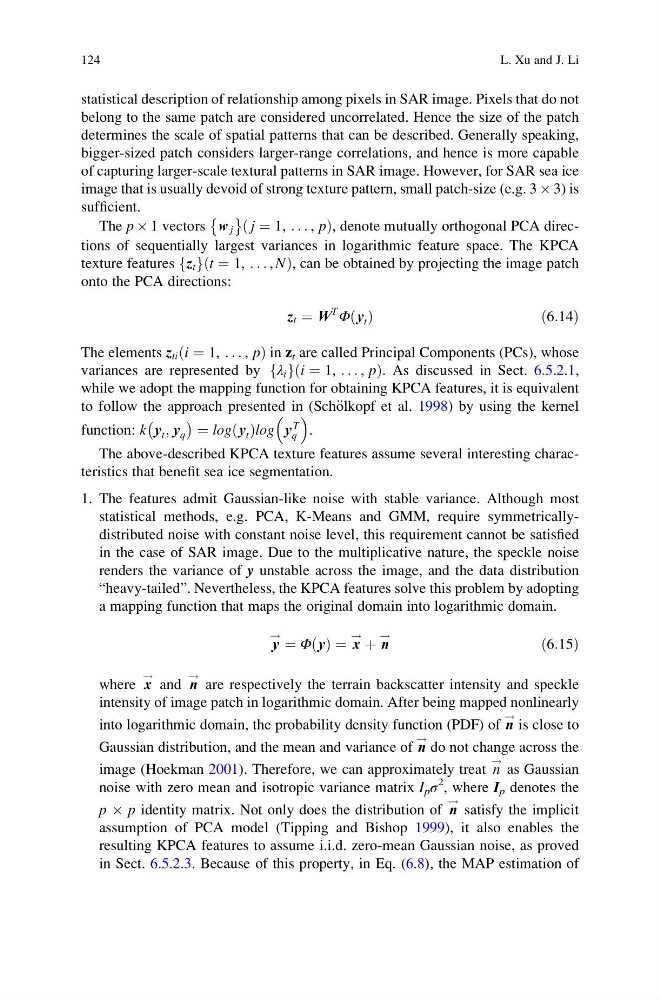
The p  1 vectors w j
È É
j ¼ 1, . . . , p
ð
Þ , denote mutually orthogonal PCA directions of sequentially largest variances in logarithmic feature space. The KPCA
texture features z t
f g t ¼ 1, . . . , N
ð
Þ , can be obtained by projecting the image patch
onto the PCA directions:
z t ¼ W
T
Φ y t
ð Þ
ð6:14Þ
The elements z ti i ¼ 1, . . . , p
ð
Þin z t are called Principal Components (PCs), whose
variances are represented by λ i
f g i ¼ 1, . . . , p
ð
Þ . As discussed in Sect. 6.5.2.1,
while we adopt the mapping function for obtaining KPCA features, it is equivalent
to follow the approach presented in (Sch€ olkopf et al. 1998) by using the kernel
function: k y t ; y q
À
Á ¼ log y t
ð Þlog y
T
q
.
The above-described KPCA texture features assume several interesting characteristics that benefit sea ice segmentation.
1. The features admit Gaussian-like noise with stable variance. Although most
statistical methods, e.g. PCA, K-Means and GMM, require symmetricallydistributed noise with constant noise level, this requirement cannot be satisfied
in the case of SAR image. Due to the multiplicative nature, the speckle noise
renders the variance of y unstable across the image, and the data distribution
“heavy-tailed”. Nevertheless, the KPCA features solve this problem by adopting
a mapping function that maps the original domain into logarithmic domain.
y
! ¼ Φ y
ð Þ ¼ x
! þ n
!
ð6:15Þ
where x
! and n
! are respectively the terrain backscatter intensity and speckle
intensity of image patch in logarithmic domain. After being mapped nonlinearly
into logarithmic domain, the probability density function (PDF) of n
! is close to
Gaussian distribution, and the mean and variance of n
! do not change across the
image (Hoekman 2001). Therefore, we can approximately treat n
! as Gaussian
noise with zero mean and isotropic variance matrix I p σ
2 , where I p denotes the
p  p identity matrix. Not only does the distribution of n
! satisfy the implicit
assumption of PCA model (Tipping and Bishop 1999), it also enables the
resulting KPCA features to assume i.i.d. zero-mean Gaussian noise, as proved
in Sect. 6.5.2.3. Because of this property, in Eq. (6.8), the MAP estimation of
124
L. Xu and J. Li
belong to the same patch are considered uncorrelated. Hence the size of the patch
determines the scale of spatial patterns that can be described. Generally speaking,
bigger-sized patch considers larger-range correlations, and hence is more capable
of capturing larger-scale textural patterns in SAR image. However, for SAR sea ice
image that is usually devoid of strong texture pattern, small patch-size (e.g. 3 Â 3) is
sufficient.
The p  1 vectors w j
È É
j ¼ 1, . . . , p
ð
Þ , denote mutually orthogonal PCA directions of sequentially largest variances in logarithmic feature space. The KPCA
texture features z t
f g t ¼ 1, . . . , N
ð
Þ , can be obtained by projecting the image patch
onto the PCA directions:
z t ¼ W
T
Φ y t
ð Þ
ð6:14Þ
The elements z ti i ¼ 1, . . . , p
ð
Þin z t are called Principal Components (PCs), whose
variances are represented by λ i
f g i ¼ 1, . . . , p
ð
Þ . As discussed in Sect. 6.5.2.1,
while we adopt the mapping function for obtaining KPCA features, it is equivalent
to follow the approach presented in (Sch€ olkopf et al. 1998) by using the kernel
function: k y t ; y q
À
Á ¼ log y t
ð Þlog y
T
q
.
The above-described KPCA texture features assume several interesting characteristics that benefit sea ice segmentation.
1. The features admit Gaussian-like noise with stable variance. Although most
statistical methods, e.g. PCA, K-Means and GMM, require symmetricallydistributed noise with constant noise level, this requirement cannot be satisfied
in the case of SAR image. Due to the multiplicative nature, the speckle noise
renders the variance of y unstable across the image, and the data distribution
“heavy-tailed”. Nevertheless, the KPCA features solve this problem by adopting
a mapping function that maps the original domain into logarithmic domain.
y
! ¼ Φ y
ð Þ ¼ x
! þ n
!
ð6:15Þ
where x
! and n
! are respectively the terrain backscatter intensity and speckle
intensity of image patch in logarithmic domain. After being mapped nonlinearly
into logarithmic domain, the probability density function (PDF) of n
! is close to
Gaussian distribution, and the mean and variance of n
! do not change across the
image (Hoekman 2001). Therefore, we can approximately treat n
! as Gaussian
noise with zero mean and isotropic variance matrix I p σ
2 , where I p denotes the
p  p identity matrix. Not only does the distribution of n
! satisfy the implicit
assumption of PCA model (Tipping and Bishop 1999), it also enables the
resulting KPCA features to assume i.i.d. zero-mean Gaussian noise, as proved
in Sect. 6.5.2.3. Because of this property, in Eq. (6.8), the MAP estimation of
124
L. Xu and J. Li