

matrix σ
2
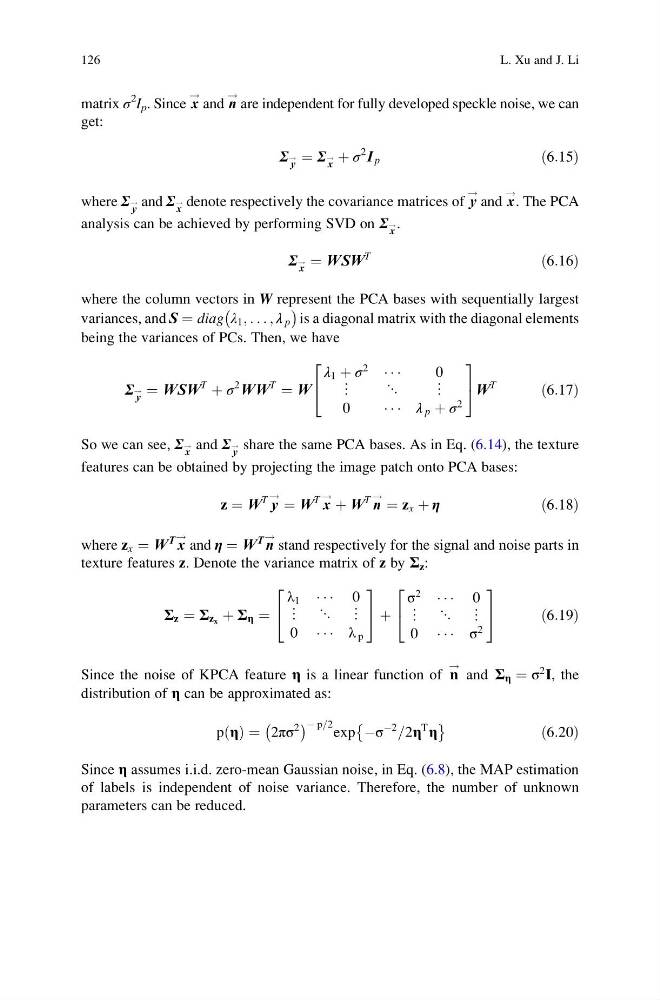
I p . Since x
! and n
! are independent for fully developed speckle noise, we can
get:
Σ y
! ¼ Σ x
! þ σ
2
I p
ð6:15Þ
where Σ y
! and Σ x
! denote respectively the covariance matrices of y
! and x
!
. The PCA
analysis can be achieved by performing SVD on Σ x
!.
Σ x
! ¼ WSW
T
ð6:16Þ
where the column vectors in W represent the PCA bases with sequentially largest
variances, and S ¼ diag λ 1 ; . . . ; λ p
À
Á
is a diagonal matrix with the diagonal elements
being the variances of PCs. Then, we have
Σ y
! ¼ WSW
T
þ σ
2
WW
T
¼ W
λ 1 þ σ
2
Á Á Á
0
⋮
⋱
⋮
0
Á Á Á λ p þ σ
2
2
4
3
5 W
T
ð6:17Þ
So we can see, Σ x
! and Σ y
! share the same PCA bases. As in Eq. (6.14), the texture
features can be obtained by projecting the image patch onto PCA bases:
z ¼ W
T
y
! ¼ W
T
x
! þ W
T
n
! ¼ z x þ η
ð6:18Þ
where z x ¼ W
T
x
! and η ¼ W
T
n
! stand respectively for the signal and noise parts in
texture features z. Denote the variance matrix of z by Σ z :
Σ z ¼ Σ z x þ Σ η ¼
λ 1 Á Á Á 0
⋮ ⋱ ⋮
0 Á Á Á λ p
2
4
3
5 þ
σ
2
Á Á Á 0
⋮ ⋱ ⋮
0 Á Á Á σ
2
2
4
3
5
ð6:19Þ
Since the noise of KPCA feature η is a linear function of n
! and Σ η ¼ σ
2 I, the
distribution of η can be approximated as:
p η
ð Þ ¼ 2πσ
2
À
Á À p=2 exp Àσ
À2
=2η
T
η
È
É
ð6:20Þ
Since η assumes i.i.d. zero-mean Gaussian noise, in Eq. (6.8), the MAP estimation
of labels is independent of noise variance. Therefore, the number of unknown
parameters can be reduced.
126
L. Xu and J. Li
2
I p . Since x
! and n
! are independent for fully developed speckle noise, we can
get:
Σ y
! ¼ Σ x
! þ σ
2
I p
ð6:15Þ
where Σ y
! and Σ x
! denote respectively the covariance matrices of y
! and x
!
. The PCA
analysis can be achieved by performing SVD on Σ x
!.
Σ x
! ¼ WSW
T
ð6:16Þ
where the column vectors in W represent the PCA bases with sequentially largest
variances, and S ¼ diag λ 1 ; . . . ; λ p
À
Á
is a diagonal matrix with the diagonal elements
being the variances of PCs. Then, we have
Σ y
! ¼ WSW
T
þ σ
2
WW
T
¼ W
λ 1 þ σ
2
Á Á Á
0
⋮
⋱
⋮
0
Á Á Á λ p þ σ
2
2
4
3
5 W
T
ð6:17Þ
So we can see, Σ x
! and Σ y
! share the same PCA bases. As in Eq. (6.14), the texture
features can be obtained by projecting the image patch onto PCA bases:
z ¼ W
T
y
! ¼ W
T
x
! þ W
T
n
! ¼ z x þ η
ð6:18Þ
where z x ¼ W
T
x
! and η ¼ W
T
n
! stand respectively for the signal and noise parts in
texture features z. Denote the variance matrix of z by Σ z :
Σ z ¼ Σ z x þ Σ η ¼
λ 1 Á Á Á 0
⋮ ⋱ ⋮
0 Á Á Á λ p
2
4
3
5 þ
σ
2
Á Á Á 0
⋮ ⋱ ⋮
0 Á Á Á σ
2
2
4
3
5
ð6:19Þ
Since the noise of KPCA feature η is a linear function of n
! and Σ η ¼ σ
2 I, the
distribution of η can be approximated as:
p η
ð Þ ¼ 2πσ
2
À
Á À p=2 exp Àσ
À2
=2η
T
η
È
É
ð6:20Þ
Since η assumes i.i.d. zero-mean Gaussian noise, in Eq. (6.8), the MAP estimation
of labels is independent of noise variance. Therefore, the number of unknown
parameters can be reduced.
126
L. Xu and J. Li