

282
predation and the National Park administration fenced the area in 2004 in order to
reduce the impacts of these ground-based predators as well as trampling by cattle.
Black Kites (Milvus migrans) also predate on the eggs and chicks.
Methods
UAVs Flight Campaigns
The first flight campaigns were carried out in 2015 as part of the research project
RECUPERA2020 funded by the European Regional Development Fund. The main
goal of the project was to transfer research knowledge on the topic of environmental sustainability to regional farmers. The specific goal of this study was to assess
the use of UAV technology for monitoring environmental integrity. The UAV system provided by the Center for Advanced Aerospace Technologies (Fada-Catec)
was an electric multirotor equiped with a camera Sony Alpha-5100, with 24
Megapixels and a focal distance of 22 mm. Table 1 shows the characteristics of every
flight campaign. Flight height and speed were selected following Vas et al. (2015).
Missions were planned to collect as many pictures as possible instead of having just
one frame for the whole colony. Flights were designed to retrieve a minimum pixel
size of 6 cm in order to be able to identify gulls in the captured pictures (Table 1).
0
100
200
300
400
500
600
700
800
900
2002
2003
2004
2005
2006
2007
2008
2009
2010
2011
2012
2013
2014
2015
2016
Number of breeding pairs
Doñana Natural Marshes
Veta la Palma fisheries area
Salinas de Sanlúcar
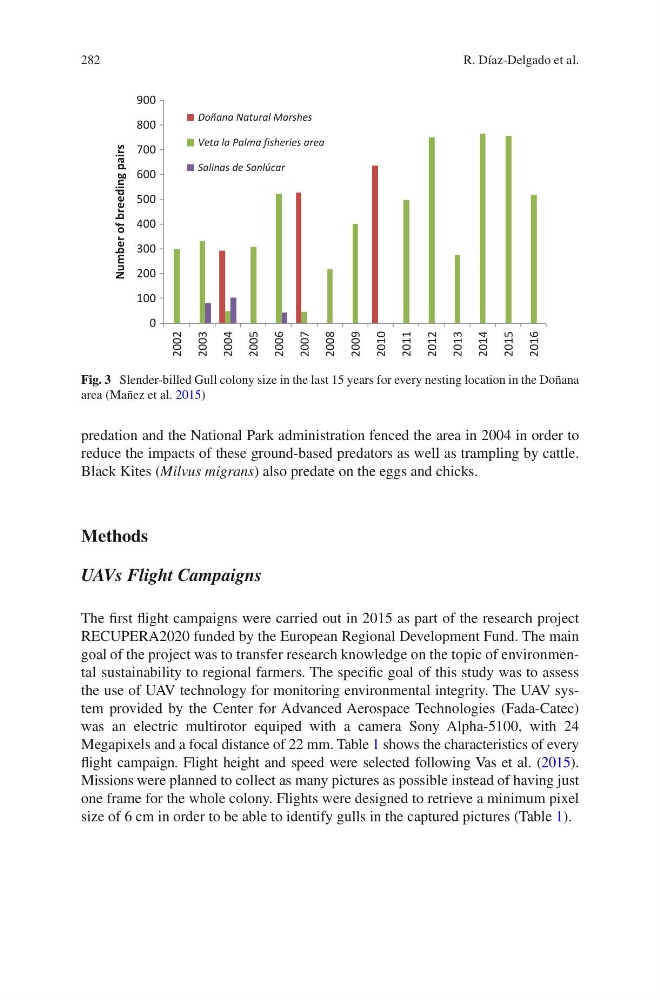
Fig. 3 Slender-billed Gull colony size in the last 15 years for every nesting location in the Doñana
area (Mañez et al. 2015)
R. Díaz-Delgado et al.
predation and the National Park administration fenced the area in 2004 in order to
reduce the impacts of these ground-based predators as well as trampling by cattle.
Black Kites (Milvus migrans) also predate on the eggs and chicks.
Methods
UAVs Flight Campaigns
The first flight campaigns were carried out in 2015 as part of the research project
RECUPERA2020 funded by the European Regional Development Fund. The main
goal of the project was to transfer research knowledge on the topic of environmental sustainability to regional farmers. The specific goal of this study was to assess
the use of UAV technology for monitoring environmental integrity. The UAV system provided by the Center for Advanced Aerospace Technologies (Fada-Catec)
was an electric multirotor equiped with a camera Sony Alpha-5100, with 24
Megapixels and a focal distance of 22 mm. Table 1 shows the characteristics of every
flight campaign. Flight height and speed were selected following Vas et al. (2015).
Missions were planned to collect as many pictures as possible instead of having just
one frame for the whole colony. Flights were designed to retrieve a minimum pixel
size of 6 cm in order to be able to identify gulls in the captured pictures (Table 1).
0
100
200
300
400
500
600
700
800
900
2002
2003
2004
2005
2006
2007
2008
2009
2010
2011
2012
2013
2014
2015
2016
Number of breeding pairs
Doñana Natural Marshes
Veta la Palma fisheries area
Salinas de Sanlúcar
Fig. 3 Slender-billed Gull colony size in the last 15 years for every nesting location in the Doñana
area (Mañez et al. 2015)
R. Díaz-Delgado et al.