

281
Study Area: The Doñana Colonies
Since 2002, the Slender-billed Gull colonies in Doñana Natural Space have usually
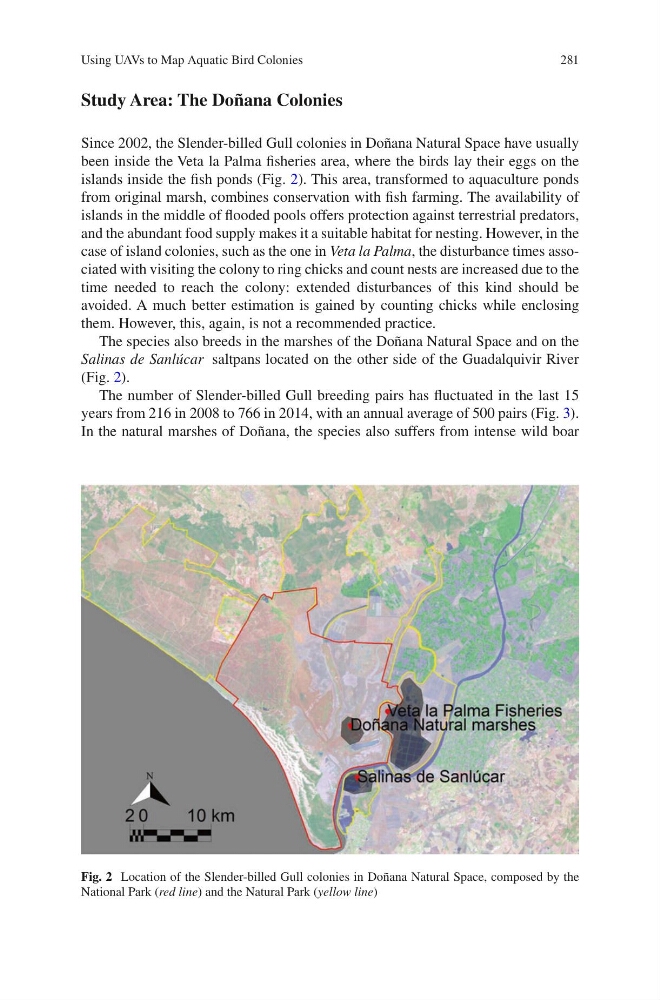
been inside the Veta la Palma fisheries area, where the birds lay their eggs on the
islands inside the fish ponds (Fig. 2). This area, transformed to aquaculture ponds
from original marsh, combines conservation with fish farming. The availability of
islands in the middle of flooded pools offers protection against terrestrial predators,
and the abundant food supply makes it a suitable habitat for nesting. However, in the
case of island colonies, such as the one in Veta la Palma, the disturbance times associated with visiting the colony to ring chicks and count nests are increased due to the
time needed to reach the colony: extended disturbances of this kind should be
avoided. A much better estimation is gained by counting chicks while enclosing
them. However, this, again, is not a recommended practice.
The species also breeds in the marshes of the Doñana Natural Space and on the
Salinas de Sanlúcar saltpans located on the other side of the Guadalquivir River
(Fig. 2).
The number of Slender-billed Gull breeding pairs has fluctuated in the last 15
years from 216 in 2008 to 766 in 2014, with an annual average of 500 pairs (Fig. 3).
In the natural marshes of Doñana, the species also suffers from intense wild boar
Fig. 2 Location of the Slender-billed Gull colonies in Doñana Natural Space, composed by the
National Park (red line) and the Natural Park (yellow line)
Using UAVs to Map Aquatic Bird Colonies
Study Area: The Doñana Colonies
Since 2002, the Slender-billed Gull colonies in Doñana Natural Space have usually
been inside the Veta la Palma fisheries area, where the birds lay their eggs on the
islands inside the fish ponds (Fig. 2). This area, transformed to aquaculture ponds
from original marsh, combines conservation with fish farming. The availability of
islands in the middle of flooded pools offers protection against terrestrial predators,
and the abundant food supply makes it a suitable habitat for nesting. However, in the
case of island colonies, such as the one in Veta la Palma, the disturbance times associated with visiting the colony to ring chicks and count nests are increased due to the
time needed to reach the colony: extended disturbances of this kind should be
avoided. A much better estimation is gained by counting chicks while enclosing
them. However, this, again, is not a recommended practice.
The species also breeds in the marshes of the Doñana Natural Space and on the
Salinas de Sanlúcar saltpans located on the other side of the Guadalquivir River
(Fig. 2).
The number of Slender-billed Gull breeding pairs has fluctuated in the last 15
years from 216 in 2008 to 766 in 2014, with an annual average of 500 pairs (Fig. 3).
In the natural marshes of Doñana, the species also suffers from intense wild boar
Fig. 2 Location of the Slender-billed Gull colonies in Doñana Natural Space, composed by the
National Park (red line) and the Natural Park (yellow line)
Using UAVs to Map Aquatic Bird Colonies