

280
evaluated in terms of their cost efficiency or their precision in retrieving population
data of sufficient accuracy (Hodgson et al. 2016). Several studies have indicated this
technology can be used to support bird observations and sampling but few have
proposed automated counting of either individuals or nests.
Targeted Species: The Slender-billed Gull
The Slender-billed Gull is a medium size Laridae (42–44 cm long and 220–350 g
weight) species that breeds widely at isolated, scattered localities, from Senegal to
Mauritania, and from the south and east of the Iberian Peninsula, through the
Mediterranean, Black Sea, Minor Asia and the Middle East to east Kazakhstan,
Afghanistan, Pakistan and north-west India (del-Hoyo et al. 1996). Least Concern
is their current IUCN Red List category (BirdLife International 2016).
The Spanish population is very small and sparsely distributed and therefore is
labelled as “vulnerable” by the Red Book on Spanish Birds (Madroño et al. 2004).
It usually breeds in marshes and saltpans with a typical laying period between
late April and late May (exceptionally till July). The nests, formed of scat and feathers,
are hardly visible as they are built on the ground or on low halophytic vegetation. It
is a very social species that forms colonies together with other gulls, terns and
shorebirds. However, the species is very sensitive to human disturbances and shows
a distinctive breeding biology. Colonies are typically very dense and chicks cluster
into nurseries just after birth. Such characteristics make the estimation of breeding
pairs from the ground very challenging, often leading to overlooked individuals and
chicks (Oro and Tavecchia 2008). Ideally, the colony should be visited at the end of
the incubation period only once, which should be enough as the species shows a
tight synchronicity during the egg-laying period (Oro and Tavecchia 2008).
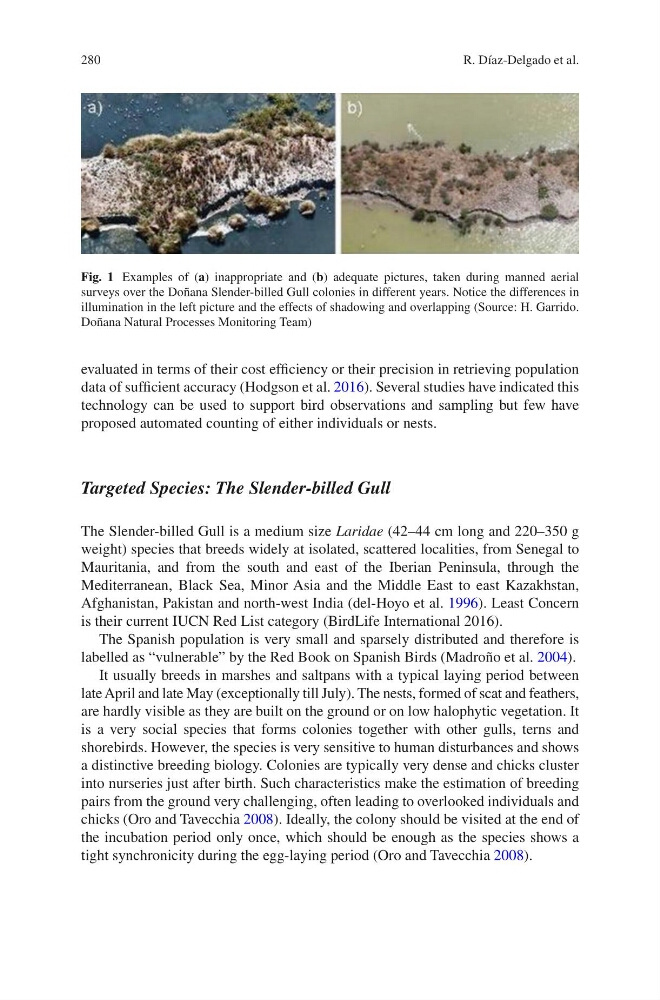
Fig. 1 Examples of (a) inappropriate and (b) adequate pictures, taken during manned aerial
surveys over the Doñana Slender-billed Gull colonies in different years. Notice the differences in
illumination in the left picture and the effects of shadowing and overlapping (Source: H. Garrido.
Doñana Natural Processes Monitoring Team)
R. Díaz-Delgado et al.
evaluated in terms of their cost efficiency or their precision in retrieving population
data of sufficient accuracy (Hodgson et al. 2016). Several studies have indicated this
technology can be used to support bird observations and sampling but few have
proposed automated counting of either individuals or nests.
Targeted Species: The Slender-billed Gull
The Slender-billed Gull is a medium size Laridae (42–44 cm long and 220–350 g
weight) species that breeds widely at isolated, scattered localities, from Senegal to
Mauritania, and from the south and east of the Iberian Peninsula, through the
Mediterranean, Black Sea, Minor Asia and the Middle East to east Kazakhstan,
Afghanistan, Pakistan and north-west India (del-Hoyo et al. 1996). Least Concern
is their current IUCN Red List category (BirdLife International 2016).
The Spanish population is very small and sparsely distributed and therefore is
labelled as “vulnerable” by the Red Book on Spanish Birds (Madroño et al. 2004).
It usually breeds in marshes and saltpans with a typical laying period between
late April and late May (exceptionally till July). The nests, formed of scat and feathers,
are hardly visible as they are built on the ground or on low halophytic vegetation. It
is a very social species that forms colonies together with other gulls, terns and
shorebirds. However, the species is very sensitive to human disturbances and shows
a distinctive breeding biology. Colonies are typically very dense and chicks cluster
into nurseries just after birth. Such characteristics make the estimation of breeding
pairs from the ground very challenging, often leading to overlooked individuals and
chicks (Oro and Tavecchia 2008). Ideally, the colony should be visited at the end of
the incubation period only once, which should be enough as the species shows a
tight synchronicity during the egg-laying period (Oro and Tavecchia 2008).
Fig. 1 Examples of (a) inappropriate and (b) adequate pictures, taken during manned aerial
surveys over the Doñana Slender-billed Gull colonies in different years. Notice the differences in
illumination in the left picture and the effects of shadowing and overlapping (Source: H. Garrido.
Doñana Natural Processes Monitoring Team)
R. Díaz-Delgado et al.