

234
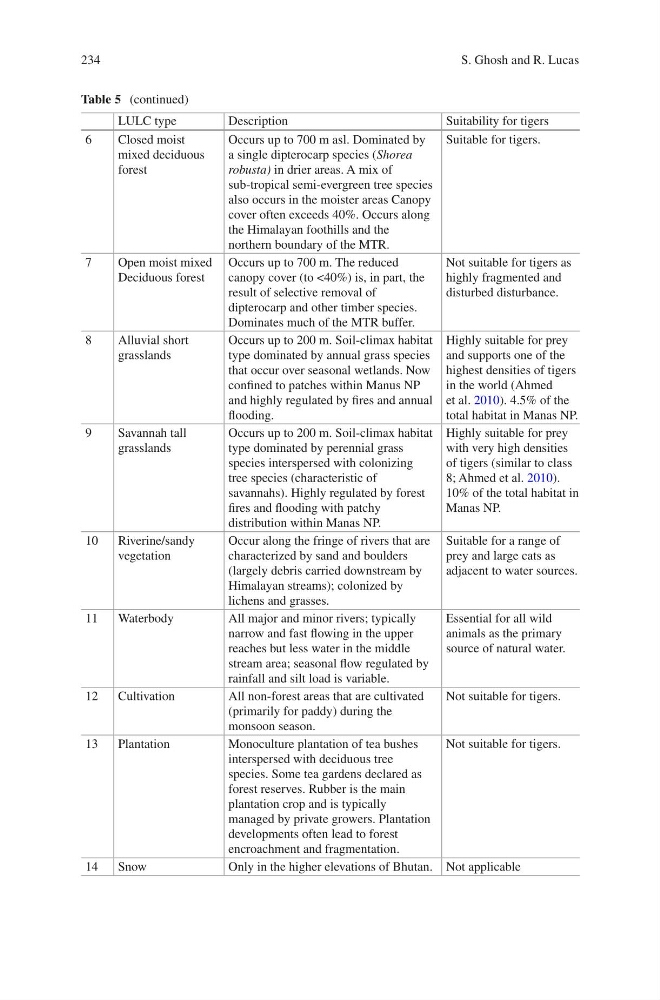
Table 5 (continued)
LULC type
Description
Suitability for tigers
6
Closed moist
mixed deciduous
forest
Occurs up to 700 m asl. Dominated by
a single dipterocarp species (Shorea
robusta) in drier areas. A mix of
sub-tropical semi-evergreen tree species
also occurs in the moister areas Canopy
cover often exceeds 40%. Occurs along
the Himalayan foothills and the
northern boundary of the MTR.
Suitable for tigers.
7
Open moist mixed
Deciduous forest
Occurs up to 700 m. The reduced
canopy cover (to <40%) is, in part, the
result of selective removal of
dipterocarp and other timber species.
Dominates much of the MTR buffer.
Not suitable for tigers as
highly fragmented and
disturbed disturbance.
8
Alluvial short
grasslands
Occurs up to 200 m. Soil-climax habitat
type dominated by annual grass species
that occur over seasonal wetlands. Now
confined to patches within Manus NP
and highly regulated by fires and annual
flooding.
Highly suitable for prey
and supports one of the
highest densities of tigers
in the world (Ahmed
et al. 2010). 4.5% of the
total habitat in Manas NP.
9
Savannah tall
grasslands
Occurs up to 200 m. Soil-climax habitat
type dominated by perennial grass
species interspersed with colonizing
tree species (characteristic of
savannahs). Highly regulated by forest
fires and flooding with patchy
distribution within Manas NP.
Highly suitable for prey
with very high densities
of tigers (similar to class
8; Ahmed et al. 2010).
10% of the total habitat in
Manas NP.
10
Riverine/sandy
vegetation
Occur along the fringe of rivers that are
characterized by sand and boulders
(largely debris carried downstream by
Himalayan streams); colonized by
lichens and grasses.
Suitable for a range of
prey and large cats as
adjacent to water sources.
11
Waterbody
All major and minor rivers; typically
narrow and fast flowing in the upper
reaches but less water in the middle
stream area; seasonal flow regulated by
rainfall and silt load is variable.
Essential for all wild
animals as the primary
source of natural water.
12
Cultivation
All non-forest areas that are cultivated
(primarily for paddy) during the
monsoon season.
Not suitable for tigers.
13
Plantation
Monoculture plantation of tea bushes
interspersed with deciduous tree
species. Some tea gardens declared as
forest reserves. Rubber is the main
plantation crop and is typically
managed by private growers. Plantation
developments often lead to forest
encroachment and fragmentation.
Not suitable for tigers.
14
Snow
Only in the higher elevations of Bhutan. Not applicable
S. Ghosh and R. Lucas
Table 5 (continued)
LULC type
Description
Suitability for tigers
6
Closed moist
mixed deciduous
forest
Occurs up to 700 m asl. Dominated by
a single dipterocarp species (Shorea
robusta) in drier areas. A mix of
sub-tropical semi-evergreen tree species
also occurs in the moister areas Canopy
cover often exceeds 40%. Occurs along
the Himalayan foothills and the
northern boundary of the MTR.
Suitable for tigers.
7
Open moist mixed
Deciduous forest
Occurs up to 700 m. The reduced
canopy cover (to <40%) is, in part, the
result of selective removal of
dipterocarp and other timber species.
Dominates much of the MTR buffer.
Not suitable for tigers as
highly fragmented and
disturbed disturbance.
8
Alluvial short
grasslands
Occurs up to 200 m. Soil-climax habitat
type dominated by annual grass species
that occur over seasonal wetlands. Now
confined to patches within Manus NP
and highly regulated by fires and annual
flooding.
Highly suitable for prey
and supports one of the
highest densities of tigers
in the world (Ahmed
et al. 2010). 4.5% of the
total habitat in Manas NP.
9
Savannah tall
grasslands
Occurs up to 200 m. Soil-climax habitat
type dominated by perennial grass
species interspersed with colonizing
tree species (characteristic of
savannahs). Highly regulated by forest
fires and flooding with patchy
distribution within Manas NP.
Highly suitable for prey
with very high densities
of tigers (similar to class
8; Ahmed et al. 2010).
10% of the total habitat in
Manas NP.
10
Riverine/sandy
vegetation
Occur along the fringe of rivers that are
characterized by sand and boulders
(largely debris carried downstream by
Himalayan streams); colonized by
lichens and grasses.
Suitable for a range of
prey and large cats as
adjacent to water sources.
11
Waterbody
All major and minor rivers; typically
narrow and fast flowing in the upper
reaches but less water in the middle
stream area; seasonal flow regulated by
rainfall and silt load is variable.
Essential for all wild
animals as the primary
source of natural water.
12
Cultivation
All non-forest areas that are cultivated
(primarily for paddy) during the
monsoon season.
Not suitable for tigers.
13
Plantation
Monoculture plantation of tea bushes
interspersed with deciduous tree
species. Some tea gardens declared as
forest reserves. Rubber is the main
plantation crop and is typically
managed by private growers. Plantation
developments often lead to forest
encroachment and fragmentation.
Not suitable for tigers.
14
Snow
Only in the higher elevations of Bhutan. Not applicable
S. Ghosh and R. Lucas