

233
specified minimum bounding geometry enclosing each input feature for each group
of input features.
Land Cover Classification
To classify land cover and associated changes between the different years, 150
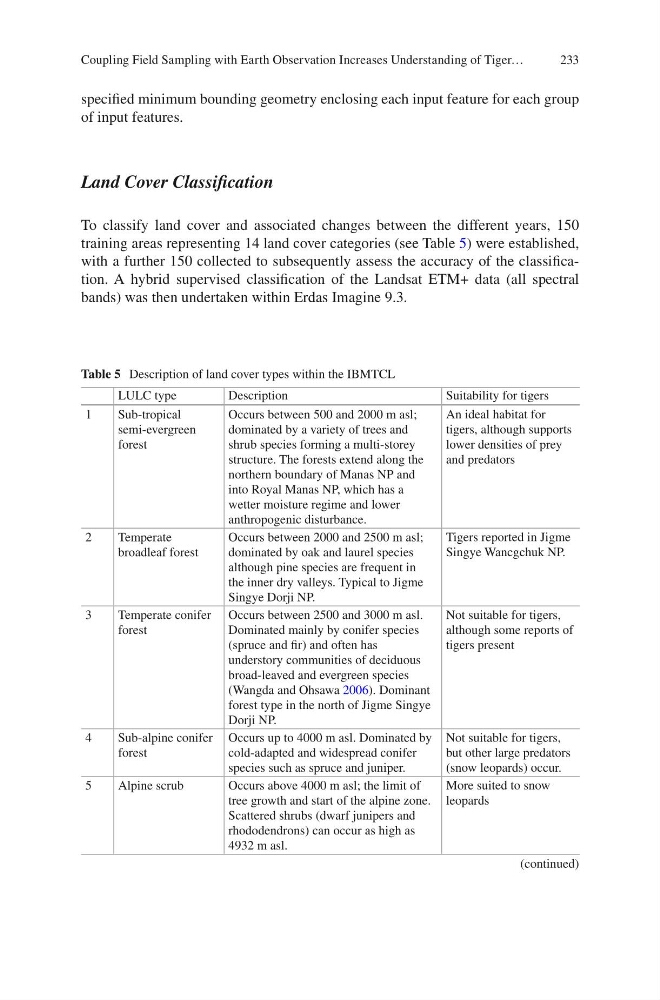
training areas representing 14 land cover categories (see Table 5) were established,
with a further 150 collected to subsequently assess the accuracy of the classification. A hybrid supervised classification of the Landsat ETM+ data (all spectral
bands) was then undertaken within Erdas Imagine 9.3.
Table 5 Description of land cover types within the IBMTCL
LULC type
Description
Suitability for tigers
1
Sub-tropical
semi-evergreen
forest
Occurs between 500 and 2000 m asl;
dominated by a variety of trees and
shrub species forming a multi-storey
structure. The forests extend along the
northern boundary of Manas NP and
into Royal Manas NP, which has a
wetter moisture regime and lower
anthropogenic disturbance.
An ideal habitat for
tigers, although supports
lower densities of prey
and predators
2
Temperate
broadleaf forest
Occurs between 2000 and 2500 m asl;
dominated by oak and laurel species
although pine species are frequent in
the inner dry valleys. Typical to Jigme
Singye Dorji NP.
Tigers reported in Jigme
Singye Wancgchuk NP.
3
Temperate conifer
forest
Occurs between 2500 and 3000 m asl.
Dominated mainly by conifer species
(spruce and fir) and often has
understory communities of deciduous
broad-leaved and evergreen species
(Wangda and Ohsawa 2006). Dominant
forest type in the north of Jigme Singye
Dorji NP.
Not suitable for tigers,
although some reports of
tigers present
4
Sub-alpine conifer
forest
Occurs up to 4000 m asl. Dominated by
cold-adapted and widespread conifer
species such as spruce and juniper.
Not suitable for tigers,
but other large predators
(snow leopards) occur.
5
Alpine scrub
Occurs above 4000 m asl; the limit of
tree growth and start of the alpine zone.
Scattered shrubs (dwarf junipers and
rhododendrons) can occur as high as
4932 m asl.
More suited to snow
leopards
(continued)
Coupling Field Sampling with Earth Observation Increases Understanding of Tiger…
specified minimum bounding geometry enclosing each input feature for each group
of input features.
Land Cover Classification
To classify land cover and associated changes between the different years, 150
training areas representing 14 land cover categories (see Table 5) were established,
with a further 150 collected to subsequently assess the accuracy of the classification. A hybrid supervised classification of the Landsat ETM+ data (all spectral
bands) was then undertaken within Erdas Imagine 9.3.
Table 5 Description of land cover types within the IBMTCL
LULC type
Description
Suitability for tigers
1
Sub-tropical
semi-evergreen
forest
Occurs between 500 and 2000 m asl;
dominated by a variety of trees and
shrub species forming a multi-storey
structure. The forests extend along the
northern boundary of Manas NP and
into Royal Manas NP, which has a
wetter moisture regime and lower
anthropogenic disturbance.
An ideal habitat for
tigers, although supports
lower densities of prey
and predators
2
Temperate
broadleaf forest
Occurs between 2000 and 2500 m asl;
dominated by oak and laurel species
although pine species are frequent in
the inner dry valleys. Typical to Jigme
Singye Dorji NP.
Tigers reported in Jigme
Singye Wancgchuk NP.
3
Temperate conifer
forest
Occurs between 2500 and 3000 m asl.
Dominated mainly by conifer species
(spruce and fir) and often has
understory communities of deciduous
broad-leaved and evergreen species
(Wangda and Ohsawa 2006). Dominant
forest type in the north of Jigme Singye
Dorji NP.
Not suitable for tigers,
although some reports of
tigers present
4
Sub-alpine conifer
forest
Occurs up to 4000 m asl. Dominated by
cold-adapted and widespread conifer
species such as spruce and juniper.
Not suitable for tigers,
but other large predators
(snow leopards) occur.
5
Alpine scrub
Occurs above 4000 m asl; the limit of
tree growth and start of the alpine zone.
Scattered shrubs (dwarf junipers and
rhododendrons) can occur as high as
4932 m asl.
More suited to snow
leopards
(continued)
Coupling Field Sampling with Earth Observation Increases Understanding of Tiger…