

120
Matt Duckham and Mike Worboys
Returning to our analogy, it was only because the Rosetta Stone contained three
copies of the same decree in different languages that the attempt to derive a meaningful Egyptian–Greek dictionary was successful. The direct correspondence was
known about because it is explicitly stated in the Greek version of the text. If, instead, the different versions of the text on the Rosetta Stone had contained different
decrees, then the Stone’s usefulness as an aid to understanding hieroglyphs would
have been severely limited.
In the context of geographical information fusion, there may still be some benefit
to applying automated inductive inference to data sets that are topically unrelated.
Although the results of such a process would not constitute geographical information
fusion according to the original definition of the term, the process may be useful as a
data mining technique for discovering relationships between semantically unrelated
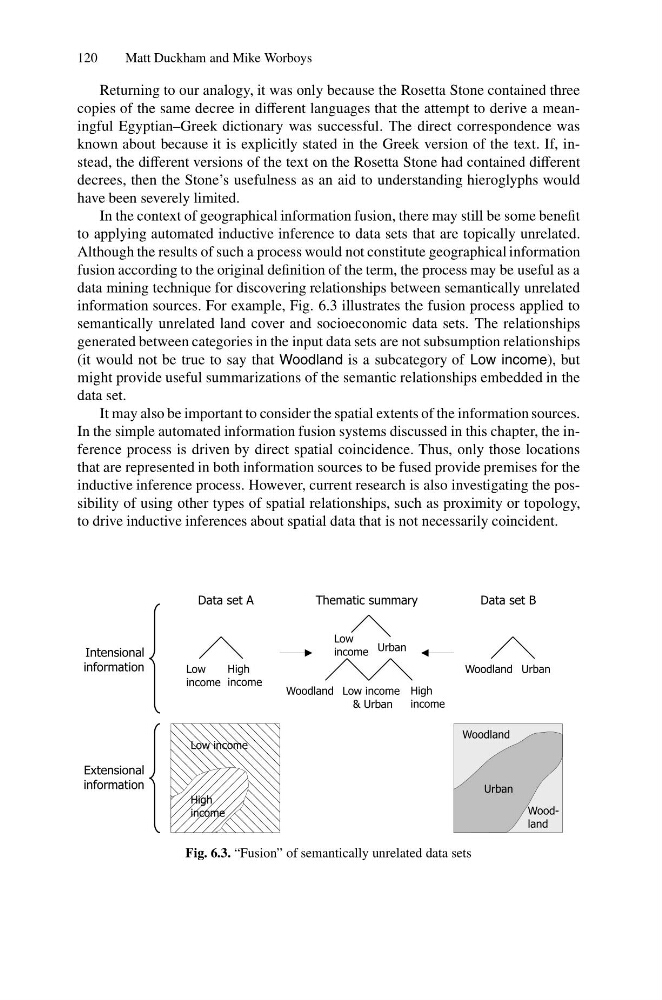
information sources. For example, Fig. 6.3 illustrates the fusion process applied to
semantically unrelated land cover and socioeconomic data sets. The relationships
generated between categories in the input data sets are not subsumption relationships
(it would not be true to say that Woodland is a subcategory of Low income), but
might provide useful summarizations of the semantic relationships embedded in the
data set.
It may also be important to consider the spatial extents of the information sources.
In the simple automated information fusion systems discussed in this chapter, the inference process is driven by direct spatial coincidence. Thus, only those locations
that are represented in both information sources to be fused provide premises for the
inductive inference process. However, current research is also investigating the possibility of using other types of spatial relationships, such as proximity or topology,
to drive inductive inferences about spatial data that is not necessarily coincident.
High
income
Low income
Woodland
Urban
Woodland Urban
Intensional
information
Extensional
information
Woodland
Low
income
High
income
Low
income Urban
Woodland Low income
& Urban
High
income
Data set A
Data set B
Thematic summary
Fig. 6.3. “Fusion” of semantically unrelated data sets
Matt Duckham and Mike Worboys
Returning to our analogy, it was only because the Rosetta Stone contained three
copies of the same decree in different languages that the attempt to derive a meaningful Egyptian–Greek dictionary was successful. The direct correspondence was
known about because it is explicitly stated in the Greek version of the text. If, instead, the different versions of the text on the Rosetta Stone had contained different
decrees, then the Stone’s usefulness as an aid to understanding hieroglyphs would
have been severely limited.
In the context of geographical information fusion, there may still be some benefit
to applying automated inductive inference to data sets that are topically unrelated.
Although the results of such a process would not constitute geographical information
fusion according to the original definition of the term, the process may be useful as a
data mining technique for discovering relationships between semantically unrelated
information sources. For example, Fig. 6.3 illustrates the fusion process applied to
semantically unrelated land cover and socioeconomic data sets. The relationships
generated between categories in the input data sets are not subsumption relationships
(it would not be true to say that Woodland is a subcategory of Low income), but
might provide useful summarizations of the semantic relationships embedded in the
data set.
It may also be important to consider the spatial extents of the information sources.
In the simple automated information fusion systems discussed in this chapter, the inference process is driven by direct spatial coincidence. Thus, only those locations
that are represented in both information sources to be fused provide premises for the
inductive inference process. However, current research is also investigating the possibility of using other types of spatial relationships, such as proximity or topology,
to drive inductive inferences about spatial data that is not necessarily coincident.
High
income
Low income
Woodland
Urban
Woodland Urban
Intensional
information
Extensional
information
Woodland
Low
income
High
income
Low
income Urban
Woodland Low income
& Urban
High
income
Data set A
Data set B
Thematic summary
Fig. 6.3. “Fusion” of semantically unrelated data sets