

13.9.2 Applications of the Fluorometers to Detect Stress
Until now, the reader has been guided through the operation of fluorometers, in this
section we will make a brief the application of the fluorometers in the stress
detection. It is well known that the photosynthetic processes are quiet related with
the comfort status of the plant, because the photosystems are the major targets of
many environmental stress modifying the crop yield, hence the chlorophyll fluorescence kinetics (Lin et al. 2007). However, there are stresses that are not directly
related with the chlorophyll fluorescence. For example, in drought stress, the
decrease of the relative water content of leaves results in a stomatal closure and
decreasing the supply of CO 2 to the mesophyll cells and then decreasing the rate of
the photosynthesis. Mentioned above, there is not a direct impact on the efficiency
of the primary photochemical events of the PSII or affect the chlorophyll fluorescence parameters (Table 13.7), such as maximum quantum yield of photochemistry
in PSII in dark-adapted (F v /F m ) (Massacci and Jones 1990). On the case of the
salinity stress is very similar to drought, and it is provoke where large amounts of
fertilization and irrigation are employed in climates with high evaporation, which
results in changes in F q
0 /F m
0 .
In the case of the temperature, for example low temperatures, the metabolism is
severely affected and the damage of the PSII that is high affecting also the measurement of the maximum quantum yield of the photochemistry in PSII. On the
other hand, with the high temperatures the inactivation of the PSII and the disorganization of the thylakoid are taken into account causing a monitoring the rise
of F o as well as the F v /F m (Baker and Rosenqvist 2004).
The nutrition is critical in yield of the crops, being Nitrogen the main mineral
nutrient needed for chlorophyll production (Muñoz-Huerta et al. 2013).
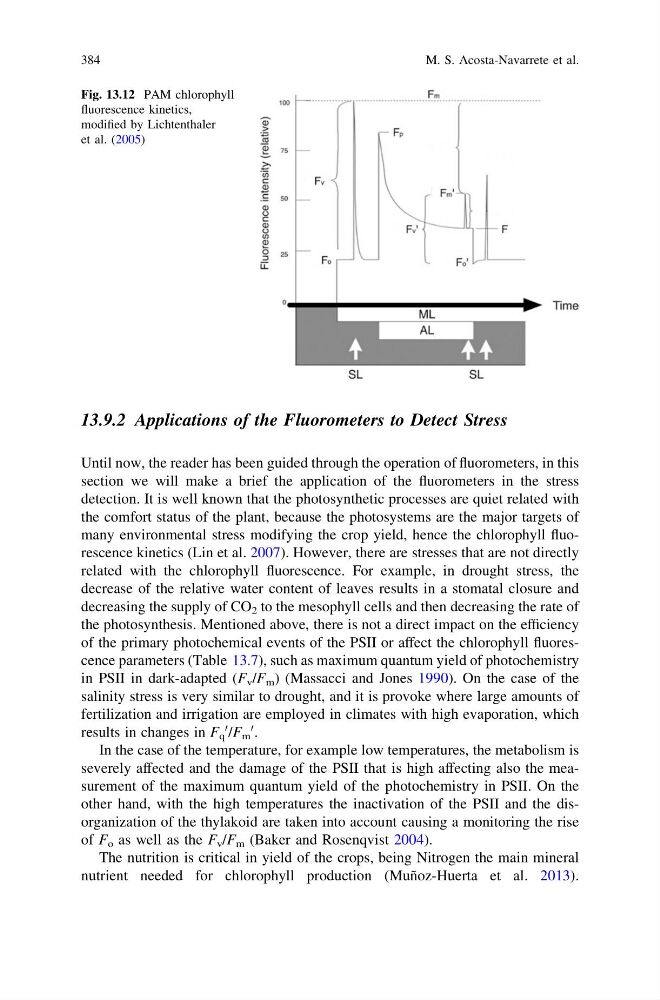
Fig. 13.12 PAM chlorophyll
fluorescence kinetics,
modified by Lichtenthaler
et al. (2005)
384
M. S. Acosta-Navarrete et al.
Until now, the reader has been guided through the operation of fluorometers, in this
section we will make a brief the application of the fluorometers in the stress
detection. It is well known that the photosynthetic processes are quiet related with
the comfort status of the plant, because the photosystems are the major targets of
many environmental stress modifying the crop yield, hence the chlorophyll fluorescence kinetics (Lin et al. 2007). However, there are stresses that are not directly
related with the chlorophyll fluorescence. For example, in drought stress, the
decrease of the relative water content of leaves results in a stomatal closure and
decreasing the supply of CO 2 to the mesophyll cells and then decreasing the rate of
the photosynthesis. Mentioned above, there is not a direct impact on the efficiency
of the primary photochemical events of the PSII or affect the chlorophyll fluorescence parameters (Table 13.7), such as maximum quantum yield of photochemistry
in PSII in dark-adapted (F v /F m ) (Massacci and Jones 1990). On the case of the
salinity stress is very similar to drought, and it is provoke where large amounts of
fertilization and irrigation are employed in climates with high evaporation, which
results in changes in F q
0 /F m
0 .
In the case of the temperature, for example low temperatures, the metabolism is
severely affected and the damage of the PSII that is high affecting also the measurement of the maximum quantum yield of the photochemistry in PSII. On the
other hand, with the high temperatures the inactivation of the PSII and the disorganization of the thylakoid are taken into account causing a monitoring the rise
of F o as well as the F v /F m (Baker and Rosenqvist 2004).
The nutrition is critical in yield of the crops, being Nitrogen the main mineral
nutrient needed for chlorophyll production (Muñoz-Huerta et al. 2013).
Fig. 13.12 PAM chlorophyll
fluorescence kinetics,
modified by Lichtenthaler
et al. (2005)
384
M. S. Acosta-Navarrete et al.