

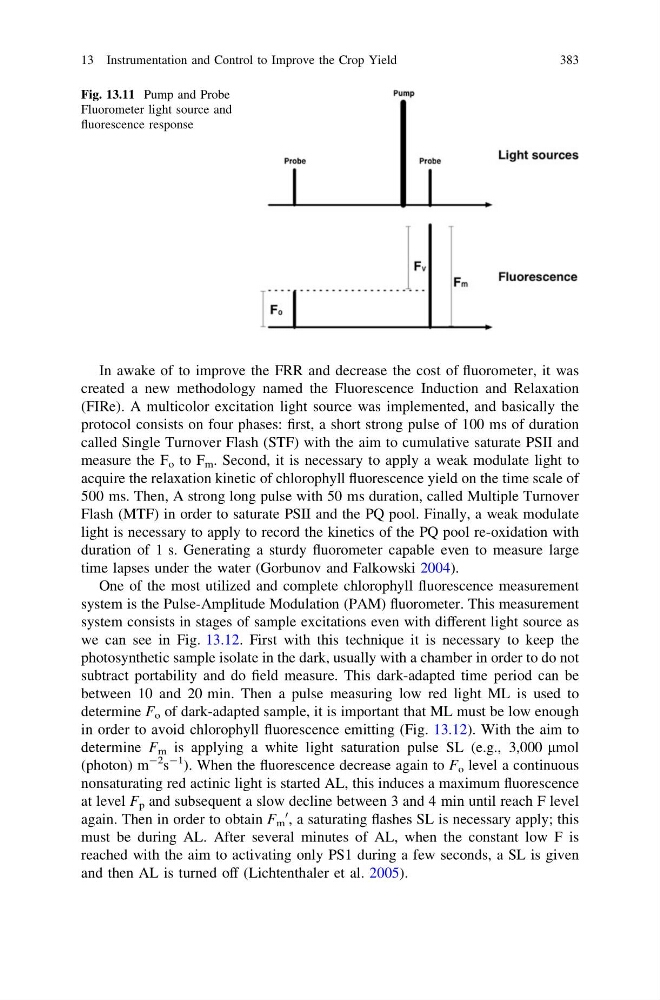
In awake of to improve the FRR and decrease the cost of fluorometer, it was
created a new methodology named the Fluorescence Induction and Relaxation
(FIRe). A multicolor excitation light source was implemented, and basically the
protocol consists on four phases: first, a short strong pulse of 100 ms of duration
called Single Turnover Flash (STF) with the aim to cumulative saturate PSII and
measure the F o to F m . Second, it is necessary to apply a weak modulate light to
acquire the relaxation kinetic of chlorophyll fluorescence yield on the time scale of
500 ms. Then, A strong long pulse with 50 ms duration, called Multiple Turnover
Flash (MTF) in order to saturate PSII and the PQ pool. Finally, a weak modulate
light is necessary to apply to record the kinetics of the PQ pool re-oxidation with
duration of 1 s. Generating a sturdy fluorometer capable even to measure large
time lapses under the water (Gorbunov and Falkowski 2004).
One of the most utilized and complete chlorophyll fluorescence measurement
system is the Pulse-Amplitude Modulation (PAM) fluorometer. This measurement
system consists in stages of sample excitations even with different light source as
we can see in Fig. 13.12. First with this technique it is necessary to keep the
photosynthetic sample isolate in the dark, usually with a chamber in order to do not
subtract portability and do field measure. This dark-adapted time period can be
between 10 and 20 min. Then a pulse measuring low red light ML is used to
determine F o of dark-adapted sample, it is important that ML must be low enough
in order to avoid chlorophyll fluorescence emitting (Fig. 13.12). With the aim to
determine F m is applying a white light saturation pulse SL (e.g., 3,000 lmol
(photon) m
-2 s
-1 ). When the fluorescence decrease again to F o level a continuous
nonsaturating red actinic light is started AL, this induces a maximum fluorescence
at level F p and subsequent a slow decline between 3 and 4 min until reach F level
again. Then in order to obtain F m
0 , a saturating flashes SL is necessary apply; this
must be during AL. After several minutes of AL, when the constant low F is
reached with the aim to activating only PS1 during a few seconds, a SL is given
and then AL is turned off (Lichtenthaler et al. 2005).
Fig. 13.11 Pump and Probe
Fluorometer light source and
fluorescence response
13 Instrumentation and Control to Improve the Crop Yield
383
created a new methodology named the Fluorescence Induction and Relaxation
(FIRe). A multicolor excitation light source was implemented, and basically the
protocol consists on four phases: first, a short strong pulse of 100 ms of duration
called Single Turnover Flash (STF) with the aim to cumulative saturate PSII and
measure the F o to F m . Second, it is necessary to apply a weak modulate light to
acquire the relaxation kinetic of chlorophyll fluorescence yield on the time scale of
500 ms. Then, A strong long pulse with 50 ms duration, called Multiple Turnover
Flash (MTF) in order to saturate PSII and the PQ pool. Finally, a weak modulate
light is necessary to apply to record the kinetics of the PQ pool re-oxidation with
duration of 1 s. Generating a sturdy fluorometer capable even to measure large
time lapses under the water (Gorbunov and Falkowski 2004).
One of the most utilized and complete chlorophyll fluorescence measurement
system is the Pulse-Amplitude Modulation (PAM) fluorometer. This measurement
system consists in stages of sample excitations even with different light source as
we can see in Fig. 13.12. First with this technique it is necessary to keep the
photosynthetic sample isolate in the dark, usually with a chamber in order to do not
subtract portability and do field measure. This dark-adapted time period can be
between 10 and 20 min. Then a pulse measuring low red light ML is used to
determine F o of dark-adapted sample, it is important that ML must be low enough
in order to avoid chlorophyll fluorescence emitting (Fig. 13.12). With the aim to
determine F m is applying a white light saturation pulse SL (e.g., 3,000 lmol
(photon) m
-2 s
-1 ). When the fluorescence decrease again to F o level a continuous
nonsaturating red actinic light is started AL, this induces a maximum fluorescence
at level F p and subsequent a slow decline between 3 and 4 min until reach F level
again. Then in order to obtain F m
0 , a saturating flashes SL is necessary apply; this
must be during AL. After several minutes of AL, when the constant low F is
reached with the aim to activating only PS1 during a few seconds, a SL is given
and then AL is turned off (Lichtenthaler et al. 2005).
Fig. 13.11 Pump and Probe
Fluorometer light source and
fluorescence response
13 Instrumentation and Control to Improve the Crop Yield
383