

produce DP by the action of E S enzyme units produced by the fermentation of Q
kg of substrate.
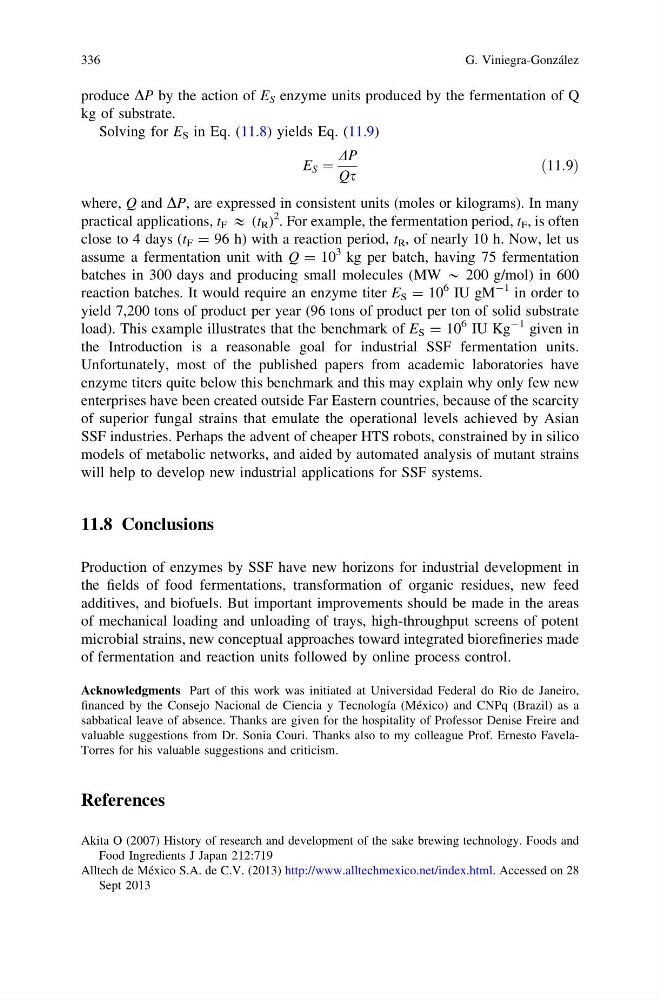
Solving for E S in Eq. (11.8) yields Eq. (11.9)
E S ¼
DP
Qs
ð11:9Þ
where, Q and DP, are expressed in consistent units (moles or kilograms). In many
practical applications, t F & (t R )
2 . For example, the fermentation period, t F , is often
close to 4 days (t F = 96 h) with a reaction period, t R , of nearly 10 h. Now, let us
assume a fermentation unit with Q = 10
3 kg per batch, having 75 fermentation
batches in 300 days and producing small molecules (MW * 200 g/mol) in 600
reaction batches. It would require an enzyme titer E S = 10
6 IU gM
-1 in order to
yield 7,200 tons of product per year (96 tons of product per ton of solid substrate
load). This example illustrates that the benchmark of E S = 10
6 IU Kg
-1 given in
the Introduction is a reasonable goal for industrial SSF fermentation units.
Unfortunately, most of the published papers from academic laboratories have
enzyme titers quite below this benchmark and this may explain why only few new
enterprises have been created outside Far Eastern countries, because of the scarcity
of superior fungal strains that emulate the operational levels achieved by Asian
SSF industries. Perhaps the advent of cheaper HTS robots, constrained by in silico
models of metabolic networks, and aided by automated analysis of mutant strains
will help to develop new industrial applications for SSF systems.
11.8 Conclusions
Production of enzymes by SSF have new horizons for industrial development in
the fields of food fermentations, transformation of organic residues, new feed
additives, and biofuels. But important improvements should be made in the areas
of mechanical loading and unloading of trays, high-throughput screens of potent
microbial strains, new conceptual approaches toward integrated biorefineries made
of fermentation and reaction units followed by online process control.
Acknowledgments Part of this work was initiated at Universidad Federal do Rio de Janeiro,
financed by the Consejo Nacional de Ciencia y Tecnología (México) and CNPq (Brazil) as a
sabbatical leave of absence. Thanks are given for the hospitality of Professor Denise Freire and
valuable suggestions from Dr. Sonia Couri. Thanks also to my colleague Prof. Ernesto FavelaTorres for his valuable suggestions and criticism.
References
Akita O (2007) History of research and development of the sake brewing technology. Foods and
Food Ingredients J Japan 212:719
Alltech de México S.A. de C.V. (2013) http://www.alltechmexico.net/index.html. Accessed on 28
Sept 2013
336
G. Viniegra-González
kg of substrate.
Solving for E S in Eq. (11.8) yields Eq. (11.9)
E S ¼
DP
Qs
ð11:9Þ
where, Q and DP, are expressed in consistent units (moles or kilograms). In many
practical applications, t F & (t R )
2 . For example, the fermentation period, t F , is often
close to 4 days (t F = 96 h) with a reaction period, t R , of nearly 10 h. Now, let us
assume a fermentation unit with Q = 10
3 kg per batch, having 75 fermentation
batches in 300 days and producing small molecules (MW * 200 g/mol) in 600
reaction batches. It would require an enzyme titer E S = 10
6 IU gM
-1 in order to
yield 7,200 tons of product per year (96 tons of product per ton of solid substrate
load). This example illustrates that the benchmark of E S = 10
6 IU Kg
-1 given in
the Introduction is a reasonable goal for industrial SSF fermentation units.
Unfortunately, most of the published papers from academic laboratories have
enzyme titers quite below this benchmark and this may explain why only few new
enterprises have been created outside Far Eastern countries, because of the scarcity
of superior fungal strains that emulate the operational levels achieved by Asian
SSF industries. Perhaps the advent of cheaper HTS robots, constrained by in silico
models of metabolic networks, and aided by automated analysis of mutant strains
will help to develop new industrial applications for SSF systems.
11.8 Conclusions
Production of enzymes by SSF have new horizons for industrial development in
the fields of food fermentations, transformation of organic residues, new feed
additives, and biofuels. But important improvements should be made in the areas
of mechanical loading and unloading of trays, high-throughput screens of potent
microbial strains, new conceptual approaches toward integrated biorefineries made
of fermentation and reaction units followed by online process control.
Acknowledgments Part of this work was initiated at Universidad Federal do Rio de Janeiro,
financed by the Consejo Nacional de Ciencia y Tecnología (México) and CNPq (Brazil) as a
sabbatical leave of absence. Thanks are given for the hospitality of Professor Denise Freire and
valuable suggestions from Dr. Sonia Couri. Thanks also to my colleague Prof. Ernesto FavelaTorres for his valuable suggestions and criticism.
References
Akita O (2007) History of research and development of the sake brewing technology. Foods and
Food Ingredients J Japan 212:719
Alltech de México S.A. de C.V. (2013) http://www.alltechmexico.net/index.html. Accessed on 28
Sept 2013
336
G. Viniegra-González