

concentrates. Also, SSF has remained as the choice for important food processes
such as koji-like industries in Asia.
11.2 Definition of Solid-State Fermentation
Solid-state fermentation can be defined as a culture of aerobic microorganisms made
of filamentous or single cells growing preferentially on beds of moist solid particles
(Fig. 11.1a), where interstitial air occupies more than 50 % of the total volume to
allow passive gas diffusion (Fig. 11.1b), and the surface area to volume ratio
(a = specific area) of the fermentation inter-phase is higher than a = 10 cm
-1 . For
example, wheat bran particles having a diameter smaller than d = 0.1 cm.
Such definition includes biodegradable supports such as wheat bran itself,
cereal particles, and lignocellulosic fibers imbibed with nutritional broths. It also
involves the use of non-biodegradable solid supports such as polyurethane foam or
amberlite beads. However, it does not include the conventional surface cultures,
either solid (agar plates) or liquid (shallow trays), where the specific area is
typically lower than a = 10 cm
-1 . This is supported by recent results of OrtegaSánchez et al. (2012) showing that biomass yield is maximal when the specific
area of the solid support is high, especially when the bulk substrate concentration
is elevated (S 0 C 0.1 g cm
-3 ).
500µ
O 2
O 2
O 2
O 2
O 2
O 2
O 2
O 2
O 2
O 2
S o
S o
S o
S o
S o
S o
S o
S o
S o
S o
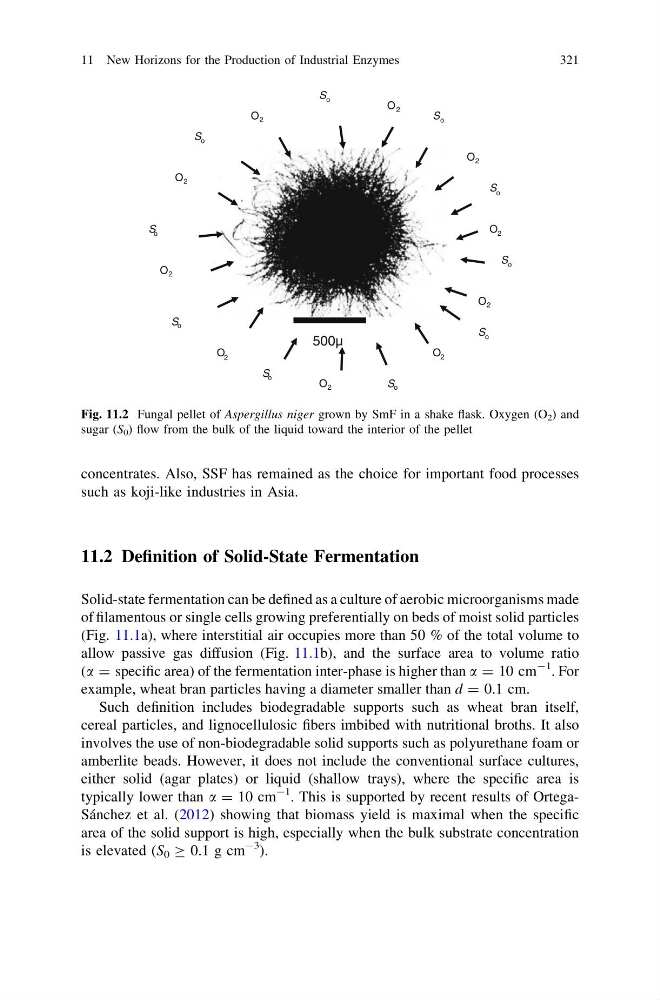
Fig. 11.2 Fungal pellet of Aspergillus niger grown by SmF in a shake flask. Oxygen (O 2 ) and
sugar (S 0 ) flow from the bulk of the liquid toward the interior of the pellet
11 New Horizons for the Production of Industrial Enzymes
321
such as koji-like industries in Asia.
11.2 Definition of Solid-State Fermentation
Solid-state fermentation can be defined as a culture of aerobic microorganisms made
of filamentous or single cells growing preferentially on beds of moist solid particles
(Fig. 11.1a), where interstitial air occupies more than 50 % of the total volume to
allow passive gas diffusion (Fig. 11.1b), and the surface area to volume ratio
(a = specific area) of the fermentation inter-phase is higher than a = 10 cm
-1 . For
example, wheat bran particles having a diameter smaller than d = 0.1 cm.
Such definition includes biodegradable supports such as wheat bran itself,
cereal particles, and lignocellulosic fibers imbibed with nutritional broths. It also
involves the use of non-biodegradable solid supports such as polyurethane foam or
amberlite beads. However, it does not include the conventional surface cultures,
either solid (agar plates) or liquid (shallow trays), where the specific area is
typically lower than a = 10 cm
-1 . This is supported by recent results of OrtegaSánchez et al. (2012) showing that biomass yield is maximal when the specific
area of the solid support is high, especially when the bulk substrate concentration
is elevated (S 0 C 0.1 g cm
-3 ).
500µ
O 2
O 2
O 2
O 2
O 2
O 2
O 2
O 2
O 2
O 2
S o
S o
S o
S o
S o
S o
S o
S o
S o
S o
Fig. 11.2 Fungal pellet of Aspergillus niger grown by SmF in a shake flask. Oxygen (O 2 ) and
sugar (S 0 ) flow from the bulk of the liquid toward the interior of the pellet
11 New Horizons for the Production of Industrial Enzymes
321