

On the other hand, SmF are defined as stirred and aerated suspensions of cells
where the gas phase (air) is mechanically dispersed in very fine bubbles
(d \ 0.1 cm) in order to have adequate oxygen mass transfer. In SmF processes,
biomass is grown either as a dispersion of single cells or as clumps of cells
(Fig. 11.2), with solid bulk concentration density lower than S = 0.1 g cm
-3 , i.e.,
substrate concentrations with biochemical oxygen demand (BOD) lower than
1,000 ppm (1 9 10
-3 g cm
-3 ).
Physical and physiological constraints for SSF cultures
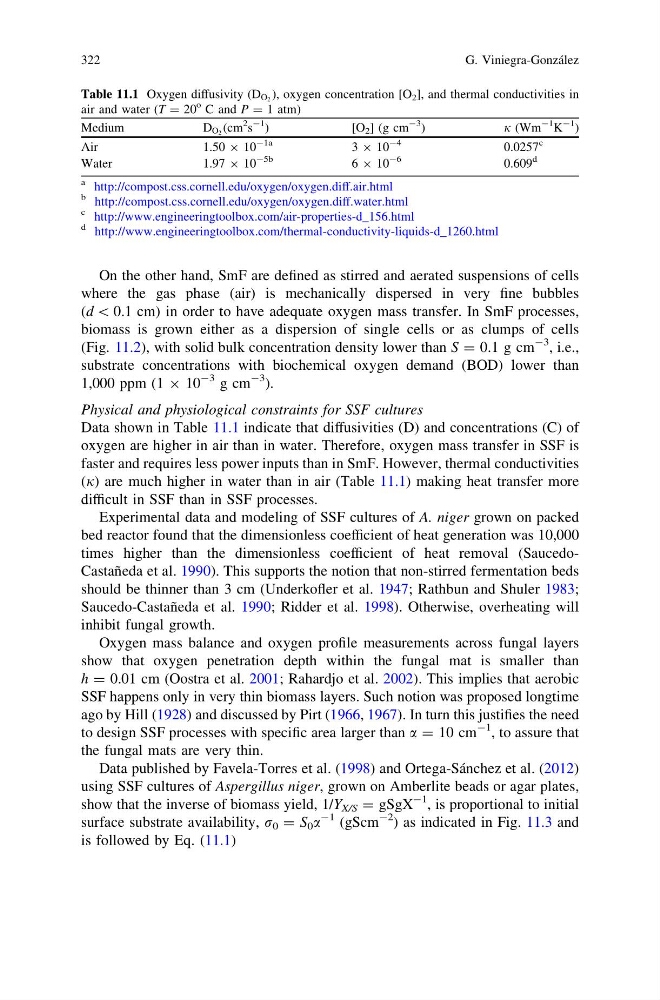
Data shown in Table 11.1 indicate that diffusivities (D) and concentrations (C) of
oxygen are higher in air than in water. Therefore, oxygen mass transfer in SSF is
faster and requires less power inputs than in SmF. However, thermal conductivities
(j) are much higher in water than in air (Table 11.1) making heat transfer more
difficult in SSF than in SSF processes.
Experimental data and modeling of SSF cultures of A. niger grown on packed
bed reactor found that the dimensionless coefficient of heat generation was 10,000
times higher than the dimensionless coefficient of heat removal (SaucedoCastañeda et al. 1990). This supports the notion that non-stirred fermentation beds
should be thinner than 3 cm (Underkofler et al. 1947; Rathbun and Shuler 1983;
Saucedo-Castañeda et al. 1990; Ridder et al. 1998). Otherwise, overheating will
inhibit fungal growth.
Oxygen mass balance and oxygen profile measurements across fungal layers
show that oxygen penetration depth within the fungal mat is smaller than
h = 0.01 cm (Oostra et al. 2001; Rahardjo et al. 2002). This implies that aerobic
SSF happens only in very thin biomass layers. Such notion was proposed longtime
ago by Hill (1928) and discussed by Pirt (1966, 1967). In turn this justifies the need
to design SSF processes with specific area larger than a = 10 cm
-1 , to assure that
the fungal mats are very thin.
Data published by Favela-Torres et al. (1998) and Ortega-Sánchez et al. (2012)
using SSF cultures of Aspergillus niger, grown on Amberlite beads or agar plates,
show that the inverse of biomass yield, 1/Y X/S = gSgX
-1 , is proportional to initial
surface substrate availability, r 0 = S 0 a
-1 (gScm
-2 ) as indicated in Fig. 11.3 and
is followed by Eq. (11.1)
Table 11.1 Oxygen diffusivity (D O2 ), oxygen concentration [O 2 ], and thermal conductivities in
air and water (T = 20
o C and P = 1 atm)
Medium
D O2 (cm
2
s
-1
)
[ O 2 ] (g cm
-3
)
j (Wm
-1
K
-1
)
Air
1.50 9 10
-1a
3 9 10
-4
0.0257
c
Water
1.97 9 10
-5b
6 9 10
-6
0.609
d
a http://compost.css.cornell.edu/oxygen/oxygen.diff.air.html
b http://compost.css.cornell.edu/oxygen/oxygen.diff.water.html
c http://www.engineeringtoolbox.com/air-properties-d_156.html
d http://www.engineeringtoolbox.com/thermal-conductivity-liquids-d_1260.html
322
G. Viniegra-González
where the gas phase (air) is mechanically dispersed in very fine bubbles
(d \ 0.1 cm) in order to have adequate oxygen mass transfer. In SmF processes,
biomass is grown either as a dispersion of single cells or as clumps of cells
(Fig. 11.2), with solid bulk concentration density lower than S = 0.1 g cm
-3 , i.e.,
substrate concentrations with biochemical oxygen demand (BOD) lower than
1,000 ppm (1 9 10
-3 g cm
-3 ).
Physical and physiological constraints for SSF cultures
Data shown in Table 11.1 indicate that diffusivities (D) and concentrations (C) of
oxygen are higher in air than in water. Therefore, oxygen mass transfer in SSF is
faster and requires less power inputs than in SmF. However, thermal conductivities
(j) are much higher in water than in air (Table 11.1) making heat transfer more
difficult in SSF than in SSF processes.
Experimental data and modeling of SSF cultures of A. niger grown on packed
bed reactor found that the dimensionless coefficient of heat generation was 10,000
times higher than the dimensionless coefficient of heat removal (SaucedoCastañeda et al. 1990). This supports the notion that non-stirred fermentation beds
should be thinner than 3 cm (Underkofler et al. 1947; Rathbun and Shuler 1983;
Saucedo-Castañeda et al. 1990; Ridder et al. 1998). Otherwise, overheating will
inhibit fungal growth.
Oxygen mass balance and oxygen profile measurements across fungal layers
show that oxygen penetration depth within the fungal mat is smaller than
h = 0.01 cm (Oostra et al. 2001; Rahardjo et al. 2002). This implies that aerobic
SSF happens only in very thin biomass layers. Such notion was proposed longtime
ago by Hill (1928) and discussed by Pirt (1966, 1967). In turn this justifies the need
to design SSF processes with specific area larger than a = 10 cm
-1 , to assure that
the fungal mats are very thin.
Data published by Favela-Torres et al. (1998) and Ortega-Sánchez et al. (2012)
using SSF cultures of Aspergillus niger, grown on Amberlite beads or agar plates,
show that the inverse of biomass yield, 1/Y X/S = gSgX
-1 , is proportional to initial
surface substrate availability, r 0 = S 0 a
-1 (gScm
-2 ) as indicated in Fig. 11.3 and
is followed by Eq. (11.1)
Table 11.1 Oxygen diffusivity (D O2 ), oxygen concentration [O 2 ], and thermal conductivities in
air and water (T = 20
o C and P = 1 atm)
Medium
D O2 (cm
2
s
-1
)
[ O 2 ] (g cm
-3
)
j (Wm
-1
K
-1
)
Air
1.50 9 10
-1a
3 9 10
-4
0.0257
c
Water
1.97 9 10
-5b
6 9 10
-6
0.609
d
a http://compost.css.cornell.edu/oxygen/oxygen.diff.air.html
b http://compost.css.cornell.edu/oxygen/oxygen.diff.water.html
c http://www.engineeringtoolbox.com/air-properties-d_156.html
d http://www.engineeringtoolbox.com/thermal-conductivity-liquids-d_1260.html
322
G. Viniegra-González