

11.7.5 Mass Balance Between Production and Use of SSF Solids ......................... 335
11.8 Conclusions................................................................................................................... 336
References................................................................................................................................ 336
11.1 Introduction
Enzymes are mass produced by submerged fermentation (SmF) using genetically
engineered strains. For example, production of subtilisin, a heat-resistant protease
added to household detergents or a-amylase and glucoamylases in the starch
industry. However, at the beginning of the twentieth century, industrial enzymes
were produced by solid-state fermentation (SSF) and were seen as an alternative to
traditional malting of grains for the production of ethanol. After the Second World
War, the use of conventional chemical engineering technology made it easier to
scale-up SmF processes as compared to the more difficult scale-up of SSF. Later,
the advent of genetic engineering of microbial strains selected gave impetus to
SmF as the major choice for large-scale enzyme production. Notwithstanding such
technological trends, there are new market signals to watch, mainly in the fields of
saving water and energy and also for the new trends for ‘‘organic’’ foods and the
management of complex fermentation systems. Thus, there are new horizons for
upgrading old fashioned SSF systems because they require lower power inputs,
generate ready-to-use crude enzyme preparations, reduce wastewater treatment
and sometimes enzyme mixtures are more effective than pure enzyme
O 2
2
h
R
O 2
2
O 2
2
O 2
O 2
2
O 2
2
O 2
2
O 2
2
S 0
(a)
(b)
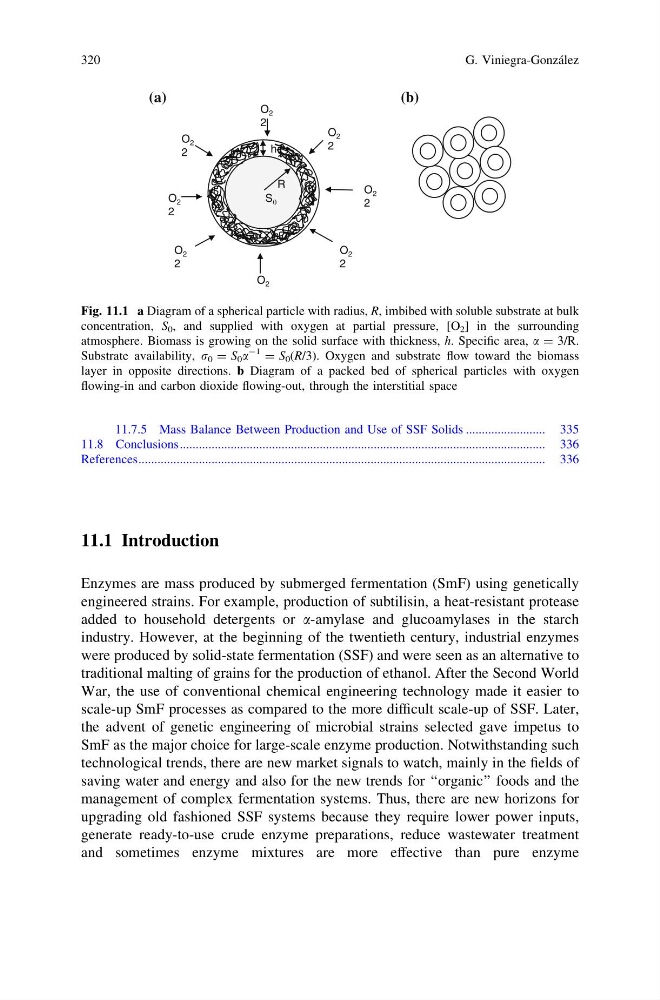
Fig. 11.1 a Diagram of a spherical particle with radius, R, imbibed with soluble substrate at bulk
concentration, S 0 , and supplied with oxygen at partial pressure, [O 2 ] in the surrounding
atmosphere. Biomass is growing on the solid surface with thickness, h. Specific area, a = 3/R.
Substrate availability, r 0 = S 0 a
-1 = S 0 (R/3). Oxygen and substrate flow toward the biomass
layer in opposite directions. b Diagram of a packed bed of spherical particles with oxygen
flowing-in and carbon dioxide flowing-out, through the interstitial space
320
G. Viniegra-González
11.8 Conclusions................................................................................................................... 336
References................................................................................................................................ 336
11.1 Introduction
Enzymes are mass produced by submerged fermentation (SmF) using genetically
engineered strains. For example, production of subtilisin, a heat-resistant protease
added to household detergents or a-amylase and glucoamylases in the starch
industry. However, at the beginning of the twentieth century, industrial enzymes
were produced by solid-state fermentation (SSF) and were seen as an alternative to
traditional malting of grains for the production of ethanol. After the Second World
War, the use of conventional chemical engineering technology made it easier to
scale-up SmF processes as compared to the more difficult scale-up of SSF. Later,
the advent of genetic engineering of microbial strains selected gave impetus to
SmF as the major choice for large-scale enzyme production. Notwithstanding such
technological trends, there are new market signals to watch, mainly in the fields of
saving water and energy and also for the new trends for ‘‘organic’’ foods and the
management of complex fermentation systems. Thus, there are new horizons for
upgrading old fashioned SSF systems because they require lower power inputs,
generate ready-to-use crude enzyme preparations, reduce wastewater treatment
and sometimes enzyme mixtures are more effective than pure enzyme
O 2
2
h
R
O 2
2
O 2
2
O 2
O 2
2
O 2
2
O 2
2
O 2
2
S 0
(a)
(b)
Fig. 11.1 a Diagram of a spherical particle with radius, R, imbibed with soluble substrate at bulk
concentration, S 0 , and supplied with oxygen at partial pressure, [O 2 ] in the surrounding
atmosphere. Biomass is growing on the solid surface with thickness, h. Specific area, a = 3/R.
Substrate availability, r 0 = S 0 a
-1 = S 0 (R/3). Oxygen and substrate flow toward the biomass
layer in opposite directions. b Diagram of a packed bed of spherical particles with oxygen
flowing-in and carbon dioxide flowing-out, through the interstitial space
320
G. Viniegra-González